Follow this blog for all things poetry.
To see our past prompts and more than 300 issues,
visit our website at poetsonline.org
July 14, 2026
Emily Dickinson, Children's Poet
March 5, 2026
Prompt: Paradox and Negation
A paradox is a statement that seems self-contradictory or absurd but reveals a deeper truth. If a poet says, "The child becomes a man," it’s clear, but it’s flat. Using a paradox forces the reader's brain to stall and then restart, which makes the meaning stick. "The child is father of the man," wrote Wordsworth. You stop. You realize this isn't about biology. It's about how our childhood experiences form our adult selves.
Follow this blog for all things poetry.
To see our past prompts and more than 300 issues,
visit our website at poetsonline.org
October 15, 2023
Conversations About Poetry
Tell all the truth but tell it slant —
Success in Circuit lies
Too bright for our infirm Delight
The Truth’s superb surprise
As Lightning to the Children eased
With explanation kind
The Truth must dazzle gradually
Or every man be blind —
Maybe that's the thing about good poems - that as much as you like hearing them and getting some meaning from them, they offer you the chance to revisit them and get even more from them.
Poets Online has been a website asking you to write to a prompt since 1998. I enjoy receiving and reading poems submitted and occasionally I develop an email connection with a poet. I know a few poets who have written on the site in real life, and just a few times someone has approached me at a reading to introduce themself as one of the poets published on the site. But that is the rare exception.
There is also a Poets Online discussion group on Facebook where people sometimes post poems they have written, or ones that touch them, or links to things poetic.
I hope you will join the conversation.
July 26, 2023
Punctuation and Poetry
PUNCTUATION: Some poets use it. Some don't.
Of course, there are many poems where punctuation is most definitely necessary, but there are also cases where it is not. Are there any "rules" for its usage?
When lines are short - three words or less - punctuation (commas and periods) can look silly.
“Cut out all these exclamation points. An exclamation point is like laughing at your own joke,”
wrote F. Scott Fitzgerald. Fitzgerald may not have been a fan of the exclamation point, but the New York School of poets took a liking to it.
- Walt Whitman liked... the ellipsis.
- Emily Dickinson was fond of using - the dash.
- A.R. Ammons did things with: the colon.
- E.E. Cummings, besides his experiments with Upper and LOWER case, liked to make use of (parentheses).
A typical manuscript for a poem might include several undated versions, with varying capitalization throughout, sometimes a "C" or an "S" that seems to be somewhere between lowercase and capital, and no degree of logic in the capitalization. While important subject words and the symbols that correspond to them are often capitalized, often (but not always) a metrically stressed word will be capitalized as well, even if it has little or no relevance in comparison to the rest of the words in the poem. Early editors removed all capitals but the first of the line, or tried to apply editorial logic to their usage. For example, poem 632 is now commonly punctuated as follows:
The Brain – is wider than the Sky –
For – put them side by side –
The one the other will contain
With ease – and You – beside –
The Brain is deeper than the sea –
For – hold them – Blue to Blue –
The one the other will absorb –
As Sponges – Buckets – do –
The Brain is just the weight of God –
For – Heft them – Pound for Pound –
And they will differ – if they do –
As Syllable from Sound –
"E. E." Dickinson
r-p-o-p-h-e-s-s-a-g-r
who
a)s w(e loo)k
upnowgath
PPEGORHRASS
eringint(o-
aThe):l
eA
!p:
S a
(r
rIvInG .gRrEaPsPhOs)
to
rea(be)rran(com)gi(e)ngly
,grasshopper;
He uses words, punctuation, and space to create a "concrete" visual image of a grasshopper jumping. The word and letter jumble makes more sense as we dig deeper and yet some of it is for pure visual rather than reader effect.
I have used some of his poems with children who like finding a hidden poem. They find the jumping-all-about grasshopper r-p-o-p-h-e-s-s-a-g-r who as we look up now gathering to leap leaps arriving...
They realize the poem is not just meant to be "read."
And then, there's the ampersand. & Not really punctuation, but an abbreviation of a sort. As I have written on another blog:.
The ampersand is a curious thing in our language that dates back to the 1st century A.D.The & picked up traction in poetry with the Beats and the Black Mountain poets. (Ginsberg: "blond & naked angel") and e.e. cummings, Frank O'Hara, Amiri Baraka, John Berryman, and Nick Flynn.
Originally, it was a ligature of the letters E and T. What's a ligature? In writing and typography, a ligature occurs where two or more graphemes are joined as a single glyph. Ligatures usually replace consecutive characters sharing common components.
Suffice it to say, the ampersand is the most common one we use in English.
"Et" is Latin for "and" - as in et cetera, which is such a mouthful that we feel the need to shorten even that to etc. It can actually be further shortened as &c.
July 17, 2023
Emily Dickinson on Gilligan's Island
I was reading a post I did some years ago about an Emily Dickinson oddity. I needed to update the post and so I checked back to the article about some Emily Dickinson curiosities that inspired my post. The one that caught my attention ( and was also something I heard Billy Collins talk about years ago in a workshop) was her connection to the castaways on Gilligan's Island.
That seems like a big stretch of the poetic imagination, but you can sing most of her poems (I could imagine myself doing this with younger students), using the theme to TV's 1960s "classic" Gilligan's Island. That theme song is an earworm in many brains of people who grew up watching the show.
Give it a try and sing this first stanza of "Because I Could Not Stop For Death." (If somehow the melody of "The Ballad Of Gilligan's Isle" is not burned into your neurons deeper than any poem, give a listen below)
Because I could not stop for Death,
He kindly stopped for me;
The carriage held but just ourselves
And Immortality.
How come this works? (And here is the lesson for the class.) Emily usually used a "common meter" in her poems. The TV theme also uses it, and it is used in lots of nursery rhymes and Protestant hymns. It's four beats followed by three beats.
In more detail, Wikipedia tells us that common meter (or metre or common measure) is a poetic meter consisting of four lines that alternate between iambic tetrameter (four metrical feet per line, with each foot consisting of an unstressed syllable followed by a stressed syllable) and iambic trimeter (three metrical feet per line, with each foot consisting of an unstressed syllable followed by a stressed syllable).
It has historically been used for ballads such as "Tam Lin", and hymns such as "Amazing Grace" and the Christmas carol "O Little Town of Bethlehem". The upshot of this commonality is that the lyrics of one song can be sung to the tune of another. This can make for some great singalongs around the campfire.
But I am quite happy to just imagine Emily on the beach with Ginger and Mary Anne, swinging in their hammocks, drinking from a coconut, and singing her poems to the delight and total misunderstanding of all those around her.
Is it a rainy day where you are? Try singing Emily's "Summer Shower" as if you were on that island with Gilligan and the crew. Coconut drink is optional but advisable.
A drop fell on the apple tree,
Another on the roof;
A half a dozen kissed the eaves,
And made the gables laugh.
A few went out to help the brook,
That went to help the sea.
Myself conjectured, Were they pearls,
What necklaces could be!
The dust replaced in hoisted roads,
The birds jocoser sung;
The sunshine threw his hat away,
The orchards spangles hung.
The breezes brought dejected lutes,
And bathed them in the glee;
The East put out a single flag,
And signed the fete away.
December 10, 2021
Emily's 191st Birthday
“We turn not older with years, but newer every day.”
| Hailee Steinfeld as a modernized Emily on Dickinson (Apple+) |
Emily Dickinson, the middle child of Edward and Emily Norcross Dickinson, was born on December 10, 1830, in the family home on Main Street in Amherst, Massachusetts.
Wild nights – Wild nights!
Were I with thee
Wild nights should be
Our luxury!
She celebrated 55 birthdays before her death in 1886. After her death, her family members found her hand-sewn books, or “fascicles.” These fascicles contained nearly 1,800 poems.
I heard a Fly buzz - when I died -
The Stillness in the Room
Was like the Stillness in the Air -
Between the Heaves of Storm -
The Eyes around - had wrung them dry -
And Breaths were gathering firm
For that last Onset - when the King
Be witnessed - in the Room -
I willed my Keepsakes - Signed away
What portion of me be
Assignable - and then it was
There interposed a Fly -
With Blue - uncertain - stumbling Buzz -
Between the light - and me -
And then the Windows failed - and then
I could not see to see -
While Dickinson was extremely prolific as a poet and regularly enclosed poems in letters to friends, she was not publicly recognized during her lifetime. The first volume of her work was published posthumously in 1890.
I'm Nobody! Who are you?
Are you – Nobody – too?
Then there's a pair of us!
Don't tell! they'd advertise – you know!
How dreary – to be – Somebody!
How public – like a Frog –
To tell one's name – the livelong June –
To an admiring Bog!
She admired the poetry of Robert and Elizabeth Barrett Browning and John Keats. She was dissuaded from reading the verse of her contemporary, Walt Whitman, because she was told that his poetry was disgraceful.
Because I could not stop for Death –
He kindly stopped for me –
The Carriage held but just Ourselves –
And Immortality.
We slowly drove – He knew no haste
And I had put away
My labor and my leisure too,
For His Civility –
We passed the School, where Children strove
At Recess – in the Ring –
We passed the Fields of Gazing Grain –
We passed the Setting Sun –
Or rather – He passed us –
The Dews drew quivering and chill –
For only Gossamer, my Gown –
My Tippet – only Tulle –
We paused before a House that seemed
A Swelling of the Ground –
The Roof was scarcely visible –
The Cornice – in the Ground –
Since then – 'tis Centuries – and yet
Feels shorter than the Day
I first surmised the Horses' Heads
Were toward Eternity –
Emily lost several close friends and several family members, including her mother in the 1880s which seemed to have a negative effect on her health. She also reported severe headaches and nausea in her letters. Her deathbed coma was punctuated by raspy and difficult breathing. This has led researchers to conclude that she died of heart failure induced by severe hypertension.
Visit our website at poetsonline.org
August 3, 2021
Prompt: Historical Intimacy
When I was in a weeklong poetry workshop with Billy Collins a chunk of years ago, he looked at a poem I was working on titled "Sex with Amelia Earhart." He said it reminded him of his poem "Taking Off Emily Dickinson's Clothes" (which appears in his collection Picnic, Lightning).
The two poems both have a title intended to give a little shock. Collins uses a lot of allusions to Emily's poems including well-known lines from them. His poem is more romantic and less sexual than mine, but I imagine both poems would gather around them the same criticisms: sensationalist and maybe even misogynist. I know that both of us thought about that and both of us disagreed with those appraisals. I think we both thought of them as love poems. Male poet imagines a romantic relationship with a female inspiration from the past.
In an interview on Fresh Air, Collins said "I mean, I actually at one point, when there were so many books out about speculating particularly on Emily Dickinson's sexuality, you know, was she lesbian, was she celibate, did she have an affair, I was driven actually by all of that curiosity and speculation to write a poem called "Taking Off Emily Dickinson's Clothes," in which I attempted, in a kind of playful way, to put the matter at rest by having sex with her."
I showed both poems to another poet, Kristin D'Agostino, and she suggested they might be a prompt here .
Deadline for submissions to our next issue: August 31, 2021
Please refer to our submission guidelines and look at our archive of more than two decades of prompts and poems.Visit our website at poetsonline.org
December 11, 2020
The Snow That Never Drifts
Post a comment answer below.
December 10, 2020
Thanking Margaret Maher on Emily Dickinson's Birthday
Taking a few minutes to remember Emily Dickinson, born on this day in 1830 and Margaret Maher.
Emily wrote nearly 2,000 poems, but she only published about 10 of these in her lifetime.
The family's maid, Margaret Maher, was the only person who knew about the full output of her writing. While Emily was in the kitchen with Margaret, baking loaves of bread and cakes, she sometimes scribbled poems on wrappers and the backs of shopping lists. Maher was literate and she even dabbled in poetry herself now and then and the wrote some poems back and forth to each other. Some scholars believe that Maher’s Irish syntax made it into some of Dickinson’s work.
She brought the poems to Lavinia, Emily’s sister and though Lavinia had already burned most of her sister’s letters, she agreed with Maher that the poems should be published.
Maher also supplied the only daguerreotype that we have of Emily Dickinson. The family didn’t like the picture, but Maher kept it and gave it to the publisher to include with the first edition of Dickinson’s poems.
To make a prairie it takes a clover and one bee,
One clover, and a bee.
And revery.
The revery alone will do,
If bees are few.
You can read some of those poems at https://www.poets.org/poetsorg/poems/45673
Source: http://writersalmanac.org/episodes/20161210/
January 28, 2020
Opening Emily Dickinson
We know Emily's poems. Emily didn't write prose. No notebooks, journals or diaries. Well, wait - she wrote letters. Lots of them.
If you're looking for who Emily Dickinson really "is" I think you will find it in the letters - when you read them along with the poems.
I remember reading Emily's poems in high school. My impression of her (bolstered by that one sad photo) was of a hermit, virgin who had a sad life spent mostly in her room, house and garden. Poor little Em.
I didn't really like Emily's poems back then. I like them a lot more now, but that came through learning more about her. I know I'm not supposed to enjoy poems more because I like the poet, but that's what has happened. I seem to write a lot here about Emily and her writing.
There is more joy and life in her letters. She's not the lonely spinster in many of those letters. There is life, love and passion.
There are a number of collections of her letters including multi-volume sets like one facsimile set published by Forgotten Books and also shorter edited (and sometimes censored) selected letters.
The letters that interest me most - and are getting more attention lately - are ones to Susan. Those letters record a thirty-six year correspondence with her childhood friend and neighbor, Susan Gilbert, who would later be her sister-in-law, Susan Dickinson.
There is a good introduction to the Susan and Emily relationship in a post on BrainPickings. I read through the single volume collection of these letters titled Open Me Carefully. These are not censored and so offer a different Emily Dickinson and her letters (also some poems) to Sue, Susan, Susie.
Show me Eternity, and I will show you Memory —Both in one package lainAnd lifted back again —Be Sue — while I am Emily —Be next — what you have ever been — Infinity.
Open Me Carefully: Emily Dickinson's Intimate Letters to Susan Huntington Dickinson is a new book that shines a new light to Emily. Not a lonely spinster in her letters which are presented here without much commentary. They speak for themselves.
"... unlike previous editors who altered line breaks to fit their sense of what is poetry or prose, Hart and Smith offer faithful reproductions of the letters' genre-defying form as the words unravel spectacularly down the original page." - Renee Tursi, The New York Times Book Review
There have been several modern screen versions of a more passionate Emily Dickinson. The latest one is an original on the new Apple+ channel called Dickinson. It is a historical period comedy-drama series that stars Hailee Steinfeld as Emily. It explores Emily's love for Susan Gilbert. The first season was released in November 2019 and a second season will follow.
In a letter to Susan:
I need you more and more, and the great world grows wider . . . every day you stay away — I miss my biggest heart; my own goes wandering round, and calls for Susie… Susie, forgive me Darling, for every word I say — my heart is full of you . . . yet when I seek to say to you something not for the world, words fail me… I shall grow more and more impatient until that dear day comes, for til now, I have only mourned for you; now I begin to hope for you.
Now, farewell, Susie . . . I add a kiss, shyly, lest there is somebody there! Don’t let them see, will you Susie?
And finally, in a mix of Emily's poems and letters, there are her poems written on envelopes which were finally published as The Gorgeous Nothings. This is a full-color facsimile edition of the envelope poems. There are 52 envelope poems.
PHOTO USED ABOVE IN SECTIONS: Daguerreotype of Emily Dickinson taken at Mt. Holyoke in December 1847 or early 1848
June 10, 2019
Will there really be a ‘Morning’?
Will there really be a “Morning”?
Is there such a thing as “Day”?
Could I see it from the mountains
If I were as tall as they?
Has it feet like Water lilies?
Has it feathers like a Bird?
Is it brought from famous countries
Of which I have never heard?
Oh some Scholar! Oh some Sailor!
Oh some Wise Man from the skies!
Please to tell a little Pilgrim
Where the place called “Morning” lies!
by Emily Dickinson. Public domain
So simple and yet so hard to fully interpret.
Looking online, I find a number of places where people ask questions of the poem. Of course, the poem itself is full of questions.
- Is "morning" heaven?
- Is it another day of life as opposed to an eternal night (death)?
- Does morning coming from the East, from countries that we don't even really know? Perhaps, those countries are the unknown of an afterlife - if there is an afterlife.
- How do we know what we know?
- Is the "little Pilgrim" that this is a child questioning the world?
- Are these religious references? Walking on water ("feet like Water lilies"), angels (feathers like a Bird") and a "pilgrimage."
April 19, 2019
Wild Nights with Emily
![]() |
| Emily (Molly Shannon) doing what she should be best remembered for -writing WILD NIGHTS WITH EMILY - Courtesy of Greenwich Entertainment |
This is not a review but a preview since I have not seen the new film about Emily Dickinson, Wild Nights with Emily. The reviews have been positive.
I have posted a few times in recent years here about poets and poetry portrayed on film. The results have been mixed, but I think it is difficult to explain what poetry's power is to someone who does not read or write it. It would be even more difficult to make it come to life on a screen. It comes to life for many of us on a page, read silently or read aloud.
On the film's website "About" page, they describe the film in this way:
"In the mid-19th century, Emily Dickinson is writing prolifically, baking gingerbread, and enjoying a passionate, lifelong romantic relationship with another woman, her friend and sister-in-law Susan...
Yes this is the iconic American poet, popularly thought to have been a recluse.
Beloved comic Molly Shannon leads in this humorous yet bold reappraisal of Dickinson, informed by her private letters. While seeking publication of some of the 1,775 poems written during her lifetime, Emily (Shannon) finds herself facing a troupe of male literary gatekeepers too confused by her genius to take her work seriously. Instead her work attracts the attention of an ambitious woman editor, who also sees Emily as a convenient cover for her own role in buttoned-up Amherst's most bizarre love triangle.
A timely critique of how women's history is rewritten, WILD NIGHTS WITH EMILY remains vibrant, irreverent and tender--a perhaps closer depiction of Emily Dickinson's real life than anything seen before."
![]() |
| Emily (Molly Shannon) and Susan (Susan Ziegler) in bed - WILD NIGHTS WITH EMILY - Courtesy of Greenwich Entertainment |
Not every filmgoer will know walking into a theater that the film's title comes from one of her poems. It is one of my favorites of Emily's poems.
Wild nights - Wild nights!
Were I with thee
Wild nights should be
Our luxury!
Futile - the winds -
To a Heart in port -
Done with the Compass -
Done with the Chart!
Rowing in Eden -
Ah - the Sea!
Might I but moor - tonight -
In thee!
What makes this new film different from other works about Emily is that it takes some of the evidence that has been found through studying the poems and Emily's erasures which seem to indicate more than just a friendship with her brother's wife, Susan.
If Emily was on Facebook, her relationship status would read "It's Complicated."
Mabel Todd (Amy Seimetz) who narrates the film and assembled and edited the first posthumous collection of Dickinson’s poetry was also the mistress of Emily’s brother. Mabel's edits out Emily’s now-famous dashes and deleted the dedications to her sister-in-law, Susan. Fake news.
Madeleine Olnek’s film is a reinterpretation of the somewhat standard story of Emily's life that was taught for many years. I certainly was given a picture of a hermetic poet who never left her bedroom and would gaze out the window at flowers, funerals and the world passing by. She wanted her poems destroyed and forgotten.
That story is not accurate. How much closer to the truth is this film's interpretation? The film is rated PG-13 for "sexual content" but it is a gentle intercutting of the edited Emily and the version of her where petticoats fall to the floor. Molly Shannon's Emily is more of a heroine in what is probably a romantic comedy. If that interpretation brings more readers to the poems and blows the dust off Emily's portrait, I'm all for it.
March 2, 2019
Dear March
![]() |
| snow on the maples - via Wikimedia |
September 22, 2017
Emily and Love
Here is one her poems that is not as often read as her more famous ones.
It was a quiet way—
He asked if I was his—
I made no answer of the Tongue
But answer of the Eyes—
And then He bore me on
Before this mortal noise
With swiftness, as of Chariots
And distance, as of Wheels.
This World did drop away
As Acres from the feet
Of one that leaneth from Balloon
Upon an Ether street.
The Gulf behind was not,
The Continents were new—
Eternity it was before
Eternity was due.
No Seasons were to us—
It was not Night nor Morn—
But Sunrise stopped upon the place
And fastened it in Dawn.
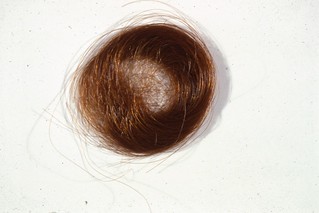
![]() |
| In 1853, Emily enclosed this lock of her hair in a letter addressed to her friend Emily Fowler. via Flickr |
April 28, 2017
The Quiet Passion of Emily
The new film, A Quiet Passion, is a story about Emily Dickinson. I had brunch with two friends last weekend and they had seen the film. One, an English major but not particularly a poetry reader, loved the movie. The other, not a poetry reader, didn't like it at all. And that seems to be the split between critics and audiences generally.
It is difficult to portray writers writing on screen because it is a solitary and not very interesting act. You need to show a life. I have always thought that Edgar Allen's life story is more interesting than his poetry, and that tale would be more appealing to contemporary audiences than his fiction. Emily Dickinson's life, as far as most people know it, does not seem to be movie material.
If you view Emily as a reclusive spinster who sat in her sepia room and wrote poems that she would hide away, then you're correct. Not movie magic. But it seems that this film has other ideas.
A Quiet Passion opens with Emily getting booted out of Mount Holyoke College. This Christian women's university was not happy with her unorthodox religious views. Emily the rebel.
My English major friend said that Emily in the film is witty and sassy. She takes digs at suitors, family and editors. She doesn't hide in her room all day, and is someone who would be good for lunch conversation.
I doubt that many of us would want to live her Amherst home life. She did escape from midnight to 3 am (when her father "allowed" her to write) to poetry, and there she put down, if somewhat cryptically, her real thoughts that probably didn't get expressed at the family dinner table.
Emily Dickinson was born in 1830 and died in 1886. The film covers her schooling to her death. She ages in the film through multiple actresses: Emma Bell as young Emily, becomes the older Emily through Cynthia Nixon in a family portrait session. One of my brunch reviewers liked this and one though they just should have aged Bell with makeup.
I read Richard B. Sewall's bio of Emily in college and that book changed my mind about her life. It lightened those dark photos of her and blew off some of the dust that has covered Emily since her poems were published.
Have you seen the film? Give us a review in the comments here or on our Facebook pages.
And, of course, read some of her poems. Here's a free sampler to begin at poets.org
This video was done when an exhibition at the Morgan Library and Museum in New York also took a brighter view of Emily's life.
March 30, 2016
Simply Emily
Emily Dickinson's poems often have images and metaphors taken from all around her, especially from nature, but they are just as often psychological landscapes.
Did she want to challenge her readers? Of course, the first published book of her poetry appeared in 1890, four years after her death. I wrote earlier this month about Sylvia Plath's collection, Ariel. I don't think there are many critics connecting Emily to Sylvia, but I see one connection. As with Plath's book, Emily's small poetry collection was also heavily edited by men. They were very selective and removed her unique syntax, spelling, and punctuation.
It took much longer for Emily's true verse to appear than it did for Plath's intended book. The complete, restored edition of Emily's poetry did not appear until 1998 - more than 100 years after the original publication.
I was never fond of allegory, but Em enjoyed using it. Was she writing for me? Was she writing for any of us? I think she was. As often as I hear poets say that they write "for themselves," they all are happy to have their poems published.
What is the writing lesson of Emily's poems? perhaps, it is similar to this passage from Mr. Whitman.
“The secret of it all, is to write in the gush, the throb, the flood, of the moment – to put things down without deliberation – without worrying about their style – without waiting for a fit time or place. I always worked that way. I took the first scrap of paper, the first doorstep, the first desk, and wrote – wrote, wrote…By writing at the instant the very heartbeat of life is caught.” Walt Whitman
I wonder if Em's odd use of dashes instead of periods, commas, and the other typical punctuation. marks. She also liked to capitalize words - not just words at the beginning of a line. Why? Not totally clear. .
I have read that the use of dashes and of capital letters to emphasize and personify common nouns was something she may have found in the grammar text (Wells' Grammar of the English Language) that she used at Mount Holyoke Female Seminary.
I like those dashes. Fast and simple punctuation. Reminds me of the dashes you find in haiku. A nice clear indicator to the reader to break, and sometimes a nice bridge to a new idea.
As a young reader, I imagined prim and proper Miss Dickinson as a good, religious girl. I discovered later she had a a lot of skepticism about traditional religion. She would fit nicely into that growing number of Americans who say they are not "religious" but are "spiritual. She said that "Some keep the Sabbath going to Church" but she was quite content Sundays at home in her garden where "the sermon is never long.”
At Mount Holyoke, they organized students into three categories: "established Christians,” those who “expressed hope,” and those who were “without hope.” Guess which group Emily was in? I bet she got picked last for softball too.
But, she had her books: Longfellow, Thoreau, Hawthorne, Emerson, George Eliot, and the Brownings.
She loved the Brontës. She wrote “All overgrown by cunning moss" for the death of Charlotte Brontë,
All overgrown by cunning moss,
All interspersed with weed,
The little cage of “Currer Bell”
In quiet “Haworth” laid.
This Bird – observing others
When frosts too sharp became
Retire to other latitudes –
Quietly did the same –
But differed in returning –
Since Yorkshire hills are green –
Yet not in all the nests I meet –
Can Nightingale be seen –
Emily requested that a poem by that other Emily - Brontë - be read at her own funeral. I hope the family granted her wish. I hope it wasn't "Remembrance." Maybe it was "Ah! Why, Because the Dazzling Sun."
Ah! why, because the dazzling sun
Restored my earth to joy
Have you departed, every one,
And left a desert sky?
March 8, 2014
Prompt: First Lines with Emily
This month's prompt began in reading an article, "Where Shall I Begin?," by Jessica Greenbaum about being inspired by first lines.
"Like poetry itself, a secret channel exists between the first line and the mind. What forces are at play may never show themselves fully, and some resounding openings attach to memory by more mysterious motives. Ever since Howard Moss handed my undergraduate class a copy of Randall Jarrell’s “The Woman at the Washington Zoo” in 1979, the poem’s first line has captained the troops of first lines, reminding me that observation, cadence, rhyme, and lyricism all prime the poem. “The saris go by me from the embassies,” begins the speaker, “Cloth from the moon. Cloth from another planet.” Where are we? What’s happening?
Bread crumbs. Eat, birds. Help me start."
Back in 1999, I wrote a rather crude program that would generate a random line for a poem and used it as a prompt. My first line generator is still online and I did a second generation line generator
because it was popular. Now it seems rather crude and limited (though fun).
But there are plenty of lists of poetry first lines in anthologies and online.
For this month's prompt, I have chosen the first lines of Emily Dickinson as our starting place. That's a lot of first lines to choose from!
I tried it myself. I was struck by her first line "How dare the robins sing." I think it was the coming spring, lack of robins in my backyard and the audacity I heard in that line that made me choose it.
I wrote my poem WITHOUT looking at the rest of Emily's poem. I suggest you do the same so as not to be influenced by her. When you finish the first draft, take a look at her poem. It might suggest some revision to your own poem. (In my case, I was pleasantly surprised that Emily and I were walking down the same spring path.)
Go to the index of Emily Dickinson's first lines and pick a line or two to start. The only requirements of this prompt are that you use that line as your first line (or start for a first line - you can lengthen it), and that when you title your poem, include the number assigned to Emily's poem (She didn't use titles.) so that others can see your inspiration.
My poem would begin:
AUDACITY XCIV (or 94)
How dare the robins sing...
Submissions are open until March 31, 2014
November 12, 2013
The Gorgeous Nothings of Emily Dickinson
![]() |
| image via http://ecx.images-amazon.com/images/I/610own-oJeL._SL1500_.jpg |
I just came across The Gorgeous Nothings: Emily Dickinson's Envelope Poems (New Directions, October 2013) which is the first full-color publication Dickinson’s complete envelope writings. The book is in facsimile edition.
This presents her experimental late work exactly as she wrote it on scraps of envelopes. I had never heard that part of Emily's process. There are 52 poems reproduced life-size in full color, front and back, with an accompanying transcription to aid in the reading.
Conceived by the artist Jen Bervin and made possible by the extensive research of the Dickinson scholar Marta L. Werner, the book gives readers another way to view Emily Dickinson's work.
The Poetry Foundation has done several things to celebrate the publication including an interesting audio slideshow of these poems with voiceover commentary from the book’s editors and a visual artist from the gallery show - Forever— is composed of Nows— : Artworks Inspired by Emily Dickinson (Oct. 15 – Nov. 30) which highlights Emily Dickinson’s influence across artistic mediums.
There is also an exhibit at the Drawing Center in New York.
July 9, 2013
Prompt: First (Poetic) Love
Who is the first poet you fell in love with? In this video from The Poetry Foundation, Edward Hirsch, Evie Shockley, Jean Valentine, Juan Felipe Herrera, Katy Lederer, Marilyn Hacker, Pierre Joris and Rachel Levitsky talk about first poetry loves.
Several of the poets ask the interviewer if the question is meant literally or figuratively, or if the answer can be a poem rather than the poet. This inspired me use that first love of poetry as our prompt and inspiration.
Who is the poet that was your first love? This might be the love of a poem, but it might be a crush on the poet, either by way of a poem or just a photo on a book jacket or an encounter at a reading.
![]() |
| Emily, as she appears on "her" Twitter page |
In “Taking Off Emily Dickinson’s Clothes,” Billy Collins takes that idea to a playful extreme. His poem is an extended metaphor for reading a Dickinson poem. The undressing is also the uncovering of the poems. FOr example, taking off her "tippet made of tulle” is like opening her book.
First, her tippet made of tulle,
easily lifted off her shoulders and laid
on the back of a wooden chair.
And her bonnet,
the bow undone with a light forward pull.
Then the long white dress, a more
complicated matter with mother-of-pearl
buttons down the back,
so tiny and numerous that it takes forever
before my hands can part the fabric,
like a swimmer’s dividing water,
and slip inside.
Emily's simple poems are "a more complicated matter" when you actually read them. They are not so easy.
Later, I wrote in a notebook
it was like riding a swan into the night,
but, of course, I cannot tell you everything -
the way she closed her eyes to the orchard,
how her hair tumbled free of its pins,
how there were sudden dashes
whenever we spoke.
Emily's habit was to wear a white dress, although she rarely left her family home in Amherst. She was a recluse for the latter part of her life, hiding behind the door when there were visitors. It is assumed that she died a virgin. You can hear Billy Collins read this poem and some of Emily's poetry online and Collins says that "There are many speculations about her...Was she lesbian? Was she celibate? Did she have an affair?" All of that speculation inspired him to write the poem in which he wanted, in a playful way, to put the guessing to rest by undressing her and having sex.
![]() |
| Naomi Shihab Nye |
In another video, Naomi Shihab Nye talks about how poetry inspires us. She says, "I've carried, for perhaps 30 years, a very tattered piece of notebook paper that says: Philip Levine has described the muse as 'being the portion of the self that largely lives asleep. Being inspired is really being totally alive.' He says that such a state feels a 'little odd' and also 'delicious.' " She also carries with her William Stafford's poem, "The Sky."
Despite my Emily and Naomi crushes, the poem I carry in my wallet is "When You Are Old" by William Butler Yeats
For this month's writing prompt, we write about First (Poetic) Love. This can mean the first poem you recall loving or the first poet you loved (in any sense of the word).
Submission Deadline: Wednesday, July 31st