Showing posts with label poets. Show all posts

November 28, 2023

The Visions of William Blake

Blake's illustration of angels guarding Jesus in the sepulchre 


November 28 is the birthday of poet and artist William Blake, born in London in 1757. He was four years old when he had a vision that God was at his window. A few years later, he went for a walk and saw a tree filled with angels, their wings shining. He had other visions, too: he saw the prophet Ezekiel sitting under a tree, and angels walking with farmers making hay.

While some aspects of his behavior and beliefs might be considered eccentric or even insane by conventional standards, it's better to approach the question of his mental state with some sensitivity and historical context.

During Blake's time (1757-1827), the understanding and classification of mental health were different from contemporary perspectives. There is no definitive evidence to suggest that Blake was clinically insane. However, he did experience visions and claimed to have mystical experiences, which heavily influenced his artistic and poetic creations. Blake's unique worldview and his incorporation of spiritual and visionary elements in his works are more often seen as products of his unconventional thinking and artistic genius rather than indicators of mental illness.

When Blake was 10 his parents sent him to drawing school, and at the age of 14, he was apprenticed to an engraver. After seven years, he went into business for himself, and a few years later he privately printed his first book, Poetical Sketches (1783 which was a total flop. The book wasn't even mentioned in the index of London's Monthly Review, a list of every book published that month.

Not long after that, Blake's beloved brother, Robert, died at the age of 24. Blake spent two sleepless weeks at his deathbed, and when he died, Blake claimed that he saw his brother's spirit rise through the ceiling, clapping its hands with joy. From then on, Blake had regular conversations with his dead brother. 

A year later, Robert appeared to William in a vision and taught him a method called "illuminated printing," which combined text and painting into one. Now known as relief etching, it was a huge breakthrough in printing. Blake printed his own Songs of Innocence (1789), Songs of Experience (1794), The Marriage of Heaven and Hell (1790), and The Book of Los (1795). 

Blake died at the age of 69. He spent the day of his death working on a series of engravings of Dante's Divine Comedy. That evening, he drew a portrait of his wife, and then told her it was his time. A friend of Blake's who was there at his deathbed wrote: "He died on Sunday night at 6 o'clock in a most glorious manner. [...] Just before he died, His Countenance became fair. His eyes Brighten'd and He burst out into Singing of the things he saw in Heaven."

At the time of his death, Blake was an obscure figure, best remembered for his engravings of other peoples' work, or maybe his one famous poem, "The Tyger." Among those who knew more about his life's work, the consensus was that Blake was insane. Songs of Innocence and of Experience, which he had engraved and painted by hand, had sold fewer than 20 copies in 30 years. 

It wasn't until more than 30 years after his death that a husband-and-wife team, Alexander and Anne Gilchrist, published a two-volume biography of Blake that firmly established him as a brilliant and important artist.

Throughout his career, he continued to see visions — in addition to communing with the spirits of relatives and friends, he claimed to be visited by the spirits of many great historical figures, including Alexander the Great, Voltaire, Socrates, Milton, and Mohammed. He talked with them and drew their portraits. He was also visited by angels and once by the ghost of a flea, whose portrait he drew. 


Blake wrote:

"I assert for My Self that I do not behold the outward Creation [...] 'What,' it will be Question'd, 'When the Sun rises, do you not see a round disk of fire somewhat like a Guinea?' O no, no, I see an Innumerable company of the Heavenly host."

"First the notion that man has a body distinct from his soul is to be expunged: this I shall do by printing in the infernal method by corrosives, which in Hell are salutary and medicinal, melting apparent surfaces away and displaying the infinite which was hid."

 "Without minute neatness of execution, the sublime cannot exist! Grandeur of ideas is founded on the precision of ideas."


Follow this blog for all things poetry.
To see our past prompts and more than 300 issues,
visit our website at poetsonline.org

September 1, 2022

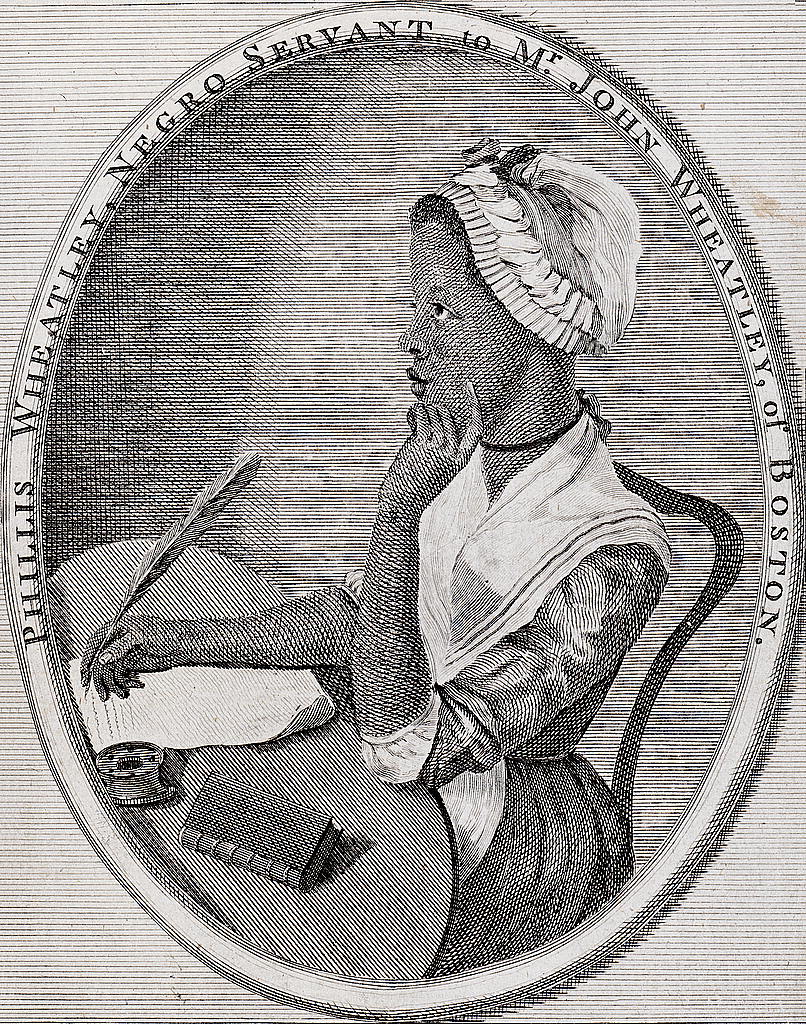
Phillis Wheatley

Portrait of Phillis Wheatley used as the frontispiece of her book.
Attributed to Scipio Moorhead. Library of Congress


September 1, 1773: Phillis Wheatley published Poems on Various Subjects, Religious and Moral. She was only 20 years old, but more importantly, it was the first published book of poetry by an African-American. 

She had been born in West Africa and brought over as a slave when she was a young girl. She was purchased by a Boston family, who taught her to read and write, and eventually gave her her freedom. 

On a 1773 trip to London with her master's son, seeking publication of her work, Wheatley met prominent people who became patrons. The publication in London of her poetry brought her fame both in England and the American colonies. It was praised by George Washington, and the Lord Mayor of London, who gave her a gift copy of Paradise Lost

Thomas Jefferson was not kind to her work or to any poetry by blacks. He wrote, "Religion indeed has produced a Phyllis Whately [sic] but it could not produce a poet. The compositions published under her name are below the dignity of criticism."

Black literary scholars from the 1960s to the present in critiquing Wheatley's writing have noted the absence in it of her sense of identity as a black enslaved person. "A number of black literary scholars have viewed her work—and its widespread admiration—as a barrier to the development of black people during her time and as a prime example of Uncle Tom syndrome, believing that Wheatley's lack of awareness of her condition of enslavement furthers this syndrome among descendants of Africans in the Americas." [source]

But other critics consider her work fundamental to the genre of African-American literature. In 2002, the scholar Molefi Kete Asante listed Phillis Wheatley as one of his 100 Greatest African Americans. Wheatley is featured, along with Abigail Adams and Lucy Stone, in the Boston Women's Memorial, a 2003 sculpture on Commonwealth Avenue in Boston, Massachusetts. In 2012, Robert Morris University named the new building for their School of Communications and Information Sciences after Phillis Wheatley, and Wheatley Hall at UMass Boston is named for her.

In The Trials of Phillis Wheatley, Henry Louis Gates Jr. explores America's first black poet and her encounters with the founding fathers and how that shaped black literary tradition. Gates posits that Jefferson, unlike his contemporaries Ben Franklin and George Washington, refused to acknowledge her gifts as a writer, and that repudiation eventually inspired generations of black writers to build a body of literature in their efforts to prove him wrong.

Though she continued to publish in magazines after the book's publication and made some money from publications, it was not enough to have a good life. Wheatley was emancipated by her masters shortly after the publication of her book, and she married John Peters, a poor grocer. They fell into debt and Peters abandoned her when she was pregnant. She died in childbirth at 31 years old, in poverty and obscurity.

Statue in Boston

Selections from her book

On being brought from Africa to America

'TWAS mercy brought me from my Pagan land,

Taught my benighted soul to understand

That there's a God, that there's a Saviour too:

Once I redemption neither sought nor knew,

Some view our sable race with scornful eye,

"Their colour is a diabolic die."

Remember, Christians, Negroes, black as Cain,

May be refin'd, and join th' angelic train.


A Hymn to the Evening

Soon as the sun forsook the eastern main
The pealing thunder shook the heav'nly plain;
Majestic grandeur! From the zephyr's wing,
Exhales the incense of the blooming spring.
Soft purl the streams, the birds renew their notes,
And through the air their mingled music floats.
Through all the heav'ns what beauteous dies are spread!
But the west glories in the deepest red:
So may our breasts with ev'ry virtue glow,
The living temples of our God below!
Fill'd with the praise of him who gives the light,
And draws the sable curtains of the night,
Let placid slumbers sooth each weary mind,
At morn to wake more heav'nly, more refin'd;
So shall the labours of the day begin
More pure, more guarded from the snares of sin.
Night's leaden sceptre seals my drowsy eyes,
Then cease, my song, till fair Aurora rise.


Visit our website at poetsonline.org

July 5, 2022

July Poets

Here are some poems by poets born in July.
Celebrate them by reading their words.
 

For My People” by Margaret Walker (July 7, 1915)

Nothing Twice” by WisÅ‚awa Szymborska (July 2, 1923)

The Song of Despair” by Pablo Neruda (July 12, 1904)

Sonnet” by Alice Dunbar-Nelson (July 19, 1875)

Alcove” by John Ashbery (July 28, 1927)

The Layers” by Stanley Kunitz (July 29, 1905)

I Am Bound, I Am Bound, For A Distant Shore” by Henry David Thoreau (July 12, 1817)

Poem for One Little Girl Blue” by June Jordan (July 12, 1817)


Visit our website at poetsonline.org

February 23, 2021

Edwin Arlington Robinson


Edwin Arlington Robinson was born in Head Tide, Maine in 1869. I first encountered his writing when my high school English teacher showed us his poem "Richard Cory" knowing that we were going to say "That's a song by Simon and Garfunkel." 

"Richard Cory" is a song written by Paul Simon in early 1965, and recorded by Simon and Garfunkel for their second studio album, Sounds of Silence, which probably everyone in my class in 1968 owned or had at least heard. It was much earlier a poem by Robinson. 

Our teacher asked us if we thought that Paul Simon had plagiarized the lyrics. (Plagiarism was a topic of discussion in that class recently.) We didn't think so and neither did our teacher who thought the use of the poem was "transformative" and so safe. 

We listened to the song and looked at the poem. Most of the class liked Simon's version better, but I remember thinking that he really owed it all to Robinson. 

I went to the library and borrowed a book of his poetry. (samples here) I remember liking "Miniver Cheevy" and "Mr. Flood's Party" because they were clear stories about people.

Whenever Richard Cory went down town,
We people on the pavement looked at him:
He was a gentleman from sole to crown,
Clean favored, and imperially slim.

And he was always quietly arrayed,
And he was always human when he talked;
But still he fluttered pulses when he said,
"Good-morning," and he glittered when he walked.

And he was rich—yes, richer than a king—
And admirably schooled in every grace:
In fine, we thought that he was everything
To make us wish that we were in his place.

So on we worked, and waited for the light,
And went without the meat, and cursed the bread;
And Richard Cory, one calm summer night,
Went home and put a bullet through his head.

Robinson lived in poverty and was an alcoholic until President Theodore Roosevelt read his book Children of the Night (1897). Roosevelt liked the poetry enough that he wrote a review of the book and found Robinson a job at the New York Customs Office, which saved Robinson’s life. It was a place where Herman Melville had also worked for a time. The job Robinson was given was a kind of grant as it was designed to give him as little work as possible so he could write. He received a stipend of $2,000 per year. 

Here are Paul Simon's lyrics:

They say that Richard Cory owns one half of this whole town
With political connections to spread his wealth around
Born into society, a banker's only child
He had everything a man could want, power, grace and style
But I work in his factory
And I curse the life I'm living
And I curse my poverty
And I wish that I could be
Oh, I wish that I could be
Oh, I wish that I could be Richard Cory

The papers print his pictures almost everywhere he goes
Richard Cory at the opera, Richard Cory at a show
And the rumor of his parties and the orgies on his yacht
Oh, he surely must be happy with everything he's got
But I, I work in his factory
And I curse the life I'm living
And I curse my poverty
And I wish that I could be
Oh, I wish that I could be
Oh, I wish that I could be Richard Cory

He freely gave to charity, he had the common touch
And they were grateful for his patronage and they thanked him very much
So my mind was filled with wonder when the evening headlines read
"Richard Cory went home last night and put a bullet through his head"
But I, I work in his factory
And I curse the life I'm living
And I curse my poverty
And I wish that I could be
Oh, I wish that I could be
Oh, I wish that I could be Richard Cory


Visit our website at poetsonline.org

April 19, 2019

Wild Nights with Emily

Emily (Molly Shannon) doing what she should be best remembered for -writing
WILD NIGHTS WITH EMILY - Courtesy of Greenwich Entertainment

This is not a review but a preview since I have not seen the new film about Emily Dickinson, Wild Nights with Emily.  The reviews have been positive.

I have posted a few times in recent years here about poets and poetry portrayed on film. The results have been mixed, but I think it is difficult to explain what poetry's power is to someone who does not read or write it. It would be even more difficult to make it come to life on a screen. It comes to life for many of us on a page, read silently or read aloud.

On the film's website "About" page, they describe the film in this way:
"In the mid-19th century, Emily Dickinson is writing prolifically, baking gingerbread, and enjoying a passionate, lifelong romantic relationship with another woman, her friend and sister-in-law Susan...
Yes this is the iconic American poet, popularly thought to have been a recluse.
Beloved comic Molly Shannon leads in this humorous yet bold reappraisal of Dickinson, informed by her private letters. While seeking publication of some of the 1,775 poems written during her lifetime, Emily (Shannon) finds herself facing a troupe of male literary gatekeepers too confused by her genius to take her work seriously. Instead her work attracts the attention of an ambitious woman editor, who also sees Emily as a convenient cover for her own role in buttoned-up Amherst's most bizarre love triangle.
A timely critique of how women's history is rewritten, WILD NIGHTS WITH EMILY remains vibrant, irreverent and tender--a perhaps closer depiction of Emily Dickinson's real life than anything seen before."
Emily (Molly Shannon) and Susan (Susan Ziegler) in bed - WILD NIGHTS WITH EMILY - Courtesy of Greenwich Entertainment

Not every filmgoer will know walking into a theater that the film's title comes from one of her poems. It is one of my favorites of Emily's poems.

Wild nights - Wild nights!
Were I with thee
Wild nights should be
Our luxury!

Futile - the winds -
To a Heart in port -
Done with the Compass -
Done with the Chart!

Rowing in Eden -
Ah - the Sea!
Might I but moor - tonight -
In thee!

The Atlantic editor Thomas Wentworth Higginson (Brett Gelman) visits Emily to tell her that her poems are inaccessible, so he won't be publishing them.  WILD NIGHTS WITH EMILY - Courtesy of Greenwich Entertainment
I liked Terence Davies' film A Quiet Passion, which is a biopic about Ms. Dickinson, but it followed the traditional story - which is at least partially true - of Emily's chronic pain, unrequited love, literary obscurity, self-confinement and isolation.

What makes this new film different from other works about Emily is that it takes some of the evidence that has been found through studying the poems and Emily's erasures which seem to indicate more than just a friendship with her brother's wife, Susan.

If Emily was on Facebook, her relationship status would read "It's Complicated."

Mabel Todd (Amy Seimetz) who narrates the film and assembled and edited the first posthumous collection of Dickinson’s poetry was also the mistress of Emily’s brother. Mabel's edits out Emily’s now-famous dashes and deleted the dedications to her sister-in-law, Susan. Fake news.

Madeleine Olnek’s film is a reinterpretation of the somewhat standard story of Emily's life that was taught for many years. I certainly was given a picture of a hermetic poet who never left her bedroom and would gaze out the window at flowers, funerals and the world passing by. She wanted her poems destroyed and forgotten.

That story is not accurate. How much closer to the truth is this film's interpretation? The film is rated PG-13 for "sexual content" but it is a gentle intercutting of the edited Emily and the version of her where petticoats fall to the floor. Molly Shannon's Emily is more of a heroine in what is probably a romantic comedy. If that interpretation brings more readers to the poems and blows the dust off Emily's portrait, I'm all for it.


June 17, 2016

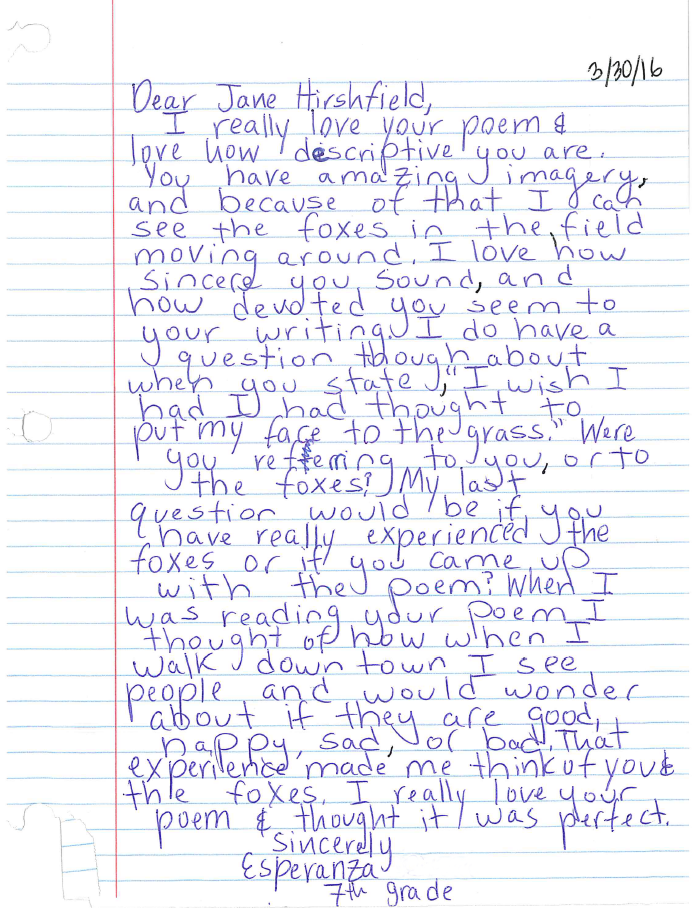
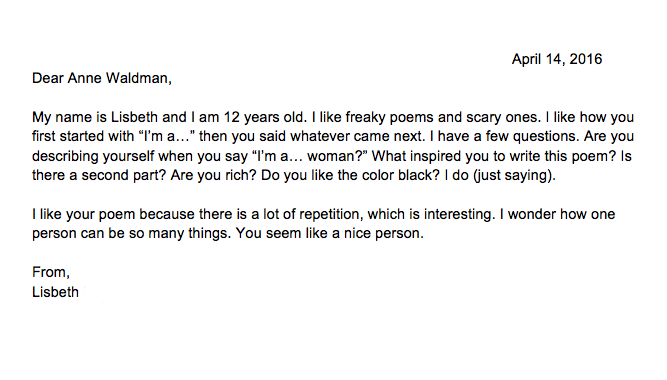
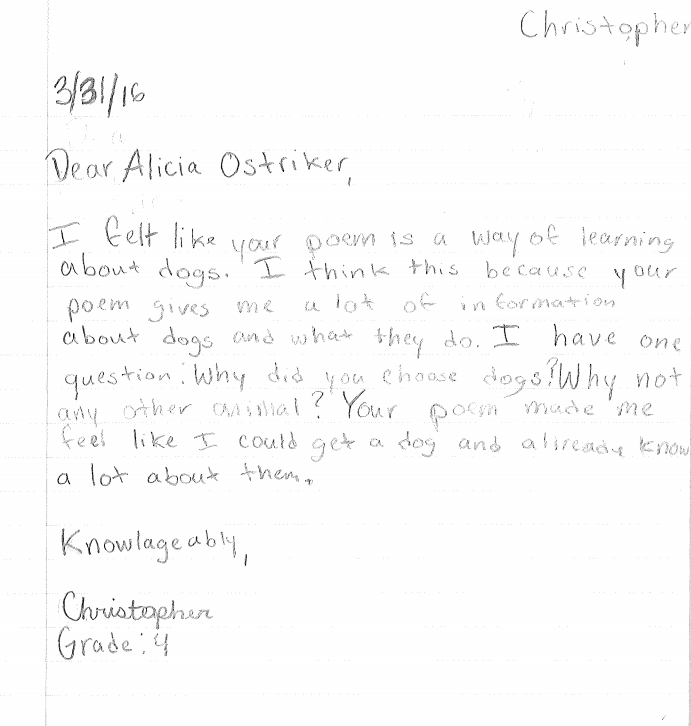
Dear Poet - 2016


Many classrooms participated in this year’s Dear Poet Project during National Poetry Month writing letters to poets. The Academy of American Poets received over 1,300 letters!

Take a look at the correspondences between students and poets who serve on the Academy of American Poets Board of Chancellors: https://www.poets.org/national-poetry-month/dear-poet-letters-2016


February 26, 2016

Touched With That Crazy Poetic Fire


Katie Holmes and Luke Kirby in Touched With Fire - directed by Paul Dalio. Credit Roadside Attractions
Ah, those crazy poets. The New York Times review for a new film is headlined "'Touched With Fire,' a Love Story Between Two Bipolar Poets"

This is not a film review. I haven't seen the film. I did read the book Touched with Fire: Manic-Depressive Illness and the Artistic Temperament by Kay Redfield Jamison some years ago because I was interested in seeing the links she found between manic-depression and creativity.

Art and madness have a history. But is the anguish and perhaps volatile intensity of the "artistic temperament" a characteristic of those who take that path, or a sign of a now-identifiable manic-depressive illness?

I have written before about the connections we make between creativity and mental illness, and also the ties to addictions.

The book is concerned with the biological foundations of the illness and examines it through the lives and works of artists including Lord Byron, Vincent Van Gogh, and Virginia Woolf.

The two poets love van Gogh's painting “The Starry Night” which they duplicate full wall-sized in their apartment. They consider van Gogh to be bipolar, and identify with that painting and its whirling euphoria that they also feel sometimes.

The film version (and film adaptations of non-fiction books are very different from those of fiction) also explores bipolar disorder (AKA manic depression) and creativity through the stories of Marco (Luke Kirby), a performance poet, and a quieter poet, Carla (Katie Holmes). They meet in a group-therapy session in a hospital.

The Times reviewer says that:
Together, they adopt a you-and-me-against-the-world attitude and embark on a mind trip fueled by Marco’s science-fiction-worthy interpretation of the mystical connections among things. They build an impenetrable fantasy of themselves as displaced otherworldly beings and parents-to-be of a yet unborn miracle child.
When people are in that manic phase of a bipolar cycle, they are euphoric and filled with promise and potential. This is when they are writing, composing or painting. They are on a natural high. This seems to be the focus of the film - and why not enjoy that high? It makes for a more enjoyable film than one about two poets in their depressive phase acting catatonic and suicidal.

It is tricky to have characters in a film that are poets, because then you need to have some of their poetry out there and deciding if a poet is really "a poet" is a subjective task. (The reviewer, Stephen Holden, feels their poetry is not very good.)

Dalio, the director, has written about his own struggles with bipolar disorder. And author Jamison plays a role in the film as the two poets visit her and she reassures them that staying on their medication won't destroy their creativity.

Several reviewers seem to feel the film is fair, though edging towards the view that the madness is okay because it feeds the creativity. Maybe poets all feel like they are a bit crazy - and perhaps some even enjoy and promote that image - but I think people in general think thay are a bit crazy in this label it and take a drug for it these days.

A review of Jamison's book in The New England Journal of Medicine (1993) notes that her "attention to the family trees of her subjects, showing how melancholia, irritability, insanity, and suicide affect many families yet leave in their wake immense contributions to our cultural heritage." Jamison sees a definite correlation, but "although mental illness is no prerequisite for creativity and at times may confer a definite disadvantage, both the manic and the depressive phases of bipolar illness may also offer something to augment the creative process."

Do we want the cure? She makes the point that although eradication of the genes responsible for the condition would prevent suffering and illness, it might also have a devastating effect on future creativity and genius.

August 15, 2015

Prompt: Directions Home

Years ago, I was interested to see a feature in The Saturday Review each issue that was called "Writer's Desk." The idea was simple. It showed a writer's actual desk and explained a bit about how they worked there. I always thought that I might gain some insight into writing or writers by knowing about the how and where of their writing. It is a questionable theory, but when I visit a writer's home I am still interested in seeing their writing space.

Thinking about Charles Bukowski's battered desk looking over the Los Angeles harbor or Raymond Carver staring out his Port Angeles, Washington window across the Strait of Juan de Fuca and thinking about going fishing, did give me a bit of a sense about their writing.

So, I looked at Emily Dickinson's home and Wallace Steven's house looking for clues. I walked through Walt Whitman's home in Camden, New Jersey looking for signs of his ecstatic poems, wandering spirit and curiosity.

I was interested to see that a poem by Juan Felipe Herrera, who was recently named Poet Laureate of the United States, was used during National Poetry Month as a writing prompt about home.


Juan Felipe Herrera reads “Five Directions to My House” as part of National Poetry Month 2014.
https://youtu.be/8UPjEcaCG5E


Five Directions to My House

1. Go back to the grain yellow hills where the broken speak of elegance
2. Walk up to the canvas door, the short bed stretched against the clouds
3. Beneath the earth, an ant writes with the grace of a governor
4. Blow, blow Red Tail Hawk, your hidden sleeve—your desert secrets
5. You are there, almost, without a name, without a body, go now
6. I said five, said five like a guitar says six.

Actually, I was more interested in the responses to his poem by students. Here are two of the poems written in response to Herrea's poem.

Six Ways to the Sky by Leyla, age 9

Turn around go to the end of the long bridge
Into the wave of clouds under the colorless arch
Under the heat of the center core.
Over the peregrine falcon flying fast as the race car
Out of the endless underwater cave
Around the wheel of fortune, around, around, around the wheel.
I said six, said six like a rainbow says seven.

Five Minutes to My House by Ilyssa, age 18


One,
the mountain cradles the rising sun as it leaves
a warm pink collection of colors in the air.
Bright, brutal sunlight turns the sky on
like an electrical switch and the sky becomes
alive.

Two,
the staccato of a wood pecker tapping on my roof
in the morning stirs me awake.

Three,
an endless stretch of rocks and dirt, harsh
to the eyes, a barren desolate land.

Four,
a dead bunny carcass lies on the newly
paved road, it ran towards the wheels of a
car. Now, it’s left behind a sore sight
for all except hungry lone scavengers.

Five,
time, time slips through the fingers like
yellow grains of sand left behind on a beach.
Even time moves slowly in this eternal home.

Your writing prompt is to write a poem that gives directions (in any format) to your house or any particular house - including the home of a poet - take a look at my earlier post about writer's homes.

Submissions to this prompt are due by September 6, 2015.


August 13, 2015

At Home With Poets and Writers

Does Robert Frost's Franconia, NH home fit his poetry?

The Saturday Review used to include a Writer's Desk page with a photo and brief piece about where a writer did their writing. Those writers included Charles Bukowski and Raymond Carver. That led me to explore both in person and online the homes of other writers. Perhaps, looking at a writer's writing space gives some clues to what they wrote or how they wrote. Perhaps.

Take a peek at the homes of Wallace Stevens, Emily Dickinson, Paul Dunbar and Walt Whitman.

President Abraham Lincoln had written a poem about his home, which opens with this stanza

My childhood home I see again,
And sadden with the view;
And still, as memory crowds my brain,
There’s pleasure in it too.

and ends with this:

I range the fields with pensive tread,
And pace the hollow rooms,
And feel (companion of the dead)
I’m living in the tombs.

The boathouse in Wales where Dylan Thomas spent the last 4 years of his life.

Poets.org did a feature on the home in poetry in which they say the home can be a "mythic, imagined place, the location of childhood memories, or the brick-and-mortar remainder of a broken relationship. It can represent the proverbial 'room of one’s own,' the simple pleasures of eating and gardening, or hold the drudgery of chores."

Stanley Kunitz said in an interview that, “There was a cloud that hung over our house in Worcester, Massachusetts and it took me almost fifty years or more before I could face it in a poem [The Portrait].”

The "cloud" was formed by the deaths of his father who publicly committed suicide weeks before Kunitz’s birth, and the death of his stepfather and both of his sisters.

W.H. Auden wrote a collection, About the House in which the home becomes an extension of the self.

I suppose I must be quite at home in the world of poetry, because I got 9 out of 10 correct on The Guardian's quiz about poets' houses.Any guesses about what writers used these homes?


I used to believe that I could be a better and more productive writer if I had an isolated cabin in the woods in order to write. I suspect many of you have fantasized about having a place in the woods, a mountaintop or island retreat where we could go and find inspiration and peace.

There is no good evidence that those places actually do inspire writers or allow them to focus, and there are plenty of writers who work in cities and at home surrounded by distractions. 

If you are interested in this topic, you might enjoy reading The Writing Life: Writers On How They Think And Work, American Writers at Home and Writers' Houses.

We know that a writer’s genius does not come from the place where they do their writing. But I think that when writers find some kind of retreat or escape their homes for a place to write, that does tell you something about them, and that space may actually be the inspiration for their writing. I like knowing about a writer’s tools. Pad and paper, or fountain pen, legal pads, an old manual typewriter or a laptop computer? I like seeing where writers work.


February 1, 2015

Poets and Madness


If you were an English major, you probably read more than most people about writers who had problems with alcohol, drugs or mental illness. In college, I started to think that those were things you had to do to be a writer. You had to suffer. It was Romantic with a capital R.

I still see articles about writers with titles like “Nine Famous Authors Who Did Stints in Mental Institutions”  and  5 Writers Who Suffered from Mental Illnesses & the Impact It Had on Their Art and Great American Writers and Their Cocktails.

This is not just anecdotal. Some early research in 1987 connected creativity with mental illness when researchers noticed a higher occurrence of bipolar disorder in study participants from the Iowa Writers Workshop than in a control group.

The question that formed was "Did they get crazy by trying to be writers, or did they become writers because they were crazy?"

A later study found that those is the arts are more likely to have mental illnesses than those in non-creative professions.

Ernest Hemingway is one of my favorites and he is a classic example of this type of writer. He had it all: depression, alcoholism, narcissistic personality, bipolar disorder, psychosis and finally suicide. Before the doctors and clinics, he “self-medicated” with booze. He liked risk-taking activities. He wrote as therapy, and when he couldn’t write anymore (largely because of the alcohol), he got electroshock treatments. For someone whose life was writing, not being able to write meant he had no reason to live.

Hemingway also had it in his genes and there is some science to it. In 2009, an article published by the Association for Psychological Science showed a definitive link between creativity and the neuregulin 1 gene, a gene that is also associated with psychosis.

Hemingway said “Write drunk. Edit sober” but also claimed he didn’t drink until after his morning writing sessions.

Of course, alcohol is a depressant.

A number of recent studies have looked at the neurological similarities of mental illness and the creative mind. Bipolar disorder and schizophrenia appear to be focused within the frontal lobe of the brain and they typically manifest with rather peculiar connections that are similar to some types of connections that would be admired in poetry and other creative writing.

A 2002 study of 1,629 writers found that poets – and specifically female poets – were more likely than even non-fiction writers, playwrights and fiction writers to have some type of mental illness. This became known as “The Sylvia Plath Effect.”

Poet Sylvia Plath’s mental illness has been written about quite a bit. She wrote about it herself in her semi-autobiographical novel The Bell Jar. She was clinically depressed for much of her life. She had electroshock therapy, attempted suicide, was admitted to a mental institution for six months, got more electric and insulin shock treatments and still the depression ended her life in suicide.

In the film Annie Hall, Woody Allen’s character, Alvy,  warns Annie that Sylvia Plath was an “interesting poetess whose tragic suicide was misinterpreted as romantic by the college girl mentality.”

Is there a relationship between poetry and psychosis?

Another tragic female poet, Anne Sexton was in and out of mental institutions  for much of her life. Bipolar and suicidal. She started with poetry as therapy at the suggestion of her therapist. Her poetry is full of madness and pain and, like Plath, Sexton took her own life.


It seems like researchers have gotten caught up in those same stories that caught me in college and they are looking to connect genius and madness.

Any one of us might have been part of a study that included 294 poets (almost all “published” poets) in an anonymous online survey. These poets online scored above average on the “Unusual Experiences”, “Cognitive Disorganization” and “Impulsive Nonconformity” traits. The poets self-identified their work as “avant-garde” scored even higher on “Unusual Experiences.” 

Two of the poets reported schizophrenia, 15 reported bipolar disorder, 152 reported depression and 80 reported anxiety disorder. 

Does that sound about right for poets? Well, actually those percentages are not much higher than the general population.

Since these poets were all self-reporting, it’s possible that they had bought into the madness and writers archetype. Or did their “abnormal” psychology lead them to become writers?

August 30, 2014

Here lies One whose Name was writ in Water

I was reading a a biography of John Keats and looking at some of his letters this past month and learned of a summer hike that Keats made. 

In the summer of 1818,  Keats went on a six-week walking tour through northern England, Scotland, and Ireland. Keats and his friend Charles Brown set off in June and walked 600 miles before sailing back to London.
Keats was not an outdoorsman and had spent most of his life in London never having been out of southern England. He was 22 and had never seen a mountain.
They set off with very little in their knapsack – shirt, stockings, nightcap, towels, a brush and comb, snuff, and one book: a translation of Dante.
They started from Lancaster and headed for the Lake District. Keats’ brother George and his wife Georgina accompanied them as far as Lancaster and then continued to Liverpool, there to emigrate to America.
This was not a poetry tour but John and Charles stopped at William Wordsworth’s home. Wordsworth was not at  home.
Keats did not write his first poem until age 18. He was encouraged by a literary circle of friends in London, though he worked at a hospital to make his living. Keats’ first book, Poems, appeared in 1817 and after that, he devoted himself entirely to poetry.
Keats wrote that as the walk continued he found himself more moved by the people they met than by the landscape. He thought much of the mountains and moors seemed bleak.
He recorded that on June 29, they set off at 4 a.m. up the mountain Skiddaw. It offered a  to the Irish Sea and Scotland.
In the town of Ireby, that watched a performance of traditional dancing and Keats wrote: “I never felt so near the glory of patriotism, the glory of making, by any means, a country happier. This is what I like better than scenery.”
Keats was not pleased with the food on the trip either. In a letter, he writes: “We dined yesterday on dirty bacon dirtier eggs and dirtiest Potatoes with a slice of Salmon.” In Scotland, they seem to have survived on oatcakes and whiskey. He hated the oatcakes but enjoyed the whiskey.
Another poetry stop was to Alloway, the birthplace of the Robert Burns in Scotland. He was happier with this area. He said that the River Doon was “the sweetest river I ever saw” and he enjoyed a large pinch of snuff while standing on the Brig o’ Doon, a bridge Burns wrote about in his poems.
Keats and Brown continued through Scotland and made a short trip into Northern Ireland averaging 10-20 miles a day. By August 2, they had made it to the top of Ben Nevis, the tallest peak in the British Isles.
Keats’s health had actually not been very good before the trip, but developed a bad cold at this point and was advised by a doctor to quit the walking tour. He headed back to London, but Brown continued and walked another 1,200 miles.
1818 was not a good year for John and his family. He had financial difficulties. His brother Tom was battling tuberculosis. George and his wife made a poor investment in America and was left penniless in Kentucky.
The one happy thing in his life was his fiancée, Fanny Brawne.
1819 was a very productive year. By September, he had written a book’s worth of poems including “Ode on a Grecian Urn,” “Ode to a Nightingale,” “Hyperion,” “The Eve of St. Agnes,” “To Autumn,” and “La Belle Dame Sans Merci.”
John Keats Tombstone in Rome 01.jpg
“John Keats Tombstone in Rome” by Piero Montesacro – Wikimedia Commons
John developed tuberculosis (for which there would be no cure until the next century),  possibly from caring for his brother. Early in 1820, the disease worsened and he was advised to move to a warmer climate.
In September 1820, Keats left for Rome knowing he would probably never see Brawne again. After leaving he felt unable to write to her or read her letters.
Keats wrote his last letter to his walking partner Charles Brown on November 30, 1820: “Tis the most difficult thing in the world to me to write a letter. My stomach continues so bad, that I feel it worse on opening any book – yet I am much better than I was in Quarantine. Then I am afraid to encounter the proing and conning of any thing interesting to me in England. I have an habitual feeling of my real life having past, and that I am leading a posthumous existence”.
He died in Rome on February 23, 1821 and is buried there. He was only 25 years old.
He wanted a tombstone without name or date, only the words, “Here lies One whose Name was writ in Water.” Charles Brown and another friend had the stone place but added a lyre with broken strings and this epitaph which lies some blame on critics who were harsh with Keats’ poetry.
“This Grave / contains all that was Mortal / of a / Young English Poet / Who / on his Death Bed, in the Bitterness of his Heart / at the Malicious Power of his Enemies / Desired / these Words to be / engraven on his Tomb Stone: / Here lies One / Whose Name was writ in Water. 24 February 1821″

July 9, 2013

Prompt: First (Poetic) Love


Who is the first poet you fell in love with? In this video from The Poetry Foundation, Edward Hirsch, Evie Shockley, Jean Valentine, Juan Felipe Herrera, Katy Lederer, Marilyn Hacker, Pierre Joris and Rachel Levitsky talk about first poetry loves.

Several of the poets ask the interviewer if the question is meant literally or figuratively, or if the answer can be a poem rather than the poet. This inspired me use that first love of poetry as our prompt and inspiration.

Who is the poet that was your first love? This might be the love of a poem, but it might be a crush on the poet, either by way of a poem or just a photo on a book jacket or an encounter at a reading.

Emily, as she appears on "her" Twitter page
I had a little adolescent crush on plain old Emily Dickinson because I felt sorry for her and imagined that if I had been there in Amherst that I might have been friends with her. I would have gotten her outside into nature and maybe we would have even dated.I also had a crush on glamorous Marilyn Monroe at that time because I also wanted to save her from the world.

In “Taking Off Emily Dickinson’s Clothes,” Billy Collins takes that idea to a playful extreme. His poem is an extended metaphor for reading a Dickinson poem. The undressing is also the uncovering of the poems. FOr example, taking off her "tippet made of tulle” is like opening her book.

First, her tippet made of tulle,
easily lifted off her shoulders and laid
on the back of a wooden chair.

And her bonnet,
the bow undone with a light forward pull.

Then the long white dress, a more
complicated matter with mother-of-pearl
buttons down the back,
so tiny and numerous that it takes forever
before my hands can part the fabric,
like a swimmer’s dividing water,
and slip inside.

Emily's simple poems are "a more complicated matter" when you actually read them. They are not so easy.

Later, I wrote in a notebook
it was like riding a swan into the night,
but, of course, I cannot tell you everything -
the way she closed her eyes to the orchard,
how her hair tumbled free of its pins,
how there were sudden dashes
whenever we spoke.

Emily's habit was to wear a white dress, although she rarely left her family home in Amherst. She was a recluse for the latter part of her life, hiding behind the door when there were visitors. It is assumed that she died a virgin. You can hear Billy Collins read this poem and some of Emily's poetry online and Collins says that "There are many speculations about her...Was she lesbian? Was she celibate? Did she have an affair?" All of that speculation inspired him to write the poem in which he wanted, in a playful way, to put the guessing to rest by undressing her and having sex.

Naomi Shihab Nye
The first time I heard a poem by Naomi Shihab Nye it was her reading "Making a Fist" at a Dodge Poetry Festival. I loved the poem and I had a bit of a crush on the poet too. I bought two of her books because I wanted to read them, but also because I wanted to go up to her and ask her to sign them and say something to her.

In another video, Naomi Shihab Nye talks about how poetry inspires us. She says, "I've carried, for perhaps 30 years, a very tattered piece of notebook paper that says: Philip Levine has described the muse as 'being the portion of the self that largely lives asleep. Being inspired is really being totally alive.' He says that such a state feels a 'little odd' and also 'delicious.' " She also carries with her William Stafford's poem, "The Sky."

Despite my Emily and Naomi crushes, the poem I carry in my wallet is "When You Are Old" by William Butler Yeats. That was one I fell in love with in high school and that I memorized and that reads even better to me as I grow old and gray and full of sleep myself.

For this month's writing prompt, we write about First (Poetic) Love. This can mean the first poem you recall loving or the first poet you loved (in any sense of the word).

Submission Deadline: Wednesday, July 31st