Showing posts with label Billy Collins. Show all posts

January 29, 2026

Dogs and Billy Collins


In a PBS interview for a new collection of Billy Collins' poems about dogs, it is said that nobody can fully understand the meaning of love unless they have had a dog. Collins agrees. 

The former U.S. poet laureate is a literary lion of the New York Public Library and a member of the American Academy of Arts and Letters. He recently released his 12th collection of poetry titled Dog Show.

Billy Collins, a dog lover and owner who's been writing about them for decades, he's now pulled together a selection of those poems in a volume he's dedicated to 85 dogs, those of friends as well as his own. The book is illustrated with Pamela Sztybel’s watercolors,

Watercolor illustrations by Pamela Sztybel help show what's beguiled Collins ever since he got his first dog as an only child. 

When we got a dog from the pound, my father said: "We're going to get a dog, but, remember, we're buying a heartache," which was, the dog's going to die before we will, which is a fact of dog and human life. Somebody said, the only -- dogs are flawless, except they die too soon. 

That's what we're trying to avoid, is the -- bring up the violins and -- but I do have that poem of -- you know, I think, "A Dog on His Master."

A Dog on His Master.
As young as I look, I'm growing older faster than he. 
Seven to one is the ratio they tend to say. 
Whatever the number, I will pass them one day 
and take the lead, the way I do on our walks in the woods. 
And if this ever manages to cross his mind, 
it would be the sweetest shadow I have ever cast on snow or grass.

On the craft of writing poetry:

I think the craft part comes from having taught English literature for many, many decades and having this kind of Rolodex of poetic stuff revolving and teaching semester after semester, Wordsworth, Emily Dickinson, Hardy.

On the voice of his poems: 

So the voice in my poems is very straightforward. It's without guile and even kind of chummy with the reader. Someone said no line must sleep. Every line needs to be aware of the lines around it, as opposed to prose, where the sentences just drive forward. Poetry is a language that means more and sounds better than other written expressions.


Billy reads two poems about what dogs think (probably)


Follow this blog for all things poetry.
To see our past prompts and more than 300 issues,
visit our website at poetsonline.org

February 26, 2024

U.S. Poet Laureate Projects

Since the Poet Laureateship was created by an act of Congress in 1985, nearly half of the laureates have taken on a signature project to raise the national appreciation of poetry. The best of them have a life beyond their tenure and some of them have an online presence.

A good example is the American Life in Poetry project by Ted Kooser from 2004-2022 to create a space and a presence for poetry in American culture. American Life in Poetry provided newspapers and online periodicals with a free weekly column by Kooser that featured a poem from a contemporary American poet. The poems and columns remain archived online.

The Favorite Poem Project by Robert Pinsky was the first digital one I experienced. It is a way to celebrate, document, and encourage a public appreciation of poetry as well as acknowledge the role of poetry in the everyday lives of Americans. The project called for Americans to share their favorite poems with the nation.

Billy Collins' Poetry 180 was one I used in my classroom. It was his effort to make poetry an active part in the daily experience of American high school students, giving students a chance to read or listen to a poem on each of the 180 days of the school year. Two anthologies came from the project.

American Conversations: Celebrating Poems in Rural Communities was the 2018 project of Tracy K. Smith who visited rural communities around the country and gave away copies of her anthology, American Journal: Fifty Poems for Our Time, to spark conversations about the power of poetry.Living Nations, Living Words was created in 2020 by Poet Laureate Joy Harjo. It gathered a sampling of work by 47 contemporary Native poets from across the nation and features an interactive Story Map and a newly developed audio collection.


Follow this blog for all things poetry.
To see our past prompts and more than 300 issues, visit poetsonline.org

July 9, 2022

Billy Collins Poetry Animated

Billy Collins, former US Poet Laureate and one of America's best-selling poets, is not big on technology. As far as I know (based on a conversation way back in 2007), he was not big on using email or computers. But he recognizes the power of the web in promoting poetry. He has been doing a poetry podcast on Facebook that started in the Pandemic Times. His Poetry 180 project while he was Laureate is available online and in book form (including a sequel). 

Back when we had that 2007 conversation, there were 11 short animated films set to Billy reading his poems. There's not much information online about them. They are produced by JWT-NY. You can watch most of them on YouTube. I have embedded a few here to sample.

Here's an interpretation of Billy's poem "Forgetfulness" with animation by Julian Grey/Head Gear.


 "Budapest" is also animated by Julian Grey/Head Gear.


"Now and Then" is animated by Eun-ha Paek of Milky Elephant.


May 4, 2022

Prompt: The Voice of the Dog

=
Photo by Paul Moody - Flickr 

“They say a poet
can never write a purely happy poem about a dog
greeting the sun and what it has done to rain.
I don’t know about that."


so writes Analicia Sotelo in her poem “Grace Among the Ferns”

Does that hold true for the two dogs who author (or are the voice) in these poems read by Billy Collins?


In talking about his poems, Collins says that putting a dog into a poem makes it harder to avoid the sentimental. The dog voices in "The Dog on His Master" and "The Revenant" seem to be able to do it, though neither is "purely happy."

 I am the dog you put to sleep,
as you like to call the needle of oblivion,
come back to tell you this simple thing:
I never liked you — not one bit.”

The dog in Mark Doty's, “Golden Retrievals” (from Sweet Machine) I imagine being his golden retriever, Beau, who he wrote about in Dog Years: A Memoir (P.S.) who along with his black lab partner, Arden, helped Mark through a very dark period in his life. Beau uses a sonnet form.

On their walk, the dog is full of joy and in the moment. But the poet?

"... Either you’re sunk in the past, half our walk,
thinking of what you never can bring back,
or else you’re off in some fog concerning
—tomorrow, is that what you call it? My work:
to unsnare time’s warp (and woof!), retrieving,
my haze-headed friend, you. This shining bark,
a Zen master’s bronzy gong, calls you here,
entirely, now: bow-wow, bow-wow, bow-wow.

In "Grace Among the Ferns, "our model poem on the website for this month's prompt, the poet envies the dog. Grace, who like Beau in Doty's poem, finds delight in exploring the late spring ferns. The poet says:  

"I am not sure I have ever had such a joy,
either in discovery or expectation..."

The call for submissions for May is a dog poem in the voice of the dog. Let's take Collins' warning about over sentimentality into account. Let's remember the joy and Zen of Beau and Grace. You don't have to have ever owned a dog to know the voice of one - but having a dog that owned you will certainly change how to approach this prompt.


Visit our website at poetsonline.org


September 5, 2021

Prompt: Letter to the Future

Writing a letter
Photo: Petar Milosevic

There are a group of poems collected at poets.org about climate change, rising global temperatures and natural disasters. We are in the season of tropical storms and hurricanes in North America and recently an earthquake in Haiti. The poems collected there all try to humanize the climate crisis. The poem that caught my attention was “Letter to Someone Living Fifty Years from Now” by Matthew Olzmann. It is about climate change but it is the title that made me think of this prompt.

Write a poem addressed to a person or the people of the future. It doesn't need to be about the environment. The topic may not even be global. It might be personal. It might not be 50 years in the future. I can imagine writing a poem for my one-year-old granddaughter when she turns 21. It might be a letter to your future self.

Whatever your focus, some other poems in that collection might be inspiring. “Thirteen Ways of Looking at a Glacier (after Wallace Stevens)” by Craig Santos Perez borrows Stevens' structure. Another poem by Matthew Olzmann also uses the epistolary form. An epistolary poem, also called a verse letter or letter poem, is one in the form of a letter (epistle) His poem "Letter Beginning with Two Lines by Czesław Miłosz," is a letter to now and the future. Its topic is clear from its opening lines:
You whom I could not save,
Listen to me.
Can we agree Kevlar
backpacks shouldn’t be needed
for children walking to school?


Visit our website at poetsonline.org

August 3, 2021

Prompt: Historical Intimacy


When I was in a weeklong poetry workshop with Billy Collins a chunk of years ago, he looked at a poem I was working on titled "Sex with Amelia Earhart." He said it reminded him of his poem "Taking Off Emily Dickinson's Clothes" (which appears in his collection Picnic, Lightning).

The two poems both have a title intended to give a little shock. Collins uses a lot of allusions to Emily's poems including well-known lines from them. His poem is more romantic and less sexual than mine, but I imagine both poems would gather around them the same criticisms: sensationalist and maybe even misogynist. I know that both of us thought about that and both of us disagreed with those appraisals. I think we both thought of them as love poems. Male poet imagines a romantic relationship with a female inspiration from the past.

In an interview on Fresh Air, Collins said "I mean, I actually at one point, when there were so many books out about speculating particularly on Emily Dickinson's sexuality, you know, was she lesbian, was she celibate, did she have an affair, I was driven actually by all of that curiosity and speculation to write a poem called "Taking Off Emily Dickinson's Clothes," in which I attempted, in a kind of playful way, to put the matter at rest by having sex with her."

I showed both poems to another poet, Kristin D'Agostino, and she suggested they might be a prompt here .

Create an intimacy between you and a historical person. Imagine a conversation or romantic encounter. "Intimacy" can occur at many levels. I did some searching online and it seems that some psychologist list four types of intimacies: emotional, mental, spiritual, and physical. Only one of those involves touching.

That is your prompt for this month. Choose your person. Select the type (types?) of intimacy. A conversation over coffee? A passionate weekend? So many possibilities.


submit

Deadline for submissions to our next issue: August 31, 2021

Please refer to our submission guidelines and look at our archive of more than two decades of prompts and poems.

Visit our website at poetsonline.org


May 13, 2020

Poetry Conversations at Home with Billy Collins


While we are all at home quarantining and poets are doing readings online and a few writers are doing their "book tours" virtually. I have been watching the daily videos from Billy Collins. They are very informal conversations and he reads his poems and poems by others. It's a low-tech iPhone production, but then so are some major newscasters and late-night TV guests.

You can check out Billy's videos on Facebook.  

At the end of today's "broadcast" (his term), he gave an "assignment" to read a poem before the Friday session. He said this was the poem he used when asked that impossible question "What is your favorite poem?"


Coleridge in 1795
Coleridge 1795, about the time he wrote the poem
Peter Vandyke - http://www.zeno.org/Literatur/I/coleridg.jpg,
held at the National Portrait Gallery, Public Domain, Link

I was surprised that his choice is "This Lime-tree Bower my Prison" by Samuel Taylor Coleridge. I had never read the poem before, but I can see that it is appropriate to a time when we are separated from friends and perhaps from nature and experiences.


You might want to read the poem and then join the live Facebook broadcast on Friday and add your comments.


Visit our website at poetsonline.org

January 18, 2020

Into the Glittering White Snow


Back in 2015, we based a writing prompt on the poem "Shoveling Snow With Buddha" by Billy Collins. It's snowing outside my window today and I was rereading that poem.

I like this Buddha being in a situation that's a bit odd. This is not a seated and meditative Buddha. And I don't think of Buddha in the snow - even though my garden Buddha is being covered with snow beside the St. Francis statue. They seem quite comfortable with each other. They don't seem to mind the cold and snow. They really enjoy it when I sprinkle birdseed around them and the little birds hop in the snow to eat.

When I head outside today to shovel some snow, I'd like to think that I can take Buddha with me. He's in my mind but he's not in my mind. Shoveling snow can certainly be an exercise in mindfulness.

I know from the poem not to talk to him out there.
This is so much better than a sermon in church,
I say out loud, but Buddha keeps on shoveling.
This is the true religion, the religion of snow,
and sunlight and winter geese barking in the sky,
I say, but he is too busy to hear me.

Why be quiet? Because:
He has thrown himself into shoveling snow
as if it were the purpose of existence,
as if the sign of a perfect life were a clear driveway
you could back the car down easily
and drive off into the vanities of the world
with a broken heater fan and a song on the radio.

Soon, outside to shovel snow with Buddha.  And then, with my boots dripping by the door, some hot chocolate.


Visit our website at poetsonline.org

December 8, 2019

Prompt: Rereading and Rewriting


In the poem "Rereading Frost" by Linda Pastan, she confronts a problem that many poets probably confront at some point. Is there anything left to write about or has everything been written?

Sometimes I think all the best poems
have been written already,
and no one has time to read them,
so why try to write more?

This is not a problem only for poets. All writers, inventors, scientists, painters, filmmakers, and other creators are faced with this problem. Is there anything new and original to create?

Of course, the answer is that there are always new things. The world changes. We change.

But the more poetry you read, the more likely you are to realize that a lot of topics have been covered already. The real problem might be that you may feel that someone else has already written a better poem than you could ever write.

Billy Collins' poem "The Trouble with Poetry" addresses this issue too.

the trouble with poetry is
that it encourages the writing of more poetry,
more guppies crowding the fish tank,
more baby rabbits
hopping out of their mothers into the dewy grass.

And how will it ever end?
unless the day finally arrives
when we have compared everything in the world
to everything else in the world,

and there is nothing left to do
but quietly close our notebooks
and sit with our hands folded on our desks.

We hope you won't close your notebook (or laptop) and sit back and stop writing. Collins didn't stop. In fact, he continues:

But mostly poetry fills me
with the urge to write poetry,
to sit in the dark and wait for a little flame
to appear at the tip of my pencil.
And along with that, the longing to steal,
to break into the poems of others

Like Pastan, we read and reread poems and poets and we are inspired to write our own. Our poem may complement the original or go against it. It might update the topic of the poem. William Shakespeare writes about love and you do a 21st-century update on his approach.

Like Collins, we might steal a bit from the other poet - a line, a title, an image, the idea for the poem itself.

In Pastan's poem, she has more of a mixed response to rereading Frost's poem.

And I decide not to stop trying,
at least not for a while, though in truth
I'd rather just sit here reading
how someone else has been acquainted
with the night already, and perfectly.


For this month's prompt, we ask you to reread and rewrite - a poem that begins in response to rereading some favorite poem. It might be one you know you can't do any better. It might be one that you can rewrite in a new way. Let the reader in on the poem or poet that inspired you.

Submission Deadline: December 31, 2019


Visit our website at poetsonline.org

November 12, 2019

A Master Class

The "Master Class" is something I associated with acting, but now there are ones on many of the creative arts, especially online. In his MasterClass on "Reading and Writing Poetry," Billy Collins covers some of the basics like subject and form, rhyme and meter. But you can tell (even in this excerpt) that he's more interested in the pleasures of a well-turned poem.


Collins is one of the best-selling contemporary poets in the United States. That works for and against him with critics who sometimes see his persona and humor as almost "too accessible." I think they are wrong.

Besides being called “America’s Favorite Poet” by the Wall Street Journal, he served two terms as U.S. Poet Laureate and is also a former New York State Poet Laureate. He’s been honored with the Mark Twain Prize for Humor in Poetry. He’s taught at Columbia University, Sarah Lawrence, and for much of his life at Lehman College, and is a distinguished professor at the City University of New York.

The MasterClass syllabus reads:
• Using humor as a serious strategy
• The fundamental elements of poetry
• Billy’s writing process
• Turning a poem
• Exploring subjects
• Rhyme and meter
• Sound pleasures
• Finding your voice
• Using form to engage readers
• The visual distinctions of poetry

There are other MasterClass offerings that might interest poets: Neil Gaiman teaches The Art of Storytelling, Margaret Atwood on Creative Writing, and even David Lynch on Creativity and Film.

Of course, these classes have a cost, but there are lots of free "classes" online too. Just staying in the Collins section of YouTube, you can hear him on the great poets.


Five of Collins' poems were the inspiration for animated films, which might seem like an odd way to look at poetry. Here he talks about the films in a TED Talk.


If you're like me, any good poetry reading is a kind of class. I always find myself inspired and making notes at readings of things that I should try to write about in my own poetry.


Here is a full reading by Billy Collins at the Strand Book Store in 2012 at the time of his collection Horoscopes for the Dead. If you have never had the chance at hearing Collins live, this is a good alternative. I think you may be inspired to write.


Visit our website at poetsonline.org

May 22, 2018

Music and Poetry

Music and poetry are certainly intertwined, but sometimes the twining is confusing. We often hear about the "music" in a poem. Both use rhythm and meter - though it is not always used in poems.

In 2014, Sir Sir Paul McCartney visited Rollins College at the invitation of Rollins Winter Park Institute Senior Distinguished Fellow Billy Collins.  During his visit, McCartney joined the two-term U.S. Poet Laureate on stage for an hour-long conversation about his influences, his education, and the art of songwriting.


April 30, 2018

Reading Poetry Like a Professor


I had Billy Collin's warning about some classes in "Introduction to Poetry" when I encountered an article titled "How to read poetry like a professor."

It turns out that the author of the piece, Thomas Foster, is a retired professor of literature who has made a side career by writing instructive books about how we ought to read. (He's not the old professor illustrated above.)

He has published How to Read Literature Like a Professor, How to Read Novels Like a Professor, Twenty-five Books that Shaped America, Reading the Silver Screen and now How to Read Poetry Like a Professor.

Foster, like many of us, couldn't quite get a "handle” on poetry in elementary school. But, as a teenager, he encountered with the poems of Lawrence Ferlinghetti and it turned around how he read poems.

Billy Collins shares that Ferlinghetti connection. In Collins' poem "The Trouble with Poetry," he says that reading poetry makes him want to write poetry and fills him with a "longing to steal."

And what an unmerry band of thieves we are,
cut-purses, common shoplifters,
I thought to myself
as a cold wave swirled around my feet
and the lighthouse moved its megaphone over the sea,
which is an image I stole directly
from Lawrence Ferlinghetti --
to be perfectly honest for a moment --

the bicycling poet of San Francisco
whose little amusement park of a book
I carried in a side pocket of my uniform
up and down the treacherous halls of high school.

Foster's article is taken from his latest how-to-read book which, thankfully, does not suggest (as Collins warned):

tie the poem to a chair with rope 
and torture a confession out of it.

They begin beating it with a hose
to find out what it really means.


Foster's suggestions include some good basic advice:

  • Read what’s actually in front of you. Make a quite literal first reading.
  • Read all the words. Each word. No skimming. He feels students often whiz past a keyword.
  • On a second reading, get into the way things are assembled on the page. He advises to read the sentences, not the lines. That means you should also 
  • obey all punctuation, including its absence. No punctuation at the end of the line? Keep that very brief pause but don't drop the voice as if the sentence is over. A comma, acts as all commas - pause - and a period, semicolon, a question mark and even a dash is meant as a stop.
  • I agree with him that at least one time you should read the poem aloud. This may not work in the library or coffee shop, but when alone or with an open group, do so. Even poems  "written for the page" reveal things when heard. That's one reason why I like audiobooks.
  • Do multiple readings of the poem. Unlike reading a novel, it is easy and to reread a poem right after the first cold reading.
  • Look up the odd words or allusions. Some poetry, especially the older classics, contain references and vocabulary that was challenging back in their own time for the less educated and is challenging today for even the educated. Even the more accessible modern poetry sometimes makes reference to a person or place that would be helpful to know a bit more about to understand the poem fully.
I am not so sure that this is so much how to read "like a professor" as much as it is simply how to read a poem. But it is instructive in correcting some of the ways that some students might misread a poem.


Painting via Wikimedia & the Brooklyn Museum of Professor William H. Goodyear by Wilford S. Conrow


January 20, 2017

Billy Collins Times Five

Billy Collins isn't particularly fond of social media. You don't find him in person on Twitter or Snapchat or Facebook or YouTube, but you will find lots of him and his poetry there via posts from others.

When Collins sat down with NPR for a reading on Facebook Live recorded at the Georgetown Public Library, it drew a large virtual crowd.

If you missed, the archive of the Internet has saved it for you.

He reads several poems and talks about the writing process and the life of a poet - or at least his life as a poet.


"Lucky Cat" is a poem about one of his cats, Audrey, although Collins says he is "basically a dog person."


On how to be a poet, his main advice is to read. And practice.

"It's such dull advice. There's no key to it. It really lies in the simple act of reading tons of poetry. And I mean not just stuff you find in magazines but if you really want to be trained in poetry you need to read Milton — you need to read Paradise Lost. You need to read Wordsworth — you need to read Wordsworth's 'Prelude'... That's if you want to take it seriously. If you don't want to take it seriously, you can just get a 79-cent pen and express yourself. No one's gonna read it with any pleasure because ... you haven't paid attention to what happened in the past."


Unlike many poets, when Collins writes a poem he is hoping it is good enough to be published, but if it is not working, he doesn't "fret the poem" (as Robert Frost said) - he lets it go.

"The waste basket is the writer's best friend," he says.


A question that is often asked of poets and about poetry is "What's the difference in hearing a poem read aloud versus reading it silently?"

Collins also talks in greater detail about one of his poems, "Cosmology."

This poem begins before we had science to explain the universe and we looked for a visual representation of cosmology. Collins begins with and rejects the mythology of the Earth balanced "on the back of a sea turtle / who is in turn supported by an infinite regression / of turtles disappearing into a bottomless forever."

But his thoughts move towards a less scientific visual of the planet being balanced on Keith Richards' head.
Now that we are on the subject,
my substitute picture would have the earth
with its entire population of people and things
resting on the head of Keith Richards,
who is holding a Marlboro in one hand
and a bottle of Jack Daniel’s in the other.
As long as Keith keeps talking about
the influence of the blues on the Rolling Stones,
the earth will continue to spin merrily
and revolve in a timely manner around the sun...


But the poems circles back to the opening thought as, like those turtles, he imagines Keith

standing on the other Rolling Stones,
who are standing on the shoulders of Muddy Waters,
and, were it not for that endless stack of turtles,
one on top of the other all the way down,
Muddy Waters would be standing on nothing at all.

October 17, 2016

Billy Collins and 'The Rain in Portugal'


Billy Collins’s twelfth collection of poetry is The Rain in Portugal (Random House). It is a sign of Collins' popularity - and saleability - that his most recent books have been first released in hardcover, unlike most poets who go straight to paperback. His last three collections were New York Times best-sellers, and that is not typical for poetry.

All that is great. I love his poetry. But it also gets him a certain amount of dismissal by some. They say he is light and goes for the the laugh too often. Yes, if you hear him read there will be laughter. I'll see him this week at the Dodge Poetry Festival in New Jersey. I've heard him read at many Dodge Festivals. I spent a week in workshops with him on Long Island just before he became U.S. Poet Laureate (2001—2003). There were lots of laughs. But there is always more to a Billy Collins poem than the funny line that you laugh at and remember.

Take as an example his poem “Mister Shakespeare.”  As a teacher, I like this poem, set in a classroom where the poet is teaching "Introduction to Literature." The poem recalls Collins' earlier poem, "Introduction to Poetry" - a favorite of teachers.

In that earlier poem, the teacher wants students to enjoy the poem and "to waterski / across the surface of a poem / waving at the author’s name on the shore." Unfortunately, all the students want to do "is tie the poem to a chair with rope / and torture a confession out of it. " They have been trained that way. "They begin beating it with a hose / to find out what it really means."

Now, in the newer "Introduction to Literature," the teacher is again angry with students for their formality. Why are they thinking that they are being respectful calling the poet "Mr. Shakespeare?" It's just Shakespeare and it's just Hemingway and just Frost. They wouldn't watch the Yankees and call him "Mr. Jeter" or call the quarterback "Mr. Brady."  Why the formality with the poets?

And what about Frank Bidart? Well, when living poets are called only by their last name it sounds "so final."  And now we are at that place when the poet becomes reduced to academic "subject matter," like those poems the students wanted to beat into submission, all of this  is “enough to make us forget where poems begin.”

And where is that?

maybe in the upstairs room of an anonymous boy,
his face illuminated by lamplight.
He has penciled some lines in a notebook
and now he pauses to think up some strange and beautiful 
       title
while the windows of his parents' house fill with falling
       leaves.

We come full circle. Famous poet and poem begin with anonymous poet and first poem.

Billy Collins is that famous living poet who was inducted into the American Academy of Arts and Letters. But many of these poems are escapes from all those who have tried to reign in his fun along the way: 1950s America, the 16 years of “the full metal jacket of Catholic education,” even the limited exposure he had to poetry.

In "The Present," he opens with a chuckle

"Much has been said about being in the present,
it's the place to be according to the gurus"

but it's not an easy job, as any Zen practitioner knows, because the present is "always in a state of vanishing" and finding your way is tough because "no one, it seems, is able to give you directions."

In “Genuflection, he recalls that he was told of the Irish habit

of tipping the cap to the first magpie
one encounters in the course of a day
and saying to him “Good morning, sir,”

An odd tradition, "But why wouldn’t every bird merit a greeting?"

For example, that great blue heron he sees by the shore, standing as motionless "as a drawing on papyrus by a Delphic priest." For that heron, not just a good morning, "will anything serve, short of a genuflection?"

And that word recalls how

As a boy, I worked on that move,
gliding in a black cassock and white surplice
inside the boundary of the altar rail
then stopping to descend,
one knee touching the cool marble floor
palms pressed together in prayer,
right thumb crossed over left, and never the other way around.

In that week of workshop sessions with Collins (Is it okay to just use his last name?), he reminded us that since many of us had been English majors, that meant we had actually majored in death. Billy, the Catholic altar boy, had been well schooled in death early on.

In the poem "Greece," we are looking at the ruins that "were taking their time falling apart" and also seeing the very alive bathers on the beach below. But between those two, the poet writes down:

Is not poetry, a megaphone
held up to the whispering lips of death?


Death floats in and out of these poems. There is more mortality lurking in a drive through the town found in “Helium” and even in a store “Balloon Designs by Pauline” that has a good chance of outliving him - though probably not as long as those Greek ruins.

Is the poem "On Rhyme" on rhyme, or on poetry?  We all remember some poems and some rhymes that are not poems - the stitch in time that saves nine, the 30 days that have September. It sticks in the head. But Collins prefers a "Little Jack Horner sitting on a sofa / old men who are not from Nantucket." And so, rather than the rain in Spain that falls mainly on the plain, he imagines:

"... the rain in Portugal,
how it falls on the hillside vineyards, 
on the surface of the deep harbors

where fishing boats are swaying, 
and in the narrow alleys of the cities
where three boys in tee shirts 
are kicking a soccer ball in the rain,
ignoring the window-cries of their mothers."

It's a rebellion. And you didn't even know it. That's what humor can do.

May 7, 2016

Poems of This Day for Mothers


There is a wide range of ways poets have written about mothers. Poets.org collected a few examples as we approach Mother's Day.

I have posted several times poems concerning mothers.

Burt Kimmelman's poem "Taking Dinner to My Mother" served as a model for one of our writing prompts. Looking at it again now and thinking about another post I made the year my mother would be 92 feels strange to reread because my mother didn't make it to her December birthday that year.

I wrote about a Mary Oliver poem and how my mother might react to it. Burt's poem is knowingly about his mother just before she died.

But Mother's Day shouldn't be a sad day, even if your mother is gone, it is a time to think of the happier moments. Maybe read some funny poems by Hal Sirowitz from his collection Mother Said.
Or recall something as in Li-Young Lee's "I Ask My Mother to Sing" or this old poem for children by Robert Louis Stevenson.

To Any Reader

As from the house your mother sees
You playing round the garden trees,
So you may see, if you will look
Through the windows of this book,
Another child, far, far away,
And in another garden, play.
But do not think you can at all,
By knocking on the window, call
That child to hear you. He intent
Is all on his play-business bent.
He does not hear; he will not look,
Nor yet be lured out of this book.
For, long ago, the truth to say,
He has grown up and gone away,
And it is but a child of air
That lingers in the garden there.

But my favorite poem for my mom might be one by Billy Collins about a small gift we might give on this day as a child before we knew "that you can never repay your mother," I made at least one of the lanyards that Billy wrote about giving to his mom and I found it after she died in a wooden box that I had made in Cub Scouts along with some other small gifts I had given her.  I was just as sure of their value as Billy. And we were right.


April 1, 2016

April Is


In "The Waste Land," T.S. Eliot wrote:
April is the cruellest month, breeding
Lilacs out of the dead land, mixing
Memory and desire, stirring
Dull roots with spring rain.
But I think you should think of April as National Humor Month as well as being National Poetry Month.

Why not save get your dull roots out of the spring pain and rain and save time by combining both of those celebrations by reading (or listening) to some humorous poetry. You might want to start with some  Billy Collins.


April 12, 2014

Billy Collins on poetry

Some thoughts by Billy Collins on poetry
  • The mind can be trained to relieve itself on paper.
  • You come by your style by learning what to leave out. At first you tend to overwrite—embellishment instead of insight. You either continue to write puerile bilge, or you change.
  • In the process of simplifying oneself, one often discovers the thing called voice.
  • High school is the place where poetry goes to die.
  • A sentence starts out like a lone traveller heading into a blizzard at midnight, tilting into the wind, one arm shielding his face, the tails of his thin coat flapping behind him.
  • Poetry is my cheap means of transportation. By the end of the poem the reader should be in a different place from where he started. I would like him to be slightly disoriented at the end, like I drove him outside of town at night and dropped him off in a cornfield.
  • The first line is the DNA of the poem; the rest of the poem is constructed out of that first line.
  • A lot of it has to do with tone because tone is the key signature for the poem. The basis of trust for a reader used to be meter and end-rhyme.
  • A motto I’ve adopted is, if at first you don’t succeed, hide all evidence that you ever tried.
via writers-write-creative-blog.posthaven.com


July 9, 2013

Prompt: First (Poetic) Love


Who is the first poet you fell in love with? In this video from The Poetry Foundation, Edward Hirsch, Evie Shockley, Jean Valentine, Juan Felipe Herrera, Katy Lederer, Marilyn Hacker, Pierre Joris and Rachel Levitsky talk about first poetry loves.

Several of the poets ask the interviewer if the question is meant literally or figuratively, or if the answer can be a poem rather than the poet. This inspired me use that first love of poetry as our prompt and inspiration.

Who is the poet that was your first love? This might be the love of a poem, but it might be a crush on the poet, either by way of a poem or just a photo on a book jacket or an encounter at a reading.

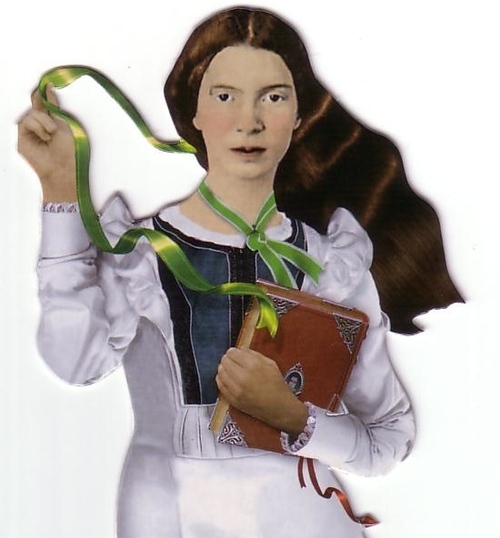
Emily, as she appears on "her" Twitter page
I had a little adolescent crush on plain old Emily Dickinson because I felt sorry for her and imagined that if I had been there in Amherst that I might have been friends with her. I would have gotten her outside into nature and maybe we would have even dated.I also had a crush on glamorous Marilyn Monroe at that time because I also wanted to save her from the world.

In “Taking Off Emily Dickinson’s Clothes,” Billy Collins takes that idea to a playful extreme. His poem is an extended metaphor for reading a Dickinson poem. The undressing is also the uncovering of the poems. FOr example, taking off her "tippet made of tulle” is like opening her book.

First, her tippet made of tulle,
easily lifted off her shoulders and laid
on the back of a wooden chair.

And her bonnet,
the bow undone with a light forward pull.

Then the long white dress, a more
complicated matter with mother-of-pearl
buttons down the back,
so tiny and numerous that it takes forever
before my hands can part the fabric,
like a swimmer’s dividing water,
and slip inside.

Emily's simple poems are "a more complicated matter" when you actually read them. They are not so easy.

Later, I wrote in a notebook
it was like riding a swan into the night,
but, of course, I cannot tell you everything -
the way she closed her eyes to the orchard,
how her hair tumbled free of its pins,
how there were sudden dashes
whenever we spoke.

Emily's habit was to wear a white dress, although she rarely left her family home in Amherst. She was a recluse for the latter part of her life, hiding behind the door when there were visitors. It is assumed that she died a virgin. You can hear Billy Collins read this poem and some of Emily's poetry online and Collins says that "There are many speculations about her...Was she lesbian? Was she celibate? Did she have an affair?" All of that speculation inspired him to write the poem in which he wanted, in a playful way, to put the guessing to rest by undressing her and having sex.

Naomi Shihab Nye
The first time I heard a poem by Naomi Shihab Nye it was her reading "Making a Fist" at a Dodge Poetry Festival. I loved the poem and I had a bit of a crush on the poet too. I bought two of her books because I wanted to read them, but also because I wanted to go up to her and ask her to sign them and say something to her.

In another video, Naomi Shihab Nye talks about how poetry inspires us. She says, "I've carried, for perhaps 30 years, a very tattered piece of notebook paper that says: Philip Levine has described the muse as 'being the portion of the self that largely lives asleep. Being inspired is really being totally alive.' He says that such a state feels a 'little odd' and also 'delicious.' " She also carries with her William Stafford's poem, "The Sky."

Despite my Emily and Naomi crushes, the poem I carry in my wallet is "When You Are Old" by William Butler Yeats. That was one I fell in love with in high school and that I memorized and that reads even better to me as I grow old and gray and full of sleep myself.

For this month's writing prompt, we write about First (Poetic) Love. This can mean the first poem you recall loving or the first poet you loved (in any sense of the word).

Submission Deadline: Wednesday, July 31st

September 11, 2011

The Names by Billy Collins


After the terrorist attacks in New York, Washington, D.C. and Pennsylvania on September 11, 2001, the Poet Laureate then in office, Billy Collins, was asked to write a poem to be read in front of a special joint session of Congress. Collins wrote "The Names, which he read on September 6, 2002.


The Names - Billy Collins

Yesterday, I lay awake in the palm of the night.
A soft rain stole in, unhelped by any breeze,
And when I saw the silver glaze on the windows,
I started with A, with Ackerman, as it happened,
Then Baxter and Calabro,
Davis and Eberling, names falling into place
As droplets fell through the dark.
Names printed on the ceiling of the night.
Names slipping around a watery bend.
Twenty-six willows on the banks of a stream.
In the morning, I walked out barefoot
Among thousands of flowers
Heavy with dew like the eyes of tears,
And each had a name --
Fiori inscribed on a yellow petal
Then Gonzalez and Han, Ishikawa and Jenkins.
Names written in the air
And stitched into the cloth of the day.
A name under a photograph taped to a mailbox.
Monogram on a torn shirt,
I see you spelled out on storefront windows
And on the bright unfurled awnings of this city.
I say the syllables as I turn a corner --
Kelly and Lee,
Medina, Nardella, and O'Connor.
When I peer into the woods,
I see a thick tangle where letters are hidden
As in a puzzle concocted for children.
Parker and Quigley in the twigs of an ash,
Rizzo, Schubert, Torres, and Upton,
Secrets in the boughs of an ancient maple.
Names written in the pale sky.
Names rising in the updraft amid buildings.
Names silent in stone
Or cried out behind a door.
Names blown over the earth and out to sea.
In the evening -- weakening light, the last swallows.
A boy on a lake lifts his oars.
A woman by a window puts a match to a candle,
And the names are outlined on the rose clouds --
Vanacore and Wallace,
(let X stand, if it can, for the ones unfound)
Then Young and Ziminsky, the final jolt of Z.
Names etched on the head of a pin.
One name spanning a bridge, another undergoing a tunnel.
A blue name needled into the skin.
Names of citizens, workers, mothers and fathers,
The bright-eyed daughter, the quick son.
Alphabet of names in a green field.
Names in the small tracks of birds.
Names lifted from a hat
Or balanced on the tip of the tongue.
Names wheeled into the dim warehouse of memory.
So many names, there is barely room on the walls of the heart.

November 22, 2009

Laughing At Poetry


Take a listen to these three poems read by Billy Collins at a Dodge Poetry Festival.

Collins is much loved, and equally criticized, because his poems are accessible - even enjoyable.

These three are not so typical of that.

I particularly like the idea behind "The First Night" which was inspired by this line by Juan Ramón Jiménez:  "The worst thing about death must be the first night."

I can sense the audience wondering if Collins means to be funny with some lines.

I used a few of his poems in a class last week. Students read "The Lanyard" silently first. I heard no laughter. Then I read it - pretty seriously - aloud. I didn't notice any chuckles from the crowd. Then I played an audio file of him reading it with an audience who laughed throughout the poem. The class wasn't rolling in the aisles, but they did laugh, smile and do that little exhalation of breath that shows they "got it."

Did they need permission to laugh? Was the laughter contagious? (Watch a comedy in a full theater and alone in your house for comparison.) Don't they know that poems can be funny?

Next we listened to him read "The Revenant" - a poem in the voice of a dog who was put to sleep to its owner. The laughs came much easier.

I asked them if they thought this poem was like most other poems - "You know, if the poet says it's a dog, it's probably not a dog. What would this poem be saying if he's talking about people?" 

A nice discussion followed. One student said it was similar to what happens in class: "You don't really know us. We don't really know you. We behave the way we are supposed to behave in class, not the way we really want to behave."

"We are all good dogs," I said.

"You got it," he replied.