Showing posts with label audio. Show all posts

August 22, 2018

Listening


Not everyone has the opportunity to attend poetry readings in their local area, but thankfully there are many available online. One source I was browsing and listening to today is the PoetryFoundation.org which has almost 3000 audio files.

I was just browsing and clicking and listening - the audio equivalent of doing that through an anthology.

I will admit to clicking on poems just because a title caught my attention - like 
 
—how her loose curls float 
above each silver fish as she leans in 
to pluck its eyes— 

or listening to "How to Love Bats" by Judith Beveridge:

open your mouth, out will fly names
like Pipistrelle, Desmodus, Tadarida. Then,
listen for a frequency
lower than the seep of water, higher
than an ice planet hibernating
beyond a glacier of Time.

As with browsing a poetry anthology or journal or an open reading, you will encounter poets you have never read before, which is always a good thing. 

I also subscribe/listen to the Poetry Foundation's podcast in which the editors talk to poets published in Poetry magazine and critics to discuss in more detail the issue. Conversations about poems are also something you might get at a reading. For example, I listened to a discussion about Terrance Hayes’s poem “How to Draw a Perfect Circle” and then promptly sat down to write a how-to poem of my own.

Some people say clicking these links leads you into a rabbit hole of more and more clicks. That is sometimes true for me. After listening to the Haye's podcast, I did click deeper into the prose selections on the site and read an essay "Another Life - Terrance Hayes and the poetics of the un-thought" by Joshua Bennett Hayes’s latest collection, American Sonnets for my Past and Future Assassin. It is a collection from the 200 days between President Trump’s election and the early summer of 2017. He wrote 70 sonnets which come from that time but are more about what led up to Trump's election.

After that though, I needed to return to some poetry to cleanse my poetry palate - perhaps William Blake's "The Ecchoing Green."  After too much reality, Blake sounds so happy that we might view him as naive. That would be a mistake.

...laugh away care,
Sitting under the oak,
Among the old folk, 
They laugh at our play, 
And soon they all say.
‘Such, such were the joys. 
When we all girls & boys, 
In our youth-time were seen, 
On the Ecchoing Green...’

January 18, 2013

Poems Out Loud

I enjoy hearing poems read aloud, but not everyone can get to readings in their area, especially ones by well-known poets. And, of course, we only have authors recorded reading their poetry going back about 100 years.

Although the site launched in April 2009, I only recently discovered Poems Out Loud.  It features recorded readings by well-known and award-winning poets, columns and general poetry news.

The name of the site was inspired by the anthology edited by Robert Pinsky called Essential Pleasures: A New Anthology of Poems to Read Aloud and the site is sponsored by that book's publisher, W. W. Norton & Company

Portrait of a Woman by Bartolomeo Veneto,
traditionally assumed to be Lucrezia Borgia.
It seems that the site stopped adding new content back in 2011, but in the archive and on others like are plenty of opportunities to discover poets and poems.

Recently, someone asked a question on Facebook about the poet Walter Savage Landor. I confess that I had never heard of him.

A quick search turned up lots of links, including one to his poem "On Lucretia Borgia's Hair" read by Robert Pinsky on the Poems Out Loud site.

I have heard of Lucretia (AKA Lucrezia) Borgia and the 2011 TV series, The Borgias, brought that family back into discussions.

The family came to epitomize Machiavellian politics and sexual corruption in the time of the Renaissance Papacy. Lucrezia is seen as a femme fatale in many artworks, novels, and films.

So, I clicked over to the poem.

I like the short text attached to the audio:


"The story is that the poet Leigh Hunt showed Landor a long, blonde strand of hair—said to be stolen from an Italian museum by Byron—of the glamorous, powerful, nefarious Lucretia Borgia. (It is tempting to think that the Italians who ran the museum were accustomed to English gentlemen stealing the purported hair several times a month, and that the museum replaced it each time from an ample supply.)

Landor, a great master of the epigram form, composed many dazzling poems of as few as two lines. In this one, the reach of the grammer across the rhyme-word “august” is expressive, a kind of flourish or fanfare preparing the way for the curt “Now thou’rt dust.” Different published versions have the final word as “unfold” and “enfold”—an interesting small ambiguity in itself, the hair as keeping the history it represents either unfolded to us, or enfolded away from us."

The poem is only four lines, and honestly, not one I would probably read if I stumbled upon it, brief as it is. But hearing it read, it worked for me.

Borgia, thou once wert almost too august
And high for adoration; now thou’rt dust.
All that remains of thee these plaits unfold,
Calm hair, meandering with pellucid gold.

Such is the power of poetry read aloud.


For more poetry read aloud, check out these sites:


November 4, 2012

Rilke and a Wild Love for the World

From On Being comes a program on A Wild Love For the World with Joanna Macy, a Buddhist philosopher of ecology and a translator of the poetry of Rainer Maria Rilke. 

One of the most beloved poets of the twentieth century, Rilke is widely celebrated for his depth of insight and timeless relevance. He has influenced generations of writers with his classic Letters to a Young Poet, and his reflections on the divine and our place in the world are disarmingly profound. Many readers find Rilke a trusted guide amid the bustle of our daily experience, reflecting on such themes as impermanence, the beauty of creation, the voice of God, and the importance of solitude.

listen: » stream online | » download mp3
subscribe: » iTunes | » radio stations


Recommended reading: A Year with Rilke: Daily Readings from the Best of Rainer Maria Rilke as translated by Joanna Macy and Anita Barrows.


October 2, 2012

Poetry Magazine Podcast

Each month, the editors of Poetry magazine, Christian Wiman and Don Share, talk about the new issue and talk to poets and critics, discuss issues, and share poems (often read by the posts) from the issue.

This month The Effect of Small Things with poems from Marie Ponsot, Laura Kasischke, Todd Boss, Campbell McGrath, and Kathleen Jamie; plus C.K. Williams on the foreboding of environmental doom.

October 2, 2011

Banned Poems

We just closed Banned Books Week when libraries and bookstores celebrate freadom.

There are banned books read aloud in the Virtual Read-Out at YouTube.

You might also consider banned poems. Poetry.about.com suggested four:
  1. The opening lines of Allen Ginsberg’s “Howl” from the Fayetteville Library
  2. Heinrich Heine poems (read here by a professor of German at the University of Texas)
  3. To the Rich Givers” and “City of Ships” from Walt Whitman’s Leaves of Grass
  4. Shel Silverstein’s “If You Have to Dry the Dishes

January 4, 2011

W. S. Merwin on Poetry

Listen to The Leonard Lopate Show with W. S. Merwin on Poetry (WNYC)

Poet W. S. Merwin talks about his collection of poems, The Shadow of Sirius, which earned him his second Pulitzer Prize. The poems focus on subjects from childhood and memory to age and, of course, dogs.

The Shadow of Sirius

October 15, 2010

Patterns of Poetry Podcast Series

I came across this nice series of podcasts (audio files) on "Patterns of Poetry" series. They are short (about 5 minutes each) discussions of poetic techniques. It's not the "how to find them in a poem" exercise that you may have had to do in some class, but more on how to use them in your writing. (Though I suppose it also accomplishes the "how to find them" mission too.)

They are presented by the English Department of St Columba's College, Whitechurch, Dublin, Ireland on their blog site.

The first one I stumbled upon through a search is on simile, and looks at how Sylvia Plath uses it in her poem 'Morning Song'.

The series (so far):

1: Introduction
2: Titles - illustrated with 'The Fish' by Elizabeth Bishop, and 'Out, Out' by Robert Frost.
3: Alliteration - 'The Windhover' by Gerard Manley Hopkins.
4: Personification - "Shancoduff' by Patrick Kavanagh.
5: Symbols - 'The Stare's Nest by my Window' by W.B. Yeats.
6. Onomatopoeia - 'A Constable Calls' and 'Sunlight' by Seamus Heaney.
7. Cliché - Sonnet 130 by Shakespeare, and 'Valentine' by Carol Ann Duffy.
8. Simile - Morning Song' by Sylvia Plath.

They have now also put together one handy compilation of the first eight Patterns of Poetry talks, if you want all the lessons at once.

They are available for play from your browser and also available using iTunes which is useful if you want to "archive" a copy for later.

MORE
Patterns of Poetry: An Encyclopedia of Forms
Patterns in Poetry: Recognizing and Analyzing Poetic Form and Meter
Poetry Patterns & Themes (for younger readers)

March 7, 2010

Poetic License will be released on April 2nd, in celebration of National Poetry Month. It is GPR Records’ first release and features 100 poems read by 100 performers of stage and screen.

Here's the teaser: Jason Alexander reads Robinson's "Richard Cory."


July 22, 2008

Open Door Poetry

Borders Books has a portion of their website devoted to Open Door Poetry. It's a project to move poetry off the page and into video and audio. The site includes Billy Collins, Paul Muldoon, Kim Addonizio, Donald Hall, Franz Wright, Jorie Graham and others reading their poems and talking about poetry

They also are sponsoring the BORDERS Open-Door Poetry Contest which will be judged by Billy Collins, former U.S. Poet Laureate.

The second Borders Open-Door Poetry Contest is open for submissions through July. The top 10 (5 adult, 5 student) poems submitted, in text or in video, will be published on their site alongside a poem by Billy Collins in an upcoming episode. Billy will also read and give feedback on the poems he selects as best. All finalists’ poems will be considered for publication in our annual “Best of” book, which will highlight the many talented poets in the Borders community.

For full information and a submission form, go to bordersmedia.com/odp/

June 23, 2007

Tales of Stubborn Children


For July, we are looking at Peter Murphy's poem "The Stubborn Child" from his book Stubborn Child which was a finalist for the 2006 Paterson Poetry Prize. The poem has its inspiration in a fairy tale of the same name from the Brothers Grimm.

I never liked fairy tales as a kid. They scared me. I don't like them much now either. I still find them creepy, and I never felt they were stories well told. Someone gave my son a book of Grimm's tales when he was very small and I read a few looking for ones I might read him at night.

That was one of the few books in my life that I threw out. I didn't even want to give it to a used book sale.

Try reading this one to a kid before he goes to sleep. This is the Grimm Brothers' version of "The Stubborn Child."
Once upon a time there was a stubborn child who never did what his mother told him to do. The dear Lord, therefore, did not look kindly upon him and let him become sick.

No doctor could cure him, and in a short time, he lay on his deathbed.

After he was lowered into his grave and was covered over with earth, one of his little arms suddenly emerged and reached up into the air. They pushed it back down and covered the earth with fresh earth, but that did not help. The little arm kept popping out.

So the child’s mother had to go to the grave herself and smack the little arm with a switch. After she had done that, the arm withdrew, and then, for the first time, the child had peace beneath the earth.

from The Complete Fairy Tales of the Brothers Grimm, Jack Zipes, translator, 1987
The puns on Grimm and grim are just too easy.

The Brothers Grimm began collecting folk tales around 1807 and produced a manuscript collection of several dozen tales, which they had recorded by inviting storytellers to their home and transcribing what they heard. It wasn't an academic undertaking and there has been some highly critical re-assessments about their sources and methods. That doesn't affect us in our reading. Actually, I like that their collecting was not so different from someone today collecting the campfire horror stories of kids. That's what some of the Grimm's tales seem like to me anyway.

Sometimes the title of this particular little tale is translated as the "willful" child. I realize that willful is basically the same obstinate child, but I think the Murphy poem might be the willful rather than just the stubborn child.

In his version, the child emerges from the grave, lives on and has a daughter to pray over and protect. He resurrects the willful child who is more than stubborn, and who still loves his mother who he knows loves him.

Of Peter's book, Stephen Dunn has said: "Stubborn Child unflinchingly enacts and examines his own painful childhood, then moves to the often damaged and compromised lives of the high school students he teaches. Like the best delineators of unhappiness, he also brings humor to his task, the dark humor of a survivor. And indeed this is a survivor's book, both transforming and transformative — in the end, Murphy the man able to love and affirm, Murphy the poet able to raise the unruly and the tawdry to the level of art."

Transformation is a key word for this prompt.

In an email to me about the poem's creation, Peter said:
"I had a deprived childhood in that I never read a fairy tale till I was in my late 30's, and when I did, I fell in love with the surreal, violent and familiar families portrayed by the Brothers Grimm. This was not Disney. This was Cinderella's evil stepsisters lopping off their heels to squeeze their fat feet into that impossibly tight glass slipper. Perverse entertainment till I came across "The Stubborn Child," perhaps the shortest Grimm tale. "Damn," I thought. "That's my childhood!" And it was, so I proceeded to write 40 or 50 drafts trying to get it right. Somewhere in this frenzy, I realized my own stubborn child was asleep in the next room, and that's when the poem found its ending and its shape, the transformation of the speaker from abused child to wounded father, trying, perhaps too hard, not to repeat the mistakes made on him.

Many stubborn children of all ages inhabit my book Stubborn Child as the poems branch away from my childhood and adolescence to the students who taught me for 30 years in Atlantic City, to other stubborn children, friends and family, who ghost the adult years of my life."
Murphy is not the first to try this self-imposed writing prompt of starting with a Grimm fairy tale. One popular anthology, The Poets' Grimm: 20th Century Poems from Grimm Fairy Tales, is an entire collection of these poems. The poets use the themes, motifs, and characters from Grimm. (poets include Anne Sexton, Carol Ann Duffy, Lucille Clifton, Galway Kinnell, Denise Duhamel, Randall Jarrell, Jane Yolen and Allen Tate. (Here is the table of contents)

Our prompt for this month is to take the story, characters, title, theme (as much as you need) from one of the Brothers Grimm's fairy tales and transform it for your own purposes. I would not be opposed to other fairy tales, but there's a lot of material in those strange tales from Jacob & Wilhelm.

If you want to try the prompt yourself, you can check a book of the tales, or Google a Grimm title that you know, but a good site to start with is SurLaLuneFairyTales.com. It includes tales that we are all familiar with like "Goldilocks and the 3 Bears", and ones I had never read, like "The Girl Without Hands". The tales there are all annotated, so you get some good background information that might well serve as your inspiration. There's a list of the Grimm tales on Wikipedia too.


Here are 2 links where you can read several other poems by Peter Murphy, and hear him reading online.


May 6, 2007

Before I start knocking people's hats off


It's getting that time of the year when these words from Melville's Moby Dick come into my head...
"Whenever I find myself growing grim about the mouth; whenever it is a damp, drizzly November in my soul; whenever I find myself involuntarily pausing before coffin warehouses, and bringing up the rear of every funeral I meet; and especially whenever my hypos get such an upper hand of me, that it requires a strong moral principle to prevent me from deliberately stepping into the street, and methodically knocking people's hats off--then, I account it high time to get to sea as soon as I can. This is my substitute for pistol and ball."
I reread at least portions of Moby Dick every year. Been doing that probably since I first read the Classics Illustrated comic version ( as series that sent me on to many classics in the library) I always find something I missed. But that passage hits me when the weather in New Jersey finally warms up to the point that I think I can catch my beloved Jersey Shore on a breeze and I feel the need to drive south and just get my feet in the sand and watch the waves of the Atlantic Ocean.


If you haven't read Moby Dick (ever or lately), you should give it a try. You can read it online at Project Guttenberg - though I can't really imagine anyone being able to do that, it's a great way to look at sections of the book.

If you don't want to pay for an audiobook version, you can also get download the free Librivox version online.

And if all else fails, at least watch the John Huston movie version with a script by Ray Bradbury instead of knocking off hats or the pistol & ball.

April 22, 2007

Wallace Stevens Audio Downloads

Just a brief post about some poems by Wallace Stevens which can be downloaded as podcasts (iTunes).

You can hear many of the most popular of his poems (Anecdote of the Jar, The Emperor of Ice Cream, Peter Quince at the Clavier, Sunday Morning, Thirteen Ways of Looking at a Blackbird).

They were recorded for LibriVox by Alan Drake and all the poems are in the public domain.

And you may want to listen to another related podcast featuring the literary critic Harold Bloom from his Yale seminar on "The Art of Reading a Poem" (listen in iTunes or get the mp3). Bloom is walking students through his reading of Stevens' "Parts of a World."

April 15, 2007

Rubaiyat and Rumi

A public radio program that I always enjoy listening to, Speaking of Faith, did a program on Rumi last month thoat inspired me to move up a prompt I wanted to use about Rumi to April.

If you are interested in how mystic and poet Rumi has shaped Muslims around the world and more about the mystical tradition of Sufism, you should listen to it. You can (free) download an mp3 audio file of the program or listen to it now using RealAudio or, better yet, subscribe to the podcast of this program. The program is far more than about "religion" and the archive has programs on Einstein, the environment, politics and other issues with the thread of faith running through them. End of endorsement.

On the Poets Online main site, we looked at some Rumi poems that are grouped under the title (given to them by American translator Coleman Barks) of "Spring Giddiness."

I thought that was appropriate to April (which is also National Poetry Month here in America).

I mentioned that I'm no qualified judge of the translation, but I suspect them to be in the spirit (rather than to the word) of the originals. I have heard Coleman Barks read and sing them at several Geraldine R. Dodge Poetry Festivals, so in some strange way I hear Rumi as having a Tennessee accent.

Some of those model poems are quatrains. In Persian it would be rubaiyat (meaning 'four' or "quatrains" in the Persian language the singular being ruba'i or rubai). In their true form the rhyme scheme would be AABA (lines lines 1, 2 and 4 rhyming) but Barks has not attempted to maintain the rhyme in those translations.

That is a verse form best known (to English speakers) for Edward FitzGerald's translation of the collection of Persian verses known as the Rubaiyat of Omar Khayyam. Here's a sample quatrain:

VII
Come, fill the Cup, and in the fire of Spring
Your Winter-garment of Repentance fling:
The Bird of Time has but a little way
To flutter--and the Bird is on the Wing.

In longer poems built in that rubaiyat rhyme scheme, sometimes it is extended so that the unrhymed line of a stanza becomes the rhyme for the following stanza. Then we have AABA BBCB CCDC etc. This is called "interlocking rubaiyat". You might even create a full circle by linking the unrhymed line of the final stanza back to the first stanza.

If this all sounds very foreign to you, look at the interlocking rubaiyat in "Stopping by Woods on a Snowy Evening" by Robert Frost. (Here's a look at that poem in Frost's own handwritten manuscript. )

Our writing prompt this month starts with the uncommon theme of seasonal change and adds the rubaiyat form. Select any change of season, and use the rhyming quatrains of the rubaiyat (any number of quatrains you choose).

It would good if your poem could capture some of the joy that Rumi's poetry sings too.

There are many editions of this best-selling poet available. My suggestion for a starting place is either The Essential Rumi or The Illuminated Rumi both translated by Barks.

If you want to read more of Rumi online, a search will provide many other websites of his poetry - here's one to get started with 4 new translations by Coleman Barks.

May 22, 2006

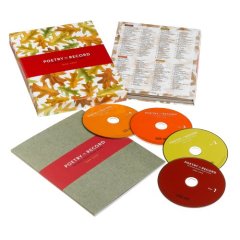
Poetry On Record CD set


I heard Billy Collins recently talking about Poetry On Record: 98 Poets Read Their Work (1888-2006). It's a collection of poems read by the people who wrote them, from early sound recording to the current day. I didn't even know there were recordings of Walt Whitman reading!

It contains four CDs and a book. They categorize the poems -Romanticism (Dylan Thomas) to Modernism (T.S. Eliot), Harlem Renaissance (Langston Hughes) to Black Arts (Amiri Baraka), from rhyme and meter (Alfred, Lord Tennyson) to free verse (Adrienne Rich) etc. - but that's so "textbook." I would hit the random button on the CD player.

It's interesting to hear how the poets intended their poems to be read aloud - but not all poets are good readers (no names from me), even of their own work.

It would be a good classroom/library purchase. It might be a bit pricey for individuals. You can listen to samples at Amazon.com.

You can listen to Billy Collins talk about this set on NPR's absolutely great program, Fresh Air.

If you get the set or if you just listen to the Fresh Air program or even just the Amazon samples, I'd be curious to know your reactions to the readings. Post a comment below (don't be afraid - you can be totally anonymous)

I liked the readings by William Carlos Williams of "The Red Wheelbarrow" (not the voice I expected and so brief that it begs multiple listenings), "Those Winter Sundays" by Robert Hayden is a great poem well read, and "After Making Love We Hear Footsteps" by Galway Kinnell which I have heard him read and I like having it captured.