Showing posts with label Robert Frost. Show all posts

November 5, 2026

Prompt: The Color of a Poem


"The Japanese have this idea of the color of a poem. Bashō talks often about the colors of poems. I think what he means by that is the moods and the tones, the sort of aesthetic principles of them. And I think that you can’t just sit down and write that, you have to really embody it. That’s the hardest part: figuring out what tone or what mood you’re writing towards. A lot of this has to do with the themes you’re working with, or the mode that you want to present. That takes sometimes weeks, months — years, really — to develop before language comes to fruition. Language has its own register, like music, and depending on the “octave” or the tone that you’re using, there are connotations, there are meanings, implicit in tone."  -  Ocean Vuong

The idea of a poem's color can be interpreted in several ways. The most direct meaning refers to the literal or suggested colors within the poem's descriptions. It can use descriptive words (e.g., crimson, slate, golden, shadowed) that map out a vivid visual scene.

But when people speak of the "color" of a poem, they are usually referring to its overall tone, atmosphere, imagery, and emotional resonance. A painting uses a palette of colors to set a mood; a poem uses language, sound, and visual imagery to paint a specific feeling or atmosphere in the reader's mind.

Sensory details that evoke a visual tone. A poem filled with descriptions of rain, wet cobblestones, and fog carries a "cool gray" or "blue" color profile, whereas a poem describing dried wheat, baking sun, and dust carries a "warm ochre" or "golden" color profile.

In the short poem "Nothing Gold Can Stay" by Robert Frost, he plays with expectation. He opens by describing nature's earliest spring shoots not as green, but as gold. Gold represents early promise, preciousness, and beauty, which quickly fades as leaves mature into ordinary green. Color here acts as a clock, measuring the fleeting nature of perfection.

"The Nomenclature of Color" by Richard Jones contains a palette of Nile blue, absinthe green, dragon's-blood red, iron gray, and Venetian pink and functions almost like a painter's color card. Jones pairs specific historical pigment names with personal imagery, such as connecting "dragon's-blood red: My mother's ark sighs,"and "absinthe green: Laura’s eyes." Exact color labels here carry emotional histories and sensory associations.

Color is deeply tied to human emotion and psychology. The "color" of a poem often serves as shorthand for its mood. Dark, somber colors (Black, Charcoal, Dark Violet) can evoke grief, mystery, melancholy, or solitude. Bright, warm colors (Yellow, Orange, Gold) can evoke joy, vitality, nostalgia, or illumination. Cool, calm colors (Soft Blue, Sage, White) can evoke serenity, distance, stillness, or contemplation. Of course, a poet may also use these in unexpected, even contrary ways, as Frost did.

The symbolic use of color in poetry is as old as recorded poetry. Green for youth and rebirth and rust or brown for aging and decay are so common that they may even feel clichéd.

Our model poem this month is "Instructions on Not Giving Up" by Ada Limón, which has a palette of deep greens, pale spring hues, and dark chartreuse. Limón focuses on the arrival of green leaves in early spring. Rather than using green as a cliché for rebirth, the poem treats the heavy green foliage as a physical weight—a thick, unapologetic presence of life returning after winter. The shifting shades of green track an internal emotional movement from winter weariness to relentless persistence.


For our December issue, we are looking for poems that use colors not only as content but to create a tone for the poem. 

SUBMISSION DEADLINE: November 30


Ada Limón was born on March 28, 1976, in Sonoma, California. In 2001, she earned an MFA from New York University's Creative Writing Program. Her first poetry collection, Lucky Wreck was the winner of the 2005 Autumn House Poetry Prize, selected by Jean Valentine. The Carrying won the National Book Critics Circle Award, and her 2015 collection Bright Dead Things was a finalist for the National Book Award, the National Book Critics Circle Award, and the Kingsley Tufts Poetry Award; Limón is also the recipient of a MacArthur “Genius” Fellowship. In 2022, Limón was appointed United States poet laureate and, in 2023, was appointed to serve a second two-year term. Limón is currently Distinguished Professor of Poetry at Texas State University. 


Follow this blog for all things poetry.
To see our past prompts and more than 300 issues,
visit our website at poetsonline.org

June 22, 2026

Frost and Auden on Artificial Intelligence

Before you start typing a comment here about how Robert Frost and W.H. Auden had no knowledge of artificial intelligence, let me explain where I'm going here.

I often use AI to create images to illustrate my (too) many blog posts. I was creating an image of myself surrounded by poetry based on what a chatbot already knew about me from prior queries. (You can see the result here.)


I can imagine many classic and modern poets sitting at a computer. The computer, the Internet, and certainly AI would be something from science fiction or fantasy, but being inquisitive people, I have to imagine they would want to experiment. They would certainly have opinions about all of it. So I proposed a kind of thought experiment to several chatbots about poets and AI, and specifically these two poets.

Robert Frost and W. H. Auden likely would have responded to AI very differently in tone, but with overlapping concerns about language, humanity, and authenticity.

Frost would be suspicious of abstraction and more interested in the human voice. I think he distrusted systems that moved people away from lived experience and direct human encounter. He valued some ambiguity and the “sound of sense” in language.

Though he might have admired AI’s technical cleverness, he would reject poetry produced without genuine experience behind it. Frost often emphasized that poetry comes from:

AI suggests to me that Frost might have asked, "Can language still be poetry if nobody has lived it?"

Auden might be intellectually fascinated by AI but morally cautious. He was interested in psychology, science, systems of thought, and modernity’s strange transformations and how language shapes society and consciousness.

But Auden worried about propaganda, impersonality, bureaucratic thinking, and probably would not be a supporter of any misuse of technology. Perhaps, he would see AI as an extraordinary linguistic tool, and also a dangerous amplifier of mass conformity or emotional detachment.

Auden wrote, “Poetry makes nothing happen,” but he did not mean that poetry is powerless. He meant poetry changes inner life indirectly, through consciousness and moral perception. He likely would have questioned whether AI can truly participate in moral experience or only imitate its language.

If the two sat down for a conversation and played with AI together, they might have some common ground. They would probably resist the idea that intelligence is merely information processing. Human meaning comes from mortality and embodiment, and art emerges from uncertainty and lived contradiction. The language of poetry matters because people risk themselves in it.

Like many people today, they might warn that AI could encourage people to substitute fluent expression for genuine thought.

They just might concede that much human language is already formulaic, imitative, and patterned. But poetry, for them, was valuable precisely because it resisted that drift into automatic speech.


Follow this blog for all things poetry.
To see our past prompts and more than 300 issues,
visit our website at poetsonline.org

December 20, 2025

On That Darkest Evening of the Year


A Winter Solstice at Stonehenge

Tomorrow is the Winter Solstice, marking the shortest day and longest night of the year, which is a profound and ancient observation and is often used in poetry. It represents darkness, reflection, and the promise of the returning light.

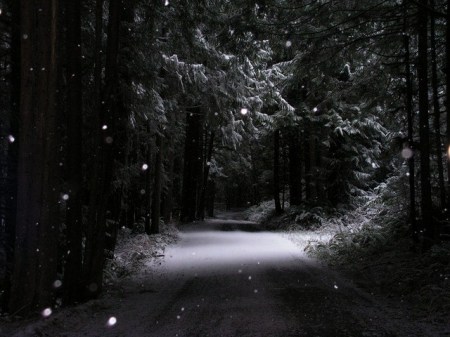
I've written before in detail about Robert Frost's "Stopping by Woods on a Snowy Evening." It is one of the most famous poems of the winter season, perfectly capturing the reflective, quiet, and even dangerous allure of the solstice darkness. It is the poem that Frost said was his "best bid for remembrance" and it is one that almost every American student encounters.

"My little horse must think it queer
To stop without a farmhouse near.
Between the woods and frozen lake
The darkest evening of the year."

It is often read as a poem about the tension between duty and life and the call of rest and the oblivion of death. My interpretation is more on the duty and life side, but you will find those who say death and even contemplating suicide are in the mix. Frost would disagree.

Interestingly, he wrote the poem on a June day.

Another Frost poem is "An Old Man's Winter Night" which focuses on isolation and quiet contemplation in the rural winter.

Here are some other poems. excerpted, which are about this time of winter.

"The Shortest Day" by Susan Cooper is a -oftquoted poem about the Winter Solstice, often read at celebrations of the day. Cooper is known more for her fantasy series The Dark Is Rising, which features the solstice as a central mystical moment.

So the Shortest Day came and the year died
And everywhere down the centuries of the snow-white world
Came people singing, dancing,
To drive the dark away.
They lighted candles in the winter trees;
They hung their homes with evergreen;
They burned beseeching fires all night long
To keep the year alive...


In "Little Gidding,"from The Four Quartets by T.S. Eliot, there is the image of the deepest winter and the unique light it holds. 

Midwinter spring is its own season
Sempiternal though sodden towards sundown,
Suspended in time, between pole and tropic.
When the short day is brightest, with frost and fire,
The brief sun flames the ice, on pond and ditches,
In windless cold that is the heart's heat,
Reflecting in a watery mirror
A glare that is blindness in the early afternoon.


Though "To Know the Dark" by Wendell Berry is a 4-line poem that doesn't name the solstice, its central theme speaks directly to the experience of the longest night and learning to embrace the necessary period of deep darkness and rest.

To go in the dark with a light is to know the light.
To know the dark, go dark. Go without sight,
and find that the dark, too, blooms and sings,
and is traveled by dark feet and dark wings.

"A Child's Christmas in Wales" by Dylan Thomas is a longer prose poem focused on Christmas.

All the Christmases roll down towards the two-tongued sea, like a cold and headlong moon bundling down the sky that was our street; and they stop at the rim of the ice-edged, fish-freezing waves, and I plunge my hands in the snow and bring out whatever I can find.

"In the Bleak Midwinter" (AKA "A Christmas Carol") by Christina Rossetti is a poem later set to music as a Christmas carol, which captures the stark cold of the season.

In the bleak midwinter, frosty wind made moan,
Earth stood hard as iron, water like a stone;
Snow had fallen, snow on snow, snow on snow,
In the bleak midwinter, long ago.


Follow this blog for all things poetry.
To see our past prompts and more than 300 issues,
visit our website at poetsonline.org

September 25, 2025

Who Was Robert Frost?

By the middle of the twentieth century, Robert Frost was the best-loved poet in America. He was our nation’s bard, simple and sincere, accompanying us on wooded roads and articulating our hopes and fears.

Who is your Robert Frost? Homespun wise poet sage? Sharp-witted trickster? A poet whose simplicity hides startling depth? Cranky old poet?

I read Maggie Doherty’s piece, titled “The Many Guises of Robert Frost," in The New Yorker, which explores how the poet constructed an image of simplicity. That simplicity was part of his public persona and also his poetic style, but he was more complex and often contradictory. Doherty is reviewing Adam Plunkett's 2025 book Love and Need: The Life of Robert Frost’s Poetry.

Early on, I considered Frost to be the persona of a rural, unassuming farmer-poet. I saw him like the photo on the cover of Plunkett's book. I liked that Frost was not like the literary elites in Boston or London. Later, I found that he was highly learned and deeply engaged with the literary tradition. A mask.

It seems like everyone had to read "Stopping by Woods on a Snowy Evening" and "The Road Not Taken" in high school. You could read them in a sincere or ironic way. I heard from teachers interpretations that ranged from celebratory to somber or even nihilistic. Was he stopping in the woods and considering suicide? Frost would shake off such interpretations. 

Frost embraced ambiguity. In a 1960 interview with The Paris Review, he described himself as liking “to fool… to be mischievous,” operating through “suggestiveness and double entendre.” He often hinted at multiple meanings rather than stating anything outright.

He wasn't a modernist in rebellion like some contemporaries. If you were writing a serious college paper on him, you could get into how he reworked canonical forms and references from Shakespeare’s “Carpe Diem” songs to Coleridge. He adapted rather than invented.

Robert Frost’s first four published books of verse, established his reputation as a preeminent American poet. A Boy’s Will (1913) is full of New England themes, traditional meters with colloquial language. next was North of Boston (1914), includes “Mending Wall,” and the rural scenes have deeper philosophical meanings. His third book, Mountain Interval (1916), contains “The Road Not Taken.” The fourth book, New Hampshire (1923), earned him his first Pulitzer Prize and includes “Stopping by Woods on a Snowy Evening.”

Frost’s late life was marked by grief, strained family ties, allegations of infidelity, and an abrasive public image that contrasted sharply with his genteel public persona.

It seems that Frost viewed his contradictions not as flaws but as essential to his poetic vitality. He credited “animus”—inner drive and conflict—as a key source of his creativity and was pleased when T. S. Eliot praised him as the “most eminent… Anglo-American poet now living.”


Follow this blog for all things poetry.
To see our past prompts and more than 300 issues,
visit our website at poetsonline.org

November 4, 2024

Prompt: Line Breaks


I was reading an anthology of short poems and was paying attention not only to their brevity but to their line breaks.

In Rae Armantrout’s poem “Unbidden," her use of short lines in conjunction with enjambment contribute to a sense of disjointedness.

The ghosts swarm
They speak as one
person. Each
loves you. Each
has left something
undone

Line breaks are one of the main things that separate prose and poetry. They give poems their slim who-cares-about-margins appearance.(We will pass on talking about prose poems for the moment.)

Enjambment is where the poet deliberately breaks a sentence across multiple lines before its natural finishing point. End-stops are the opposite of enjambed lines in that an end-stopped line contains complete thoughts, phrases, or sentences.You can usually tell a poetic line is end-stopped if there is punctuation at the end. The punctuation could be internal (e.g. comma, semi-colon, colon, em dashes), or external (e.g. period, exclamation mark, question mark).These lines give the reader logical moments to pause at the line break. It is used in many traditional poems and it supports poetic forms using rhyme and meter.

William Carlos Williams' "The Red Wheelbarrow" is a modernist poem orriginally published without a title. It was designated "XXII" in Williams' 1923 book Spring and All, a hybrid collection that incorporated alternating selections of free verse and prose

so much depends
upon

a red wheel
barrow

glazed with rain
water

beside the white
chickens

Notice that to maintain his very short, two-line stanzas Williams breaks two words that could be together - wheelbarrow and rainwater.

Line breaks create white space in the text and are one way that poets can exercise a greater degree of control over the speed and rhythm that you read. It is unlike our everyday language and unlike prose literature.

Personally, I find it annoying when poems have breaks that seem to be used simply to keep line lengths the same - almost like a margin. It is possible a poet will do that in order to create a shape for the poem. There are good reasons to break a line. There is no rule book but consideration should be given to the first and last words: Avoid having weak words at the beginning or end of lines. For example, action verbs and nouns tend to be strong.

"Fire and Ice" by Robert Frost has strong end words: fire, ice, desire,twice, hate, great, suffice. (Although I find that breaking a line on "ice" - "To say that for destruction ice / Is also great" - seems more in service of the rhyme than the line break. Sorry, Robert).

"Dreams" by Langston Hughes is a good example of end-stopped lines that each contain a complete thoughts, phrases or sentences.

Our two model poems by two very different poets are both 9 lines / 8 line breaks. This month's call for submissions is for a 9-line poem on any topic of your choosing. Stanza breaks are another consideration - one stanza, 4X2, 3X3 or any combination. The key here is for you (and the editors) to pay special attention this month to line breaks. Whether enjambed or end-stopped, each of your 8 breaks should be logical and pushing us to read in a particular way with a particular attention. Sounds easy. It is not.


Follow this blog for all things poetry.
To see our past prompts and more than 300 issues,
visit our website at poetsonline.org

December 13, 2023

Robert Frost's Christmas Cards


Our call for submissions for the January 2024 issue is about "personal" holidays which do not get on official calendars and probably don't get you a day off from work or cards and gifts. But I thought of how Robert Frost sent out Christmas poem “cards” from 1929 to 1962.

Each year, Frost would select a poem and often write an original piece for the occasion. he sent them to some friends and loved ones. Later they went out to his publisher’s friends and loved ones. If you were lucky enough to be on that list and still have them, they are collectors’ items.

They began as just his way to honor the winter season with a poem. One poem used was "Christmas Trees." (an excerpt below)

...He proved to be the city come again 
To look for something it had left behind   
And could not do without and keep its Christmas. 
He asked if I would sell my Christmas trees; 
My woods—the young fir balsams like a place 
Where houses all are churches and have spires. 
I hadn't thought of them as Christmas trees.   
I doubt if I was tempted for a moment 
To sell them off their feet to go in cars 
And leave the slope behind the house all bare, 
Where the sun shines now no warmer than the moon...


Frost, 1929 (by Doris Ulmann, national Portrait Gallery)

Joseph Blumenthal headed Spiral Press during those years. Without Frost's knowledge, while working on an edition of Frost’s poetry in 1929, he printed 250 copies for friends and colleagues of “Christmas Trees.” When the poet saw the publication, his first response was not to sue him but to request a few copies to send out to his own family members. And so, the annual tradition was born.

The last Christmas mailing contained "The Prophets Really Prophesy as Mystics, the Commentators Merely by Statistics” which went out with 16,555 copies. 

The collection would feature other classic poems by Frost, including “Birches,” “A Boy’s Will,” and “The Wood-Pile”

"Christmas Trees" is no Hallmark greeting card, but it ends with this Christmas wish:   

A thousand Christmas trees I didn’t know I had!
Worth three cents more to give away than sell,
As may be shown by a simple calculation.
Too bad I couldn’t lay one in a letter.
I can’t help wishing I could send you one,
In wishing you here with a Merry Christmas.

More about the cards at poets.org/text/robert-frosts-christmas-cards


Follow this blog for all things poetry.
To see our past prompts and more than 300 issues,
visit our website at poetsonline.org

March 21, 2021

Spring and All


Spring slipped into place yesterday morning. Did you feel it? Perhaps not, since there is a good chance that where you are now doesn't look or feel like spring. In my neighborhood, it still looks like winter but for a few buds on trees or shoots poking out of the muddy ground. Of course, you might be south of me and it looks like summer, or far north where winter still reigns. Still, the universe tells us that in the Northern Hemisphere will begin on March 20 and ends on June 20 and by that last day of spring, it will probably look and feel like summer here. 

In William Carlos Williams' poem, "Spring and All," the opening is rather ominous. 

By the road to the contagious hospital
under the surge of the blue
mottled clouds driven from the
northeast—a cold wind.

Williams wrote the poem not long after T. S. Eliot's "The Waste Land," was published. Eliot's poem also opens with a not-so-favorable view of early spring.

April is the cruellest month, breeding
Lilacs out of the dead land, mixing
Memory and desire, stirring
Dull roots with spring rain.

Eliot goes on to use an image of winter that is not typical: 

Winter kept us warm, covering
Earth in forgetful snow, feeding
A little life with dried tubers.

When we brought my first son home from the hospital, it was the first day of spring and the daffodils, crocuses, and wood hyacinths were covered with snow.  Spring is a fickled season.

In literature and mythology, spring usually concerns themes of rebirth and renewal with symbols from the season. Spring also refers to love, hope, youth and growth. The seasonal symbolism for this period may also allude to religious celebrations such as Passover or Easter.

The Vernal Equinox: "vernal" translates to “new” or “fresh” and equinox comes from the Latin aequus (equal) and nox (night). The time of daylight between sunrise and sunset has been growing slightly longer each day since the Winter Solstice in December. Of course, we messed with the celestial plan last weekend with Daylight Saving Time.

I still try to mark the vernal equinox as it has been seen for centuries as a turning point. It is not the only turning point, but daylight does defeat darkness, and that is a reason to celebrate.

Soon, I hope the only things like snowfall here will be the storm of blossoms from cherry and other spring-blooming trees.


A version of this post first appeared at Weekends in Paradelle.  


Visit our website at poetsonline.org

March 29, 2020

You Stay Home Too


I have been exchanging poems with friends during this "shelter at home" time. We use email not some video programs, like Zoom, because these are not workshops. We have a prompt. We write on our own. We share the poems and comment on them.

The inbox got a bit full, which was why I suggested and then posted here a prompt where anyone could post their poem response as a comment. I hope some of you will participate.

One of my poet friends sent this poem by Wendell Berry which seems appropriate for this stay home time. (Thanks, Dana!)


Stay Home

I will wait here in the fields
to see how well the rain
brings on the grass.
In the labor of the fields
longer than a man’s life
I am at home. Don’t come with me.
You stay home too.

I will be standing in the woods
where the old trees
move only with the wind
and then with gravity.
In the stillness of the trees
I am at home. Don’t come with me.
You stay home too.


I didn't remember reading that poem earlier, but the first thought I had after reading it was the opposing view in a Robert Frost poem. In Frost's springtime poem, "The Pasture," he asks us not to stay home but to go with him.

I'm going out to clean the pasture spring;
I'll only stop to rake the leaves away
(And wait to watch the water clear, I may):
I sha'n't be gone long.—You come too.

I'm going out to fetch the little calf
That's standing by the mother. It's so young,
It totters when she licks it with her tongue.
I sha'n't be gone long.—You come too.


Of course, we can go with Frost - and Berry - through their poems. That (along with email, phone calls and video chat) is a very safe way to walk with other poets.


Visit our website at poetsonline.org

January 24, 2019

A Series of Fortunate Poetry Events 2

a young Robert Frost

In my earlier post, I wrote about the actual Series of Unfortunate Events book and TV series and how poetry enters the story with some fortunate events. (part 1)

Another fortunate event this month was that on January first, a huge cache of too-long-copyrighted material entered the public domain.

One example is the best-known poem by Robert Frost, which might also be the best-known American poem - "Stopping by Woods on a Snowy Evening."

The 1923 poem would have entered the public domain in 1999 because most creative works were protected for 75 years.  But a number of efforts to extend copyright protections for many categories of intellectual property have been enacted that extended that law. Because of heavy lobbying led by the Walt Disney Co., Congress passed the 1998 Sonny Bono Copyright Term Extension Act, which retroactively extended copyright protection until Dec. 31, 2018.

But this month, poetry by Edna St. Vincent Millay, E.E. Cummings, William Carlos Williams, Rainer Maria Rilke, Wallace Stevens, Robert Frost, Sukumar Ray, and Pablo Neruda have all entered the public domain. The new public domain volumes are Duino Elegies by Rainer Maria Rilke (original German version) New Hampshire by Robert Frost, Spring and All and also the novel The Great American Novel by William Carlos Williams, Harmonium by Wallace Stevens, Tulips and Chimneys by E.E. Cummings and Poems by Edna St. Vincent Millay.

Other literature now in the public domain includes The Prophet by Kahlil Gibran, The Complete Works of Anthony Trollope, George Bernard Shaw’s play Saint Joan, stories by Christie, Virginia Woolf, H.P. Lovecraft, Katherine Mansfield, and Ernest Hemingway and other works by Jane Austen, D.H. Lawrence, Edith Wharton, Jorge Luis Borges, Mikhail Bulgakov, Jean Cocteau, Italo Svevo, Aldous Huxley, Winston Churchill, G.K. Chesterton, Maria Montessori, Lu Xun, Joseph Conrad, Zane Grey, H.G. Wells, and Edgar Rice Burroughs.

I have written here about the inspiration for "Stopping by Woods on a Snowy Evening" and also about the oddity that Frost was writing this classic winter poem in summer.

Now I can reproduce the entirety of Frost’s poems from that period without permission or restriction. And you could print them in books, webpages, and on t-shirts, if you want.


Stopping by Woods on a Snowy Evening

Whose woods these are I think I know.
His house is in the village though;
He will not see me stopping here
To watch his woods fill up with snow.

My little horse must think it queer
To stop without a farmhouse near
Between the woods and frozen lake
The darkest evening of the year.

He gives his harness bells a shake
To ask if there is some mistake.
The only other sound’s the sweep
Of easy wind and downy flake.

The woods are lovely, dark and deep,
But I have promises to keep,
And miles to go before I sleep,
And miles to go before I sleep.

by Robert Frost (public domain)


October 5, 2018

Prompt: Acquainted with the Night


I think most people would consider an "acquaintance" to be a person we know, but not someone we would describe as close friend. In this time of social media "friends," we probably have many more acquaintances than we have true friends.

When I heard Garrison Keillor read Robert Frost's “Acquainted with the Night,” I thought about the word and wondered if Frost's relationship with the night was like that - known, but not known very well.

A dictionary will tell you I am wrong because "acquainted" means having personal knowledge of something by way of study and experiences. A lawyer is "acquainted with law" and that (hopefully) means he is informed about it through studying it and dealing with it in real situations.

This made me reread Frost's poem looking for the deeper relationship the speaker has with the night from studying and experiencing it. This is not some lightweight relationship with the night.  

Acquainted with the Night

I have been one acquainted with the night.
I have walked out in rain—and back in rain.
I have outwalked the furthest city light.

I have looked down the saddest city lane.
I have passed by the watchman on his beat
And dropped my eyes, unwilling to explain.

I have stood still and stopped the sound of feet
When far away an interrupted cry
Came over houses from another street,

But not to call me back or say good-by;
And further still at an unearthly height,
One luminary clock against the sky

Proclaimed the time was neither wrong nor right.
I have been one acquainted with the night.

When I studied this poem in college, it was presented the poet's thoughts on depression. Experiencing depression was like walking through the night. Whether the person walks in a city or beyond it to where there is no light, he is alone.

That interpretation seems less certain to me now. I feel that the poem is as much about experiencing the literal night and darkness as it is about any symbolic meanings we attach to the night.

The night does not "call me back or "say good-by" and the night - and my interpretation - is "neither wrong nor right."

For our October writing prompt, write a poem about something (not someone) that you are acquainted with. That means you know it quite well - both by study of some kind and by personal experiences.

Follow Frost's titling and use "acquainted with" as part of your title.

You also might want to follow Frost's other formal elements. His poem is strict iambic pentameter. It has 14 lines like a sonnet. It has a terza rima rhyme scheme (aba bcb cdc dad aa). That rather complex "third rhyme" is credited to Dante Alighieri from his The Divine Comedy. Be warned: terza rima is easier in Italian because so many Italian words have vowel endings.

SUBMISSION DEADLINE: October 31, 2018


June 16, 2018

Stopping by Woods on a June Morning


It was a warm June morning in 1922 in Shaftsbury, Vermont when Robert Frost sat down at his dining room table and wrote "Stopping by Woods on a Snowy Evening." It became one of his most famous poems.

The house was surrounded by seven acres of land, old stone walls, a barn and some heirloom apple trees that would all figure into Frost's poems.

"I have moved a good part of the way to a stone cottage on a hill at South Shaftsbury in southern Vermont on the New York side near the historic town of Bennington where if I have any money left after repairing the roof in the spring I mean to plant a new Garden of Eden with a thousand apple trees of some unforbidden variety." 
Frost's letter to a friend on Oct. 23, 1920 - from Robert Frost A Life

Frost's Dutch Colonial stone house was built in 1769. After leaving his teaching post at Amherst College, he moved his family there with plans to be an apple farmer - a profession that he found better suited to writing.

It must have worked as the family lived there for 9 years, and he won the first of his four Pulitzer Prizes during that time.


I think it is interesting that it was a June day and not a snowy, winter night, when Frost sat down to write "Whose woods these are I think I know." He was probably recalling a ride through those snowy woods. Maybe the apple blossoms were falling like snow as he walked his property. He said that the poem came to him like a "hallucination."

His poem has been analyzed (and over-analyzed) for almost 100 years. I still recall a high school English teacher telling us "it's really about suicide and death." I doubted that interpretation then, and I still question its validity. But that final repeated line, "And miles to go before I sleep" may be one of the best-known lines in poetry for the average American.

On this early June day, perhaps you should sit down under some blossoms and think about what happened to you this past winter and write that poem.

Frost's little house is now a museum. He gave the house to his son and moved to a farm across the road. His son struggled with depression and took his own life at the house in 1940. The house stayed in the family and was privately owned, but opened as a museum in 2002, and Bennington College acquired the house from the nonprofit Friends of Robert Frost in 2017.   

July 12, 2016

Prompt: Roads Not Taken

Two Roads - CC via geograph.org.uk

One poem that you can safely assume that an American student has encountered is Robert Frost's "The Road Not Taken." It is in many anthologies used in schools and has become a phrase used by people who may not even know the source. It's so much of a classic that it's almost a cliché.

An article by Katherine Robinson on www.poetryfoundation.org goes into greater detail than your high school English teacher may have in discussing the poem.

Did you know that Robert Frost wrote “The Road Not Taken” as a joke for a friend? That friend was fellow poet Edward Thomas, who took walks with Frost. Apparently, Thomas was quite indecisive about the path to take and sometimes expressed regret later about the one not taken.

Frost wrote the poem in 1915 and told Thomas that after reading the poem at a college, he was surprised that the audience had been “taken pretty seriously … despite doing my best to make it obvious by my manner that I was fooling. … Mea culpa.”

From the poem's opening decision about choosing a road to the conclusion that the choice has made all the difference, there is an odd and somewhat surprising word journey.


The Road Not Taken

Two roads diverged in a yellow wood,
And sorry I could not travel both
And be one traveler, long I stood
And looked down one as far as I could
To where it bent in the undergrowth;

Then took the other, as just as fair,
And having perhaps the better claim,
Because it was grassy and wanted wear;
Though as for that the passing there
Had worn them really about the same,

And both that morning equally lay
In leaves no step had trodden black.
Oh, I kept the first for another day!
Yet knowing how way leads on to way,
I doubted if I should ever come back.

I shall be telling this with a sigh
Somewhere ages and ages hence:
Two roads diverged in a wood, and I—
I took the one less traveled by,
And that has made all the difference.

Initially, the speaker wishes he travel both roads, but admits that the one he took looked "just as fair" as the other and people using both roads had "worn them really about the same.”  Despite the usual interpretation of the poem, it's important to note that the two roads are more similar than not - "And both that morning equally lay / In leaves no step had trodden black."

This month's prompt is to consider roads not taken. Of course, roads come in many forms - not all looking like a road. So, is this a classic poem that is prompting us to write about choices and decisions and regret?

Frost wrote this poem when Europe was deep into WWI and a year before America would enter the war. Frost sent the poem to his friend Edward Thomas, who, like many readers to follow, did not see it as a joke (about him) but as a serious meditation on decision-making. He may have even connected the poem with the war and America's entry into it. Shortly after receiving this poem in a letter, Thomas enlisted in the army and was killed in France two months later.

At the end of the poem, the speaker says he will "be telling this with a sigh / Somewhere ages and ages hence."  Is that a sigh of content or regret?

The answer depends on how you view the final lines:

I took the one less traveled by,
And that has made all the difference.

Has the difference been a good one, or is there the regret of the opening? The speaker really would like to have taken both roads, but knows "how way leads on to way, I doubted if I should ever come back."

And if both roads were very similar, how much of a difference would there have been in his life if he had chosen the other?

There are certainly "roads" you did not take, but that may have been a good or bad decision. It may not have been your choice. Or you may have made the choice casually or quite unaware that it would carry any significant consequences.

Submission Deadline: August 7, 2016


December 20, 2013

Stopping by Woods on a Solstice Evening


woods


Robert Frost called "Stopping by Woods on a Snowy Evening" the poem that was his "best bid for remembrance" and it is one that almost every American student encounters.

I'm thinking about that poem on this solstice evening before Christmas which was part of its inspiration.

Robert Frost was a character and he built his own kind of image as a poet for the public. He had said that the poem came to him in one quick rush, but biographers have found drafts of the poem that show revisions. No matter. I am sure it was a poem that came to him in a rush. It has happened to me that way and no matter how much I play with the words and lines later, it will always feel like it came in one piece.

In Roads Not Taken: Rereading Robert Frost, a story is retold about a conversation Frost had with an audience member about the poem after a reading at Bowdoin College.

The poem had been around for 24 years and was a part of his reading repertoire. During the Q&A,  a young man named N. Arthur Bleau asked that standard and unanswerable question - Which poem is your favorite? Frost replied that he liked them all equally. But after the reading, Frost invited Bleau up to the stage and told him that really his favorite was "Stopping by Woods on a Snowy Evening." And, according to Bleau, he told him the poem's back story.

It was on a winter solstice when Frost and his wife knew they were poor enough that they probably wouldn't be able to buy Christmas presents for their children. Frost was a farmer, but not a very successful one. He took whatever produce he had and took it into town with horse and wagon to see if he could sell enough to buy some gifts.

He didn't sell anything. He didn't buy any presents. He headed home as evening came and it began to snow. Imagine that journey. He had failed as a farmer, but right then he had failed in some way as a father and as a provider.
My little horse must think it queer
To stop without a farmhouse near
Between the woods and frozen lake
The darkest evening of the year.
Perhaps, he was in his own head and not paying attention to the road. Maybe his horse sensed his mood or inattention because it stopped in the middle of a wood that wasn't near home. Frost told Bleau that he "bawled like a baby."

They were still. The snow continued to fill the woods. They were in woods owned by someone who lived in town and might have been a wealthy landowner. The horse shook and jingled its bells. A reminder of Christmas and a reminder to go on and get home to his family.
The woods are lovely, dark, and deep.
But I have promises to keep,
And miles to go before I sleep,
And miles to go before I sleep.
In the book, Roads Not Taken (page 127), Frost's daughter, Lesley, confirmed the story told at the reading. She said her father told her that "A man has as much right as a woman to a good cry now and again. The snow gave me shelter; the horse understood and gave me the time."

I encountered the poem a few times in school. I recall being told it was about responsibility, about taking time to see the beauty around us, about depression and suicide. There's some of all those in it. It's also about going home.

I took my big volume of his poems, The Collected Poems, Complete and Unabridged, off the shelf this morning. I may go for a walk in the little woods near my home today. I do that a lot anyway. And tonight, when the night is dark and deep, I think I will read some Frost poems about winter, snow and going home.


There is also a very nice picture-book edition of "Stopping By Woods on a Snowy Evening" illustrated by Susan Jeffers

Cross-posted from Weekends in Paradelle

February 10, 2013

The Secret Poetic Life of Trees

Autumn in reds

I like trees because they seem more resigned to
the way they have to live than other things do.
- Willa Cather

This month's prompt was inspired by a series of programs about trees that I listened to on the BBC. They were created in response to the ash dieback disease that has hit trees in the UK. Roger McGough hosts Poetry Please and presented some tree poems, old and new by DH Lawrence, Philip Larkin, Thomas Hardy, WB Yeats, Gerard Manley Hopkins and others.

 "The Secret Power of Trees"  looks at Britain's woodlands that were planted for timber or hunting but are now also used to help the mentally ill and elderly people as part of what is known as "social forestry." The power comes with seeing woodlands as therapeutic and healing landscapes, and not just by new age types. He points out that in Japan, doctors take seriously the practice of "forest air bathing", and claim all kinds of health benefits from simply being in the woods. It's a different trend in the poetry of trees, since in much older poetry, forests were often seen as scary places, full of evil spirits and outlaws.

Thinking about trees, some poems come to mind immediately, like "Birches" by Robert Frost which ends with that glorious wish to be a swinger of birches.

I'd like to get away from earth awhile
And then come back to it and begin over.
May no fate willfully misunderstand me
And half grant what I wish and snatch me away
Not to return. Earth's the right place for love:
I don't know where it's likely to go better.
I'd like to go by climbing a birch tree,
And climb black branches up a snow-white trunk
Toward heaven, till the tree could bear no more,
But dipped its top and set me down again.
That would be good both going and coming back.
One could do worse than be a swinger of birches.
Moving amateur birch swinging into a profession, one segment from the radio program looks at a professional tree climber, James Aldred, who climbs one of Britain's tallest trees, a giant redwood affectionately called Goliath, and sleeps in its branches.

In our current season, I think of  "Winter Trees" by William Carlos Williams

All the complicated details
of the attiring and
the disattiring are completed!
A liquid moon
moves gently among
the long branches.
Thus having prepared their buds
against a sure winter
the wise trees
stand sleeping in the cold.

But the two poems I decided to focus on this month for our writing prompt are poems that feature women interacting directly with a tree.

Woman Waving to Trees by Dorothea Tanning

Not that anyone would
notice it at first.
I have taken to marveling
at the trees in our park.
One thing I can tell you:
they are beautiful
and they know it.
They are also tired,
hundreds of years
stuck in one spot—
beautiful paralytics.
When I am under them,
they feel my gaze,
watch me wave my foolish
hand, and envy the joy
of being a moving target.

Loungers on the benches
begin to notice.
One to another,
"Well, you see all kinds..."
Most of them sit looking
down at nothing as if there
was truly nothing else to
look at until there is
that woman waving up
to the branching boughs
of these old trees. Raise your
heads, pals, look high,
you may see more than
you ever thought possible,
up where something might
be waving back, to tell her
she has seen the marvelous.


Another woman who might be seen from a distance as - odd? - is looking up into a plum tree and addressing the tree, its fruit and a visiting bird.

Woman Looking Up Into A Plum Tree by Melanie McCabe

Strung with whistle bones, frail reeds fledged, a bird
can fly or fold in, tuck beneath the wing the skull's
little engine, that tiny grist, that whit of will.

This is the secret kept in the crook of the limbs:
what claims flight must first be hollowed, must
whittle to a straw grace. Desire, that heavy

marrow, will someday open, riddle with holes
for wind to clean. The wet plum will parch to its
stone pit, dwindle and lift its faint whiff of almond.

But she is rooted still, tang of riven earth on
the back of her tongue, a late seed considering
another rending, an improbable sprouting into

turning air, a farfetched bloom. If she lightens, it is
slowly. Above her, the bird unfolds, beats sky with
thoughtless wings. She does not yet envy its going.
This month's prompt is obviously to write a poem that focuses on someone interacting, perhaps addressing, a tree. Your woman (or Man Swinging From Birches or Man Sleeping in a Redwood) will also need to be specific in their tree choice. It's sad how many people can't even identify the trees on their own property or ones they pass every day.  Of course, in Jane Kenyon's tale of "Taking Down the Tree," the specificity is that the tree is a Christmas tree, which is an alternate and legitimate take on the prompt too.

Submission Deadline: March 3, 2013.

January 30, 2013

Robert Frost: Darkness or Light?

From The New Yorker blog:
image
Photograph: Library of Congress.
“It’s hard to imagine the author of “Stopping By Woods on a Snowy Evening”—the watcher of trees and grass, of frozen lakes and forested darkness—pinning up political posters in a crowded San Francisco bar. But, while the personality that comes through in Frost’s poems was a genuine one, it was also edited...
Yesterday was the fiftieth anniversary of Robert Frost’s death.

Joshua Rothman looks at the poet’s two sides: http://nyr.kr/VSHmr5


January 14, 2013

Prompt: Five

I Saw the Figure 5 in Gold by Charles Demuth, 1928.
Image: metmuseum.org

Although I am going to write first here about five-line stanza forms, this prompt is really about the number five.

The cinquain (AKA quintain or quintet and pronounced sing-keyn) is both a poem or a stanza form that is composed of five lines. Cinq is French for five and examples of cinquain poems are found in many European languages, but the origin of the form is in medieval French poetry.

This form can be very formal or more loosely followed, and there are several variations that have developed over the centuries.

In very formal English poetry, cinquains follow a rhyme scheme of ababb, abaab or abccb.

Going back to the 16th and 17th century poets, such as Sir Philip Sidney, George Herbert, Edmund Waller, and John Donne, you find this form used.  Here is the first stanza of  "The World" by George Herbert:
Love built a stately house, where Fortune came,
And spinning fancies, she was heard to say
That her fine cobwebs did support the frame,
Whereas they were supported by the same;
But Wisdom quickly swept them all away.

An American example is "To Helen" by Edgar Allen Poe, whose first stanza is:
Helen, thy beauty is to me
Like those Nicean barks of yore,
That gently, o'er a perfumed sea,
The weary, way-worn wanderer bore
To his own native shore.

The Sicilian quintain rhyme scheme is used in "Home is so Sad” by Philip Larkin:
Home is so sad. It stays as it was left,
Shaped to the comfort of the last to go
As if to win them back. Instead, bereft
Of anyone to please, it withers so,
Having no heart to put aside the theft

When Poets Online looked at cinquains earlier, we used as our model Adelaide Crapsey. She was an early twentieth-century poet who used a cinquain form of 22 syllables distributed among the five lines in a 2, 4, 6, 8, and 2 pattern.

She was influenced by the Japanese tanka, another five-line form that we have tried on Poets Online. Her poems also focused on imagery and the natural world.

Adelaide Crapsey's poetry was published after her death in 1915 as Verseand the completed portion of her work on prosody is in (the very dry volume) A Study in English Metrics. What her form does that the Japanese form consciously avoids doing is to include the very Western closing, climax or message.

Here are two of her poems
Amaze

I know
Not these my hands
And yet I think there was
A woman like me once had hands
Like these.

Niagara
Seen on a Night in November


How frail
Above the bulk
Of crashing water hangs,
Autumnal, evanescent, wan,
The moon.

Not all of her poetry was in the cinquain form. Take a look at her "To The Dead in the Graveyard Underneath My Window", a poem written as her death from tuberculosis approached, and one she said was “Written in a Moment of Exasperation.”


Five, the number, appears in many forms. It is the third prime number. A Fermat prime. 5 sided polygons are pentagons. Pentagrams are 5-sided stars with many symbolic meanings. I like that it is the fifth Fibonacci number.

And five has many symbolic meanings in cultures from the Greeks through the Maya, Celtic and others, and allusions in the Bible and literature.

A quick search online turns up many poems using five, such as "To a Farmer Who Hung Five Hawks on His Barbed Wire" by David Wagoner, "It Was Going on Five in the Morning" by André Breton, and "Five Easy Prayers for Pagans" by Philip Appleman.

Our new prompt has two parts (I guess it should have had 5 parts) and an additional option.

1. Write a poem that uses some aspect of five as an element of its content and meaning.
2.  Use 5-line stanza(s). You can write a short single cinquain or you can write multiple stanzas (5X5?).
* Optional Challenge: Use one of the formal cinquain/quintain/quintet rhyme schemes as illustrated above by Crapsey and Larkin.


I chose as a model poem on the website this month a poem that uses the quintain and is well known to poetry fans: “The Road Not Taken” by Robert Frost. I could not find a poem that uses the five-line form and also has a theme of five. I'm sure one exists. If you find it, post a comment here. 

Frost ends his poem with:
I shall be telling this with a sigh
Somewhere ages and ages hence:
Two roads diverged in a wood, and I
—I took the one less traveled by,
And that has made all the difference.

July 11, 2008

Fall of Frost

I started reading Brian Hall's Fall of Frost last week. It's a fictional life of poet Robert Frost.

Hall says that he wanted to write the "life story of the poems," and write a book that goes into Frost's inner life.

On the shelf in the bookstore were other traditional biographies: an early one, Gorham B. Munson's Robert Frost: A Study in Sensibility and Good Sense, Lawrance Thompson's three-volume biography, Jeffrey Meyers's Robert Frost and Jay Parini's Robert Frost: A Life. The only one of that group I had read before was the Parini book.


Depending on the book you choose, Frost might be portrayed as a dairy framer, Yankee sage, country sage, a man of rather mean wit, a warmer verson of the Modernists of his time.

I didn't know of Brian Hall, but he has done this novel-bio before with I Should Be Extremely Happy in Your Company, a novel about Lewis and Clark.

Frost’s life has already been squeezed like apples in a press to try to find hidden meanings though he once said that his poetry, "means enough without its being pressed." How many teachers have led students through "The Road Not Taken" or "Stopping By Woods On A Snowy Evening" and pointed out the symbols & meanings?

The book is a series of a 128 non-chronological scenes starting near the end of his life and pausing in his childhood, adulthood, and old age.


  • Frost's troubled childhood in San Francisco and his father, a newspaperman with a "paper-white face, blue below the eyes, the red coins in his cheeks not a sign of health"
  • his mother, described as a "Swedenborgian blessed with second sight, patient wife, incipient lunatic, embryonic writer."
  • time in Great Britain at the onset of WWI
  • his relationship with his married secretary
  • New England winters on the farm
  • perhaps the greatest tragedies: Frost's children's deaths - four of six preceded their father - his "brood of brooders" - the firstborn son dead of cholera at 4, the other son killing himself with a deer rifle at 38, a daughter institutionalized for mental illness


The book's title comes, not from Robert Frost, but from a poem by Emily Dickinson.


I watcher her face to see which way
She took the awful news --
Whether she died before she heard
Or in protracted bruise
Remained a few slow years with us --
Each heavier than the last --
A further afternoon to fail,
As Flower at fall of Frost.


Frost's wife, Elinor, plays a role throughout the book, including those times when he slips references to her into the poems. Hall uses the device of a character, "The Younger Poets," to represent Galway Kinnell, Donald Hall, Philip Larkin and other poets in the novel.


The book sometimes gets into the origins of the poems. It's a topic I find that many readers of poetry enjoy hearing - just listen to all the background material most poets give at a reading. But Frost had once warned a biographer that "It would seem soft for instance to look in my life for the sentiments in 'The Death of the Hired Man.' There's nothing to it believe me."


The novel opens in a hotel room in Moscow in November 1962, has the poet waiting to meet Soviet leader Nikita Khrushchev. He was sent by the Kennedy administration in the hope his words might have some softening effect on Russia's grip on Berlin or help the nuclear standoff over Cuba. How strange this hope that words might save the world. How different from today. The mission failed and in three months Frost died, and President Kennedy would be killed the following fall.


From Russia, we cut to Massachusetts July 1900 where Frost’s first child, three-year old Elliot, is dying. And then the scene shifts to a train from Boston in 1940, where Frost meets an adoring young poet who he tells "My son, Carol, died last night. He killed himself…. Please don’t talk to me anymore."

This is Robert Frost as an unsuccessful farmer, tormented father, distanced husband, but mostly as poet. The novel is a good read - simple and rather lonely and sad.


July 6, 2008

Prompt: Imagism and Natural Landscape


I read the poem "The Changing Light" by Lawrence Ferlinghetti and thought of some photographs I had taken in San Francisco many years ago. There was something about the light. It wasn't East Coast light.

That poem is from his book How to Paint Sunlight, and in the foreword he wrote: "All I ever wanted was to paint light on the walls of life. These poems are another attempt to do it."

I also couldn't help but think about Carl Sandburg's "Fog."
The fog comes
on little cat feet.

It sits looking
over harbor and city
on silent haunches
and then moves on.
That's a poem I read a few times in school classrooms and probably had an English teacher use it for a lesson in Imagism. That was the name given to a movement in poetry in the early 20th century and represented by Ezra Pound, Amy Lowell, and others. It aimed at clarity of expression through the use of precise visual images.

A few other poems that might have been in that section of the anthology:
In a Station of the Metro by Ezra Pound

The Apparition of these faces in the crowd;
Petals on a wet, black bough.
and the poem that is sometimes called "The Red Wheelbarrow" by William Carlos Williams. He actually left it untitled but for a number when it was first published. (I think it should be untitled.)

XXII

so much depends
upon

a red wheel
barrow

glazed with rain
water

beside the white
chickens.

Are all imagist poems so short? No, but many are rather brief. Still, people have a lot to say about a little poem like Williams' "XXII."

I thought this month you might try your hand at a poem that is very much anchored in an outdoor place. Your poem does not need to be purely an exercise in imagism, but it should bring into it the light, the weather, and the natural atmosphere of the place. A kind of natural landscape should be present in the poem. Beyond that informal form, if you choose to have something else going on in the poem, all the better.

I was also reading a book about Robert Frost this week, and in one section Frost said that a poem should have several doors in it - but the poem shouldn't open them. I'd say that's good advice for this prompt too.