Showing posts with label W.B. Yeats. Show all posts

April 5, 2026

Prompt: Uncertainty

Our theme this month is uncertainty. You could say we live in a time of uncertainty, but hasn't that always been true?

In 1927, physicist Werner Heisenberg first described his Uncertainty Principle, saying that the more precisely we can determine a particle's momentum, the less information we have about its position, and vice versa. The principle represents one of the most fundamental differences between quantum mechanics and classical physics. Albert Einstein, a classical physicist, disagreed with quantum mechanics in general and the Uncertainty Principle in particular. 

Einstein said, "I like to believe that the moon is still there even if we don't look at it," and that "God does not play dice with the universe." He wanted certainty. He wanted to believe that there was some certainty in the universe.


In his 1919 poem "The Second Coming," William Butler Yeats describes the atmosphere of post-WWI Europe and a vision of the future. I saw that future as uncertain.

The first stanza introduces Yeats' concept of the gyre, a world which is "turning and turning" in a gyre that widens to the point of apocalypse.

THE SECOND COMING 
by William Butler Yeats

Turning and turning in the widening gyre
The falcon cannot hear the falconer;
Things fall apart; the centre cannot hold;
Mere anarchy is loosed upon the world,
The blood-dimmed tide is loosed, and everywhere
The ceremony of innocence is drowned;
The best lack all conviction, while the worst
Are full of passionate intensity.

Surely some revelation is at hand;
Surely the Second Coming is at hand.
The Second Coming! Hardly are those words out
When a vast image out of Spiritus Mundi
Troubles my sight: somewhere in sands of the desert
A shape with lion body and the head of a man,
A gaze blank and pitiless as the sun,
Is moving its slow thighs, while all about it
Reel shadows of the indignant desert birds.
The darkness drops again; but now I know
That twenty centuries of stony sleep
Were vexed to nightmare by a rocking cradle,
And what rough beast, its hour come round at last,
Slouches towards Bethlehem to be born?

The second stanza is a prophetic vision that uses Christian imagery regarding the Apocalypse and Second Coming. Yeats is reaching for some certainty, but there is uncertainty in the lines "Surely some revelation is at hand / Surely the Second Coming is at hand."

There are many poems on the theme of uncertainty. In "The Road Not Taken" and "Stopping by Woods on a Snowy Evening" by Robert Frost, we see that the former is about choice and the uncertainty of paths offered. The latter poem is about the uncertainty of yielding to temptation versus continuing on. Einstein might have liked Frost's "Design," which is a darker meditation on whether events in nature and life have meaning or are governed by randomness.

In "Ode to a Nightingale," John Keats expresses uncertainty about what is real, what is fleeting, and whether transcendence is possible.

"Because I could not stop for Death" shows Emily Dickinson exploring the uncertainty of death and eternity in a calm but mysterious tone, leaving readers unsure what lies beyond.

Our call for submissions for our May issue is for poems that clearly focus on the theme of uncertainty.

Submission deadline: April 30, 2026.


Follow this blog for all things poetry.
To see our past prompts and more than 300 issues,
visit our website at poetsonline.org

October 21, 2024

Birthdays and Sailing to Byzantium

It was my birthday last weekend  I think most people are curious about with whom they share a birthday. My October 20 is shared with Mickey Mantle, Bela Lugosi, Kamala Harris, Viggo Mortensen, John Krasinki, Snoop Dogg, and Tom Petty. I did play baseball as a kid, but I was no Mantle. I do play guitar, but I'm no Petty. The birthdays that I most connect to are two poets. 

Arthur Rimbaud was a French poet known for his transgressive and surreal themes and for his influence on modern literature and arts, prefiguring surrealism. I've read his poetry and about his life and I don't feel we are similar in either our lives or writing. It did connect with me that at a point he just stopped writing and the reason seems to be that he had lost hope of being heard. I know that feeling.

My strongest connection is to the poet Robert Pinsky. I've met him several times at readings and shared our connections. He was also born in New Jersey (Long Branch, down the Jersey shore). In high school he played the saxophone and it was his "first experience of art, or the joy in making art." Like me, he was the first person in his family to go to college and we both attended Rutgers. In his freshman poetry class, he encountered "Sailing to Byzantium" by W.B. Yeats. He said: "It was the speed with which he covered the ground. Wow: 'artifice of eternity'!'' Pinsky typed up "Sailing to Byzantium" and hung it on his dorm room wall, and decided to become a poet himself. Pinsky was the first poet laureate consultant in poetry to serve three consecutive one-year terms.

In my freshman year, I discovered T.S. Eliot and his poetry took me to a very different place from the poetry I had been writing in high school.

William Butler Yeats is considered one of the greatest poets of the English language. He received the 1923 Nobel Prize for Literature. His work was greatly influenced by the heritage and politics of Ireland.

I reread that poem which I'm pretty sure I had read in high school (when I naively thought Yeats and Keats rhymed) and again in college, but it wasn't the epiphany that Pinsky had with the words. Rereading it five decades later, it is opening and closing lines that hits me hardest: "That is no country for old men... Of what is past, or passing, or to come."

I was too young for this poem when I first read it. It is about mortality and the frailty of the human body as we age. Yeats wrote this poem when he was 62 and beginning to address old age - though he would live another 11 years.

Yeats chose Byzantium as the setting for his poem because it represented a mythical, timeless realm of spiritual beauty and artistic excellence. It was at least a symbolic escape from the aging process and the material world of his own time. Byzantium's rich history in art, particularly its gold mosaics, further contributed to this idealization of a place where the soul could transcend mortality through creative expression.

The Byzantine Empire is long gone, but the legacy of the empire and its capital city, Byzantium, can still be seen today. The former capital of the Byzantine Empire, Constantinople, is now known as Istanbul, Turkey. The city is still considered a crossroads between Europe and Asia.

The poem still reads to me like the kind of poem I would never write. It feels old. I don't write poems that are very similar to Pinsky, though I am closer in style to him than Yeats. 

Sailing to Byzantium by William Butler Yeats (1865 –1939)

That is no country for old men. The young

In one another’s arms, birds in the trees

—Those dying generations—at their song,

The salmon-falls, the mackerel-crowded seas,

Fish, flesh, or fowl, commend all summer long

Whatever is begotten, born, and dies.

Caught in that sensual music all neglect

Monuments of unageing intellect.


An aged man is but a paltry thing,

A tattered coat upon a stick, unless

Soul clap its hands and sing, and louder sing

For every tatter in its mortal dress,

Nor is there singing school but studying

Monuments of its own magnificence;

And therefore I have sailed the seas and come

To the holy city of Byzantium.


O sages standing in God’s holy fire

As in the gold mosaic of a wall,

Come from the holy fire, perne in a gyre,

And be the singing-masters of my soul.

Consume my heart away; sick with desire

And fastened to a dying animal

It knows not what it is; and gather me

Into the artifice of eternity.


Once out of nature I shall never take

My bodily form from any natural thing,

But such a form as Grecian goldsmiths make

Of hammered gold and gold enamelling

To keep a drowsy Emperor awake;

Or set upon a golden bough to sing

To lords and ladies of Byzantium

Of what is past, or passing, or to come.


Follow this blog for all things poetry.
To see our past prompts and more than 300 issues,
visit our website at poetsonline.org

September 22, 2019

A Fall of Leaves


That time of year thou mayst in me behold
When yellow leaves, or none, or few, do hang
Upon those boughs which shake against the cold,
Bare ruined choirs, where late the sweet birds sang…
     ~ William Shakespeare, Sonnet 73


The words "autumn" and "fall" meaning the season that begins today in the Northern Hemisphere both originated in Britain, but one is more commonly used there while the other is more common in America. By the mid-1800s, "fall" was considered to be the  American season by lexicographers.

Autumn is the older word, coming into English in the 1300s from the Latin word autumnus.

At one time there was an intermediary season preceding our autumn that was called "harvest." It seems that autumn came into usage to distinguish between the time when one harvests crops and the actual crop harvest itself.

"To Autumn" by John KeatsSeason of mists and mellow fruitfulness,
Close bosom-friend of the maturing sun;
Conspiring with him how to load and bless
With fruit the vines that round the thatch-eves run;
To bend with apples the moss’d cottage-trees,
And fill all fruit with ripeness to the core;
To swell the gourd, and plump the hazel shells
With a sweet kernel; to set budding more,
And still more, later flowers for the bees,
Until they think warm days will never cease,
For summer has o’er-brimm’d their clammy cells...

Writers, especially poets, wrote about the dazzling seasonal colors of this time and the phrase "the fall of the leaves" came into more common usage. That phrase was shortened sometime in the 1600s to "fall." This coincides with English moving across the ocean with explorers and settlers to the New World. But both words must have been used in the New World as they were in Britain because "fall" for the season doesn't appear until 1755 when Samuel Johnson added it to his Dictionary of the English Language.

"The Falling of the Leaves" by W.B. Yeats  Autumn is over the long leaves that love us,
And over the mice in the barley sheaves;
Yellow the leaves of the rowan above us,
And yellow the wet wild-strawberry leaves.
The hour of the waning of love has beset us,
And weary and worn are our sad souls now;
Let us part, ere the season of passion forget us,
With a kiss and a tear on thy drooping brow.

Fall is still occasionally used in countries where British English is spoken, but more likely in phrases, like "spring and fall." American though I may be, I prefer autumn, since it is used by astronomers to mark the Autumnal Equinox.


Visit our website at poetsonline.org
December 27, 2013

Prompt: When You and I

white on white, on Flickr by Ken Ronkowitz

I was paging through an anthology of poems looking for inspiration this past weekend. Sometimes, anthologies will index poems by author, title and first lines. I noticed little groupings in the titles and first lines - ones that a number of authors have used.

A poem that I memorized for a class many years ago was in such a group of "when" poems. "When You are Old" by William Butler Yeats is a poem I have loved for a long time. I imagine it as a great dedication for a book of poems - a book to be picked up by the woman who inspired the poems many years later.

When you are old and grey and full of sleep,
And nodding by the fire, take down this book,
And slowly read, and dream of the soft look
Your eyes had once, and of their shadows deep;

How many loved your moments of glad grace,
And loved your beauty with love false or true,
But one man loved the pilgrim soul in you,
And loved the sorrows of your changing face;

And bending down beside the glowing bars,
Murmur, a little sadly, how Love fled
And paced upon the mountains overhead
And hid his face amid a crowd of stars.

Another poem in the group is also an old favorite:

"When I Have Fears that I May Cease to Be" by John Keats

When I have fears that I may cease to be
Before my pen has glean’d my teeming brain,
Before high piled books, in charact’ry,
Hold like rich garners the full-ripen’d grain;
When I behold, upon the night’s starr’d face,
Huge cloudy symbols of a high romance,
And think that I may never live to trace
Their shadows, with the magic hand of chance;
And when I feel, fair creature of an hour!
That I shall never look upon thee more,
Never have relish in the faery power
Of unreflecting love!—then on the shore
Of the wide world I stand alone, and think
Till Love and Fame to nothingness do sink.


And that led me to another poem from the period - a poem sometimes titled "Song" or just known for its first line "When I am dead, my dearest" by Christina Rossetti

When I am dead, my dearest,
Sing no sad songs for me;
Plant thou no roses at my head,
Nor shady cypress tree:
Be the green grass above me
With showers and dewdrops wet;
And if thou wilt, remember,
And if thou wilt, forget.

I shall not see the shadows,
I shall not feel the rain;
I shall not hear the nightingale
Sing on, as if in pain:
And dreaming through the twilight
That doth not rise nor set,
Haply I may remember,
And haply may forget.

Sometimes, the simplest prompt can set you to writing. I attended a poetry retreat this month and the two poets leading us, Maria Gillan and Laura Boss, hit you with a shotgun blast of prompts. They might give a half dozen suggestions or opening lines and people write for twenty minutes and return with some unbelievably good first drafts that use one or a combination of those prompts, or start with one and turn unexpectedly in another direction.

And that's all we should expect from a prompt - a little push to set our boat into the water.

For this month's prompt, as an opening line, begin with "When you" or "When I" and start paddling. You might choose to use use both openings for different lines or stanzas or blend the two into "When you and I."

There are plenty of modern poems that use that opening too. Listen to "When You're Lost in Juarez in the Rain and It's Easter Time Too" by Charles Wright which starts with that title which is tangled up in some lines by Bob Dylan.

In "When I Am in the Kitchen" by Jeanne Marie Beaumont, she uses the line as her title and moves on like this:
I think about the past. I empty the ice-cube trays
crack crack cracking like bones, and I think
of decades of ice cubes and of John Cheever,
of Anne Sexton making cocktails, of decades
of cocktail parties, and it feels suddenly far
too lonely at my counter...
Submission deadline: Sunday, January 19, 2013


July 9, 2013

Prompt: First (Poetic) Love


Who is the first poet you fell in love with? In this video from The Poetry Foundation, Edward Hirsch, Evie Shockley, Jean Valentine, Juan Felipe Herrera, Katy Lederer, Marilyn Hacker, Pierre Joris and Rachel Levitsky talk about first poetry loves.

Several of the poets ask the interviewer if the question is meant literally or figuratively, or if the answer can be a poem rather than the poet. This inspired me use that first love of poetry as our prompt and inspiration.

Who is the poet that was your first love? This might be the love of a poem, but it might be a crush on the poet, either by way of a poem or just a photo on a book jacket or an encounter at a reading.

Emily, as she appears on "her" Twitter page
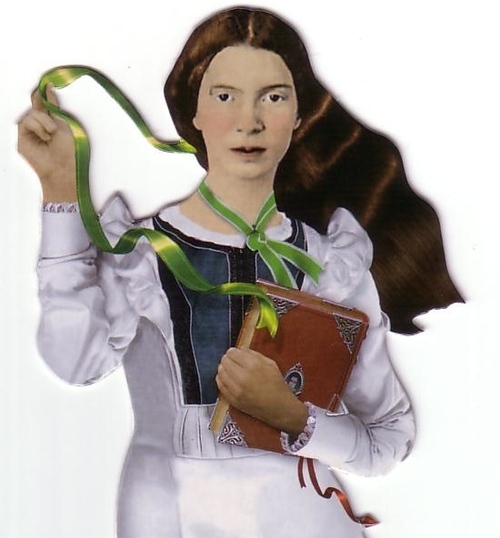
I had a little adolescent crush on plain old Emily Dickinson because I felt sorry for her and imagined that if I had been there in Amherst that I might have been friends with her. I would have gotten her outside into nature and maybe we would have even dated.I also had a crush on glamorous Marilyn Monroe at that time because I also wanted to save her from the world.

In “Taking Off Emily Dickinson’s Clothes,” Billy Collins takes that idea to a playful extreme. His poem is an extended metaphor for reading a Dickinson poem. The undressing is also the uncovering of the poems. FOr example, taking off her "tippet made of tulle” is like opening her book.

First, her tippet made of tulle,
easily lifted off her shoulders and laid
on the back of a wooden chair.

And her bonnet,
the bow undone with a light forward pull.

Then the long white dress, a more
complicated matter with mother-of-pearl
buttons down the back,
so tiny and numerous that it takes forever
before my hands can part the fabric,
like a swimmer’s dividing water,
and slip inside.

Emily's simple poems are "a more complicated matter" when you actually read them. They are not so easy.

Later, I wrote in a notebook
it was like riding a swan into the night,
but, of course, I cannot tell you everything -
the way she closed her eyes to the orchard,
how her hair tumbled free of its pins,
how there were sudden dashes
whenever we spoke.

Emily's habit was to wear a white dress, although she rarely left her family home in Amherst. She was a recluse for the latter part of her life, hiding behind the door when there were visitors. It is assumed that she died a virgin. You can hear Billy Collins read this poem and some of Emily's poetry online and Collins says that "There are many speculations about her...Was she lesbian? Was she celibate? Did she have an affair?" All of that speculation inspired him to write the poem in which he wanted, in a playful way, to put the guessing to rest by undressing her and having sex.

Naomi Shihab Nye
The first time I heard a poem by Naomi Shihab Nye it was her reading "Making a Fist" at a Dodge Poetry Festival. I loved the poem and I had a bit of a crush on the poet too. I bought two of her books because I wanted to read them, but also because I wanted to go up to her and ask her to sign them and say something to her.

In another video, Naomi Shihab Nye talks about how poetry inspires us. She says, "I've carried, for perhaps 30 years, a very tattered piece of notebook paper that says: Philip Levine has described the muse as 'being the portion of the self that largely lives asleep. Being inspired is really being totally alive.' He says that such a state feels a 'little odd' and also 'delicious.' " She also carries with her William Stafford's poem, "The Sky."

Despite my Emily and Naomi crushes, the poem I carry in my wallet is "When You Are Old" by William Butler Yeats. That was one I fell in love with in high school and that I memorized and that reads even better to me as I grow old and gray and full of sleep myself.

For this month's writing prompt, we write about First (Poetic) Love. This can mean the first poem you recall loving or the first poet you loved (in any sense of the word).

Submission Deadline: Wednesday, July 31st

March 30, 2013

Easter, 1916 by William Butler Yeats


Easter, 1916
by William Butler Yeats

I have met them at close of day
Coming with vivid faces
From counter or desk among grey
Eighteenth-century houses.
I have passed with a nod of the head
Or polite meaningless words,
Or have lingered awhile and said
Polite meaningless words,
And thought before I had done
Of a mocking tale or a gibe
To please a companion
Around the fire at the club,
Being certain that they and I
But lived where motley is worn:
All changed, changed utterly:
A terrible beauty is born.

That woman's days were spent
In ignorant good-will,
Her nights in argument
Until her voice grew shrill.
What voice more sweet than hers
When, young and beautiful,
She rode to harriers?
This man had kept a school
And rode our wingèd horse;
This other his helper and friend
Was coming into his force;
He might have won fame in the end,
So sensitive his nature seemed,
So daring and sweet his thought.
This other man I had dreamed
A drunken, vainglorious lout.
He had done most bitter wrong
To some who are near my heart,
Yet I number him in the song;
He, too, has resigned his part
In the casual comedy;
He, too, has been changed in his turn,
Transformed utterly:
A terrible beauty is born.

Hearts with one purpose alone
Through summer and winter seem
Enchanted to a stone
To trouble the living stream.
The horse that comes from the road,
The rider, the birds that range
From cloud to tumbling cloud,
Minute by minute they change;
A shadow of cloud on the stream
Changes minute by minute;
A horse-hoof slides on the brim,
And a horse plashes within it;
The long-legged moor-hens dive,
And hens to moor-cocks call;
Minute by minute they live:
The stone's in the midst of all.

Too long a sacrifice
Can make a stone of the heart.
O when may it suffice?
That is Heaven's part, our part
To murmur name upon name,
As a mother names her child
When sleep at last has come
On limbs that had run wild.
What is it but nightfall?
No, no, not night but death;
Was it needless death after all?
For England may keep faith
For all that is done and said.
We know their dream; enough
To know they dreamed and are dead;
And what if excess of love
Bewildered them till they died?
I write it out in a verse—
MacDonagh and MacBride
And Connolly and Pearse
Now and in time to be,
Wherever green is worn,
Are changed, changed utterly:
A terrible beauty is born.


For an interesting explication of this complicated Easter (as in "Easter Rebellion") poem, look at this article.


April 1, 2008

Poetry Makes Nothing Happen: Poems of Protest

I'm still thinking about the issues addressed in my last post and it had me thinking about a line from a W.H. Auden poem that is frequently quoted out of context. It's the line, "Poetry makes nothing happen."

It's often taken to be a negative comment on the effect, or lack thereof, of poetry on the world. Does poetry matter? Knowing Auden, you would have to wonder if that's what he really meant.

Another case like that would be these three lines from William Butler Yeats:
I think it better that in times like these
A poet keep his mouth shut, for in truth
We have no gift to set a statesman right.
Actually, both poets had a political side. W.H. Auden went to Spain and supported the Republican cause during the Spanish Civil War, and Yeats supported Ireland in the uprising against British colonial power. He even served as a Senator for the newly-formed Republic of Ireland.

Here's that line from Auden's "In Memory of W. B. Yeats" with a bit more context:
For poetry makes nothing happen: it survives
In the valley of its making where executives
Would never want to tamper, flows on south
From ranches of isolation and the busy griefs,
Raw towns that we believe and die in; it survives,
A way of happening, a mouth.


Just three days after Auden arrived in New York in early 1939, news came that W. B. Yeats had died. Yeats was 73; Auden was 31. He quickly wrote "In Memory of W. B. Yeats."

It's not a protest poem in the traditional sense at all. So why is it in his post?

Read the complete poem "In Memory of W. B. Yeats" and you'll see that it has two ideas in it. It starts with unrhymed verse paragraphs that suggest that poets can't do much more than create a way of being remembered. The second section is in stricter form and argues that poetry is more powerful than time or death. There's an unresolved feeling to the poem as to which is true. Perhaps, Auden wasn't completely sure. I'm not sure myself.

Our April prompt is poems of protest. They might be poems against the war or following a prompt from ProtestPoems.org or in protest of what is happening in Tibet or Darfur or any number of world situations. But Poets Online is not a political website. So, your submissions can also be poems of protest against more abstract or personal concerns.

If you feel the need for writing prompts with more meaning, sign up for monthly poetry prompts at ProtestPoems.org and visit the Poets Against the War site. Post a comment below and let us know about other sites that encourage action-poetry.

Back in February 2003, First Lady Laura Bush canceled her symposium on "Poetry and the American Voice" because she learned that some of the poets on her guest list refused to attend in protest against the impending war. A spokesperson for her said that t it would be "inappropriate to turn a literary event into a political forum." As a reaction to that non-event, the Poets Against the War movement was born. Since then, the group's volunteer editors has reviewed more than 22,000 poems.

And just last month, we crossed the 5 year mark for the war in Iraq. Since 2002, at least 775 men have been held in the U.S. detention center at Guantánamo Bay, Cuba. A poetry collection was published in August 2007 that gives voice to the men held at Guantánamo. Poems from Guantánamo has poems by 17 detainees, most of whom are still being held there. The poems may not be poetry of the highest quality, but they are a powerful use of poetry, and they make something happen.


Further Reading
There's an extended discussion online about this in "Conversing With the World: The Poet in Society" by Rachel Galvin.