Showing posts with label autumn. Show all posts

September 22, 2022

To Autumn 1819

On September 19, 1819, 24-year-old John Keats wrote the ode "To Autumn." It is one of the most anthologized poems in the English language. He wrote to his friend: "Somehow a stubble plain looks warm — in the same way that some pictures look warm — this struck me so much in my Sunday's walk that I composed upon it."

Photo by Mohan Nannapaneni


To Autumn 

Season of mists and mellow fruitfulness,

   Close bosom-friend of the maturing sun;

Conspiring with him how to load and bless

   With fruit the vines that round the thatch-eves run;

To bend with apples the moss'd cottage-trees,

   And fill all fruit with ripeness to the core;

      To swell the gourd, and plump the hazel shells

   With a sweet kernel; to set budding more,

And still more, later flowers for the bees,

Until they think warm days will never cease,

      For summer has o'er-brimm'd their clammy cells.


Who hath not seen thee oft amid thy store?

   Sometimes whoever seeks abroad may find

Thee sitting careless on a granary floor,

   Thy hair soft-lifted by the winnowing wind;

Or on a half-reap'd furrow sound asleep,

   Drows'd with the fume of poppies, while thy hook

      Spares the next swath and all its twined flowers:

And sometimes like a gleaner thou dost keep

   Steady thy laden head across a brook;

   Or by a cyder-press, with patient look,

      Thou watchest the last oozings hours by hours.


Where are the songs of spring? Ay, Where are they?

   Think not of them, thou hast thy music too,—

While barred clouds bloom the soft-dying day,

   And touch the stubble-plains with rosy hue;

Then in a wailful choir the small gnats mourn

   Among the river sallows, borne aloft

      Or sinking as the light wind lives or dies;

And full-grown lambs loud bleat from hilly bourn;

   Hedge-crickets sing; and now with treble soft

   The red-breast whistles from a garden-croft;

      And gathering swallows twitter in the skies.


1819 is known as Keats' greatest year of creativity. He wrote almost all his great poetry during that year, including a series of odes during that spring and summer, among them "Ode to a Nightingale," "Ode to a Grecian Urn," and "Ode to Psyche." "To Autumn" was the last of these odes. Keats died from tuberculosis at age 25.
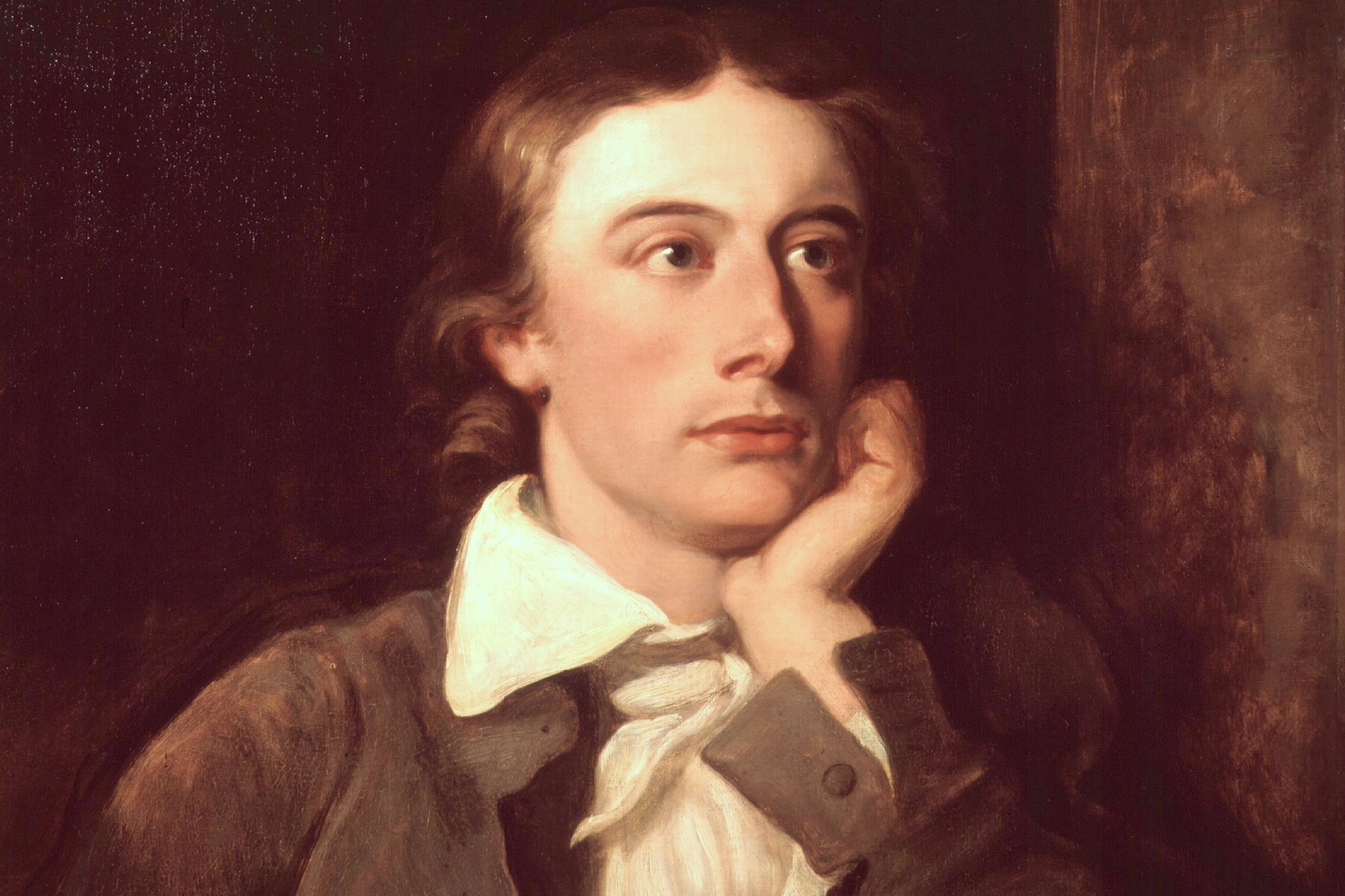
Portrait of John Keats by William Hilton


Visit our website at poetsonline.org

September 22, 2021

An Ode "To Autumn"

Just before the equinox in 1819, a 24-year-old John Keats wrote the ode "To Autumn." There is a good chance that you read it in some English class. It appears in almost every literature anthology. 

He wrote in a letter about the day that inspired the poem. "Somehow a stubble plain looks warm — in the same way that some pictures look warm — this struck me so much in my Sunday's walk that I composed upon it."

Keats did not consider 1819 to be a great year, particularly for his poetry life. He wrote to his brother, "Nothing could have in all its circumstances fallen out worse for me than the last year has done, or could be more damping to my poetical talent."

That's ironic because now most critics call that year his "Great Year," or "Fertile Year" because Keats wrote almost all his great poetry that year. In the spring and summer, he had written "Ode to a Nightingale," "Ode to a Grecian Urn," and "Ode to Psyche."  The last of the odes was "To Autumn.

Keats died from tuberculosis less than two years later at age 25.

"This grave contains all that was Mortal of a Young English Poet Who on his Death Bed,
 in the Bitterness of his Heart at the Malicious Power of his Enemies
Desired these Words to be engraven on his Tomb Stone:
  Here lies One Whose Name was writ in Water. "


To Autumn 
by John Keats

Season of mists and mellow fruitfulness,

   Close bosom-friend of the maturing sun;

Conspiring with him how to load and bless

   With fruit the vines that round the thatch-eves run;

To bend with apples the moss'd cottage-trees,

   And fill all fruit with ripeness to the core;

      To swell the gourd, and plump the hazel shells

   With a sweet kernel; to set budding more,

And still more, later flowers for the bees,

Until they think warm days will never cease,

      For summer has o'er-brimm'd their clammy cells.


Who hath not seen thee oft amid thy store?

   Sometimes whoever seeks abroad may find

Thee sitting careless on a granary floor,

   Thy hair soft-lifted by the winnowing wind;

Or on a half-reap'd furrow sound asleep,

   Drows'd with the fume of poppies, while thy hook

      Spares the next swath and all its twined flowers:

And sometimes like a gleaner thou dost keep

   Steady thy laden head across a brook;

   Or by a cyder-press, with patient look,

      Thou watchest the last oozings hours by hours.


Where are the songs of spring? Ay, Where are they?

   Think not of them, thou hast thy music too,—

While barred clouds bloom the soft-dying day,

   And touch the stubble-plains with rosy hue;

Then in a wailful choir the small gnats mourn

   Among the river sallows, borne aloft

      Or sinking as the light wind lives or dies;

And full-grown lambs loud bleat from hilly bourn;

   Hedge-crickets sing; and now with treble soft

   The red-breast whistles from a garden-croft;

      And gathering swallows twitter in the skies.


more about the poem


Visit our website at poetsonline.org


September 22, 2019

A Fall of Leaves


That time of year thou mayst in me behold
When yellow leaves, or none, or few, do hang
Upon those boughs which shake against the cold,
Bare ruined choirs, where late the sweet birds sang…
     ~ William Shakespeare, Sonnet 73


The words "autumn" and "fall" meaning the season that begins today in the Northern Hemisphere both originated in Britain, but one is more commonly used there while the other is more common in America. By the mid-1800s, "fall" was considered to be the  American season by lexicographers.

Autumn is the older word, coming into English in the 1300s from the Latin word autumnus.

At one time there was an intermediary season preceding our autumn that was called "harvest." It seems that autumn came into usage to distinguish between the time when one harvests crops and the actual crop harvest itself.

"To Autumn" by John KeatsSeason of mists and mellow fruitfulness,
Close bosom-friend of the maturing sun;
Conspiring with him how to load and bless
With fruit the vines that round the thatch-eves run;
To bend with apples the moss’d cottage-trees,
And fill all fruit with ripeness to the core;
To swell the gourd, and plump the hazel shells
With a sweet kernel; to set budding more,
And still more, later flowers for the bees,
Until they think warm days will never cease,
For summer has o’er-brimm’d their clammy cells...

Writers, especially poets, wrote about the dazzling seasonal colors of this time and the phrase "the fall of the leaves" came into more common usage. That phrase was shortened sometime in the 1600s to "fall." This coincides with English moving across the ocean with explorers and settlers to the New World. But both words must have been used in the New World as they were in Britain because "fall" for the season doesn't appear until 1755 when Samuel Johnson added it to his Dictionary of the English Language.

"The Falling of the Leaves" by W.B. Yeats  Autumn is over the long leaves that love us,
And over the mice in the barley sheaves;
Yellow the leaves of the rowan above us,
And yellow the wet wild-strawberry leaves.
The hour of the waning of love has beset us,
And weary and worn are our sad souls now;
Let us part, ere the season of passion forget us,
With a kiss and a tear on thy drooping brow.

Fall is still occasionally used in countries where British English is spoken, but more likely in phrases, like "spring and fall." American though I may be, I prefer autumn, since it is used by astronomers to mark the Autumnal Equinox.


Visit our website at poetsonline.org

September 22, 2014

Celebrating Autumn with Keats

A few days before the autumnal equinox 195 years ago, 24-year-old poet named John Keats wrote "To Autumn."

You can find this ode in many anthologies and even if you have little interest in poetry, you may recognize a line that was dropped into your memory in a classroom.

Keats wasn't having a great poetic year. In November, he would tell his brother in a letter, "Nothing could have in all its circumstances fallen out worse for me than the last year has done, or could be more damping to my poetical talent." But he wrote in another letter about this ode: "Somehow a stubble plain looks warm — in the same way that some pictures look warm — this struck me so much in my Sunday's walk that I composed upon it."

Ironically, Keats scholars have since decided that 1819 was his best year as a poet because he wrote almost all his great poems that year. The poems included a group of odes - "Ode to a Nightingale," "Ode to a Grecian Urn," "Ode to Psyche" and "To Autumn" was the last of them.

Poets often see autumn as a good symbol of aging. A preparation for winter. Young Mr. Keats took another view of the season, but he would die from tuberculosis in less than two years after writing the poem. He was 25.


To Autumn

Season of mists and mellow fruitfulness,
Close bosom-friend of the maturing sun;
Conspiring with him how to load and bless
With fruit the vines that round the thatch-eves run;
To bend with apples the moss’d cottage-trees,
And fill all fruit with ripeness to the core;
To swell the gourd, and plump the hazel shells
With a sweet kernel; to set budding more,
And still more, later flowers for the bees,
Until they think warm days will never cease,
For summer has o’er-brimm’d their clammy cells.

Who hath not seen thee oft amid thy store?
Sometimes whoever seeks abroad may find
Thee sitting careless on a granary floor,
Thy hair soft-lifted by the winnowing wind;
Or on a half-reap’d furrow sound asleep,
Drowsed with the fume of poppies, while thy hook
Spares the next swath and all its twined flowers:
And sometimes like a gleaner thou dost keep
Steady thy laden head across a brook;
Or by a cider-press, with patient look,
Thou watchest the last oozings, hours by hours.

Where are the songs of Spring? Ay, where are they?
Think not of them, thou hast thy music too,--
While barred clouds bloom the soft-dying day,
And touch the stubble-plains with rosy hue;
Then in a wailful choir the small gnats mourn
Among the river sallows, borne aloft
Or sinking as the light wind lives or dies;
And full-grown lambs loud bleat from hilly bourn;
Hedge-crickets sing; and now with treble soft
The redbreast whistles from a garden-croft,
And gathering swallows twitter in the skies.


October 3, 2012

Prompt: The Four Seasons


Autumn on Reservoir Road by Ken Ronkowitz on Flickr

It is hard to read poetry without occasionally coming  across a poem about one of the seasons. If you read haiku, you know that the seasons enter almost all haiku written in a traditional way. If you have been writing poetry for a few years, you probably have a few poems about seasons. So, it would be easy enough for poets to dig into their poetry collection and come up with a poem about one of the seasons.

Right now, in the Northern Hemisphere, we are in early autumn and so you may be inspired to write about what you see in the season.

You could create quite a thick anthology just collecting poems on autumn. And the collection would include traditional takes on this season "When yellow leaves, or none, or few, do hang / Upon those boughs which shake against the cold" as Shakespeare writes in Sonnet LXXIII.

There are certain literary associations to the seasons, as in this short poem,"November Night," by Adelaide Crapsey.
Listen...
With faint dry sound,
Like steps of passing ghosts,
The leaves, frost-crisp'd, break from the trees
And fall.
Some of these associations have become clichés - such as, the Old Man Winter of old age, dying and death and the rebirth of spring.

I prefer poems that use the season as setting but go somewhere that I have not been in that season. In
"My Autumn Leaves" by Bruce Weigl
the poet starts with a familiar place and familiar seasonal props like deer and apples.
I watch the woods for deer as if I’m armed.
I watch the woods for deer who never come.
I know the hes and shes in autumn
rendezvous in orchards stained with fallen
apples’ scent...
and then goes back to find a younger self who has not left him.
                                    ...They know the boy
who lives inside me still won’t go away.
The deer are ghosts who slip between the light   
through trees, so you may only hear the snap   
of branches in the thicket beyond hope.   
I watch the woods for deer, as if I’m armed.

That departure was what appealed to me in reading "Another Autumn" by Adele Kenny from her collection, What Matters. It is the model poem for our current writing prompt for October.
Like Weigel, she uses some of the familiars of the season - leaf-rot, chrysanthemums, chilling air and gaunt roses - but they are contrasted with a hidden passion of "sweat, and the smell of it" that leads us to a place where "trees on fire" are not just fall foliage.

On Adele's own blog, she offers a range of writing prompts from playing with form (such as in writing an "adeleanelle") and her own approach to what autumn brings.

And our own prompt this month? We will not limit ourselves to autumn. In "To Autumn," John Keats' writes about this "season of mists and mellow fruitfulness" but asks "Where are the songs of Spring?"

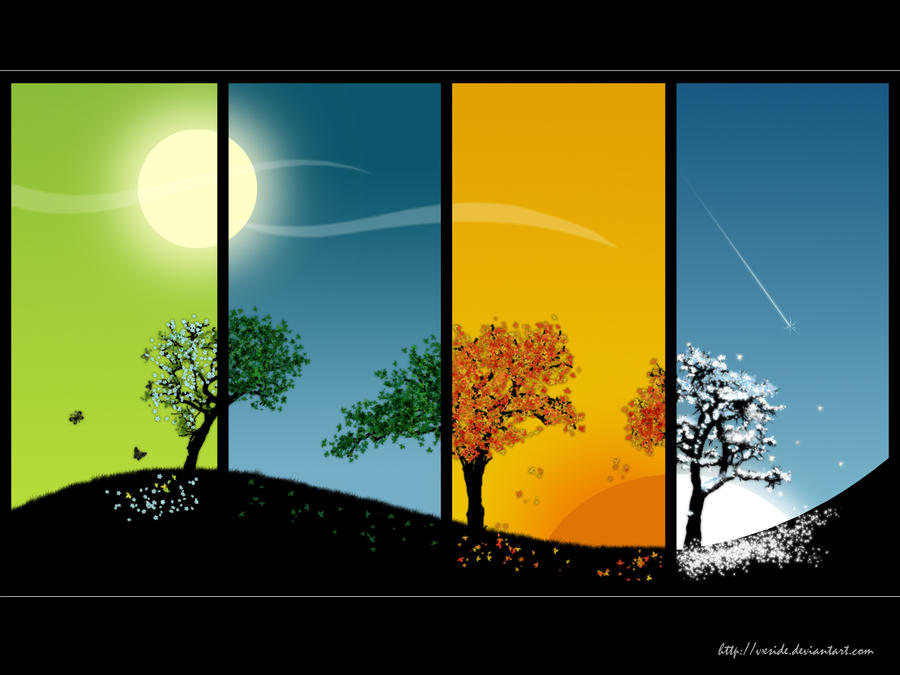
Your assignment this month is to write a poem that includes all four seasons. For example, you might take a place, a person or a situation through the seasons as a way of contrasting changes. (Perhaps, you can listen to Vivaldi's Four Seasons as you write.) You could take alternative views on those seasonal clichés. (Think of T.S. Eliot's view of spring/April as "the cruelest month" rather than a time of rebirth.) 

Four Seasons image/print available from vxside.deviantart.com

You may be interested in reading an earlier version of Adele Kenny's poem "Another Autumn" to contrast it with the version published in What Matters which we used as the model this month.