Showing posts with label Naomi Shihab Nye. Show all posts

May 16, 2024

How Do You Know When a Poem Is Finished?

How do you know when a poem is finished? It is the kind of question new poets ask older poets. I have heard it in my classroom.   

"How Do I Know When a Poem Is Finished?" is Naomi Shihab Nye's poem answer.  It begins:

When you quietly close
the door to a room
the room is not finished.

It is resting. Temporarily.
Glad to be without you
for a while.

I use her poem (You can hear her read the full poem in the video below.) and also tell students that Paul Valery famously said "A poem is never finished, only abandoned."

In this time of immediate gratification, young poets often feel that their poem is finished as soon as they write that final word. I find that at poetry readings by famous poets or new poets at open readings, a frightening introduction to a poem is "Here is a poem that I wrote today."

There have been poems that I have written and when I was done, it felt finished. More typically, when I come back to the poem a day or weeks later with fresh eyes, I can better tell if it is complete. I would estimate that I revise poems about 90% of the time. The first draft that is a final version is rare - but it does happen.

Reading a new poem to someone or to a group that can give you honest feedback is very useful.  Standup comics tend to try out new material in small clubs where the stakes are lower before they use them in their act. They workshop the jokes. So, perhaps that new poem written today and then read at an open might be a way to test out a poem. Though I wouldn't expect much constructive feedback from an audience, a laugh at a line you hoped was funny or at a line you didn't want to be funny would be useful. Applause is a lousy indicator as it is sometimes just a courtesy clap.

How do you know when a poem is finished? Or are your poems never finished? Post a comment!!

Naomi Shihab Nye reading "How Do I Know When a Poem Is Finished" as part of Dear Poet, the Academy of American Poets' educational project for National Poetry Month 2015. 


Follow this blog for all things poetry.
To see our past prompts and more than 300 issues,
visit our website at poetsonline.org

December 2, 2021

Prompt: Year End

Stonehenge

As a year ends, we often look back on what we have experienced. That review may bring to mind what we have accomplished and good memories. It may also include regrets, things undone, and things we wish we could forget.

In a poem from 1784, "New Year’s Verses" by Philip Freneau, he blesses whoever came up with the idea of a year.

Blest be the man who early prov’d
    And first contriv’d to make it clear
That Time upon a dial mov’d,
    And trac’d that circle call’d a year;

I'm not sure if all of us would bless that calendar maker. Some might instead curse.

December is filled with holidays that mark the Winter Solstice and the end of the year. Though some of us in the North might be sad to see winter arrive, since ancient times both solstices were viewed as a celebration. Starting on the winter solstice, the days get longer moving to the vernal equinox and the start of spring.

From the Scandinavia Yule, to Hanukkah, to a bonfire on Mount Fuji and the Hopi tradition of Soyal with its Sun Chief,  the day of the "sun's rebirth” is often marked with fire and light.

For this month's writing prompt, we look at "Burning the Old Year" by Naomi Shihab Nye (from Words Under the Words: Selected Poems) which seems to follow these fire traditions. In her short poem, "Letters swallow themselves in seconds" and notes "sizzle like moth wings" in a "swirling flame of days." 

Read the full poem. Is Nye is actually burning something or is this a metaphor using the idea of burning? What does she mean when she says, "I begin again with the smallest numbers?" Why is it that "only the things I didn’t do" are what will finally "crackle after the blazing dies?"  (If you have thoughts on this poem, please post a comment below.)

The end-of-year celebration that seems closest to Nye's poem is from England. The modern-day (and possibly short-lived) “Burning of the Clocks” festival in the seaside town of Brighton takes fire as a necessity for lighting the dark days of winter. People wear clock costumes and carry paper lanterns to the beach to put in a bonfire. Do they symbolize wishes, hopes, fears, or Time itself?

In ancient cultures, marking time for farmers planting crops and tending animals was important and treated at times as religious. Winter was dangerous and the return of light and warmth was critical to their survival. The Neolithic who constructed Stonehenge did so to monitor movements of the sun and seasons and it probably had religious uses too. At the winter solstice, where the tallest trilithon at the monument once stood is where the sun would have set between in its narrow gap.

Our prompt for December is to write a poem to close the year, but this is not "a happy new year" poem prompt but more of a look back at a year - this one or some past one. Would you burn some or all of it? Do you see the light of the solstice? How do you close "that circle call’d a year?"

Submission deadline January 4, 2022.     Please view our submission guidelines.


Visit our website at poetsonline.org

September 1, 2018

Prompt: Poetry in School


Most of us were introduced to poetry in school. As a teacher, I hope it was a kind introduction, but there are many people whose introduction to poetry in school seems to have been unpleasant.

Billy Collins' poem "Introduction to Poetry" is one that is often used to make a point about poetry in the classroom. The teacher asks the students to "take a poem / and hold it up to the light / like a color slide / or press an ear against its hive." Though the teacher wants the students to simply enjoy the poem - "to waterski / across the surface of a poem / waving at the author's name on the shore" - the students have been trained in school about how to read a poem, so they want to "tie the poem to a chair with rope / and torture a confession out of it. / They begin beating it with a hose / to find out what it really means."

You may have more pleasant memories of your introduction to poetry or a good classroom encounter with poetry in a classroom. I can recall how Mrs. Cavico read and spoke about Keats' "Ode to a Grecian Urn" with such love and appreciation - and how she recognized that I "got it" while most of the class looked out the window at kids in gym class.

Having met her and heard her read and talk about writing, I imagine poet Naomi Shihab Nye would be a great teacher to have for poetry. In one of her poems, "The Young Poets of Winnipeg,"
scurried around a classroom papered with poems.
Even the ceiling, pink and orange quilts of phrase…
they introduced one another, perched on a tiny stage
to read their work, blessed their teacher who
encouraged them to stretch, wouldn’t let their parents
attend the reading because parents might criticize

These very confident young poets had not been taught to tie down a poem or beat it.

They knew their poems
were glorious, that second-graders could write better

than third or fourth, because of what happened
on down the road, the measuring sticks
that came out of nowhere, poking and channeling
the view

For our September, back-to-school prompt, write a poem about poetry in school. I'm guessing we have positive and negative tales to tell, from our own experiences as students and teachers or from imagined classrooms.

Submission guidelines.        Submission deadline September 30, 2018


July 30, 2016

Your Life Is a Poem


In the new episode of ON BEING, "Your Life Is a Poem," poet Naomi Shihab Nye talks about growing up in Ferguson, Missouri and on the road between Ramallah and Jerusalem. Her father was a refugee Palestinian journalist, and through her poetry, she carries forward his hopeful passion, his insistence, that language must be a way out of cycles of animosity.

Your life is a poem. This is how the poet Naomi Shihab Nye sees the world, and she teaches how that way of being and writing is possible. She’s engaged the real world power of words through her upbringing between her father’s Palestinian homeland and Ferguson, Missouri. Her mother was American. Her father was a refugee journalist, and she carries forward his hopeful passion, his insistence, that language must be a way out of cycles of revenge and animosity. A poem she wrote called “Kindness,” that was written in a moment of trauma, is carried around in the pockets and memories of readers around the world.
Listen to the podcast


January 1, 2016

Burning the Old Year

Burning the Old Year
by Naomi Shihab Nye

Letters swallow themselves in seconds.
Notes friends tied to the doorknob,
transparent scarlet paper,
sizzle like moth wings,
marry the air.

So much of any year is flammable...

continues at poetryfoundation.org


March 31, 2015

Prompt: Epistles to the Poets


It is National Poetry Month 2015 in America. The Academy of American Poets has many special features on its website for this month. One is called "Dear Poet." It is a multimedia education project that invites young people in grades five through twelve to write letters in response to poems written and read by some of the award-winning poets who serve on their Board of Chancellors.

Poets Online asks you this month to join the students. You can read and watch a group of poets reading and discussing their poems. The students are being asked to write letters to the poets to express their thoughts, ideas, or ask any questions they may have about the poems. I wonder why they didn't ask students to write poems to the poets - which is what we we will do.

Epistles, or epistolary poems, comes from the Latin “epistula” for “letter," are poems that read as letters. As poems of direct address, they can be intimate and colloquial or formal and measured.

On our main site, the prompt includes two of the poems and poets from Dear Poets. One is Naomi Shihab Nye's "How Do I Know When A Poem Is Finished?" which itself is addressed to someone - perhaps a student who has asked the poet that question, though all poets ask that question to themselves.

The second example and video is for Edward Hirsch's poem "Cotton Candy" which looks back to the candy and a grandfather.

What would you write to Nye or Hirsch about their poems?

Our prompt is much wider. You can choose any poem on the Academy site or any poem at all. The only requirement is that you address the poet by name and that you include the title of the poem you are responding to in the poem.

Your poem might be titled "Dear Mr. Hirsch" or Dear Elizabeth" for a poem to Elizabeth Bishop, whose own epistle "Letter to N.Y." begins:
In your next letter I wish you’d say
where you are going and what you are doing;
how are the plays, and after the plays
what other pleasures you’re pursuing:

taking cabs in the middle of the night,
driving as if to save your soul
where the road goes round and round the park
and the meter glares like a moral owl
I might write to W. B. Yeats during this Easter week 2015 about his poem "Easter 1916" to let him know that this year:
I am sitting at the start of day
looking out the window
at my desk at a sky gray
above twenty-first century homes
that I have passed on my way,
like you, nodding and saying
polite meaningless words...


July 9, 2013

Prompt: First (Poetic) Love


Who is the first poet you fell in love with? In this video from The Poetry Foundation, Edward Hirsch, Evie Shockley, Jean Valentine, Juan Felipe Herrera, Katy Lederer, Marilyn Hacker, Pierre Joris and Rachel Levitsky talk about first poetry loves.

Several of the poets ask the interviewer if the question is meant literally or figuratively, or if the answer can be a poem rather than the poet. This inspired me use that first love of poetry as our prompt and inspiration.

Who is the poet that was your first love? This might be the love of a poem, but it might be a crush on the poet, either by way of a poem or just a photo on a book jacket or an encounter at a reading.

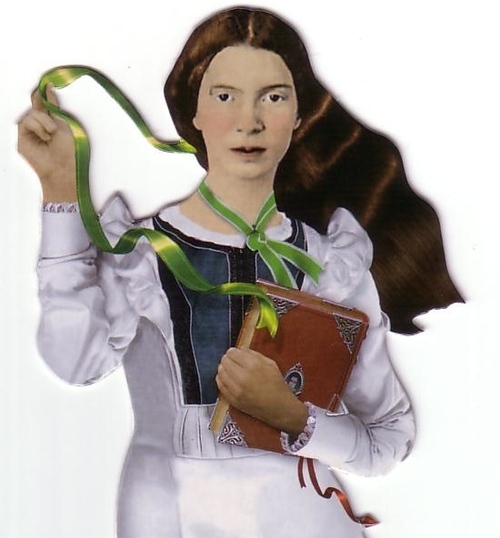
Emily, as she appears on "her" Twitter page
I had a little adolescent crush on plain old Emily Dickinson because I felt sorry for her and imagined that if I had been there in Amherst that I might have been friends with her. I would have gotten her outside into nature and maybe we would have even dated.I also had a crush on glamorous Marilyn Monroe at that time because I also wanted to save her from the world.

In “Taking Off Emily Dickinson’s Clothes,” Billy Collins takes that idea to a playful extreme. His poem is an extended metaphor for reading a Dickinson poem. The undressing is also the uncovering of the poems. FOr example, taking off her "tippet made of tulle” is like opening her book.

First, her tippet made of tulle,
easily lifted off her shoulders and laid
on the back of a wooden chair.

And her bonnet,
the bow undone with a light forward pull.

Then the long white dress, a more
complicated matter with mother-of-pearl
buttons down the back,
so tiny and numerous that it takes forever
before my hands can part the fabric,
like a swimmer’s dividing water,
and slip inside.

Emily's simple poems are "a more complicated matter" when you actually read them. They are not so easy.

Later, I wrote in a notebook
it was like riding a swan into the night,
but, of course, I cannot tell you everything -
the way she closed her eyes to the orchard,
how her hair tumbled free of its pins,
how there were sudden dashes
whenever we spoke.

Emily's habit was to wear a white dress, although she rarely left her family home in Amherst. She was a recluse for the latter part of her life, hiding behind the door when there were visitors. It is assumed that she died a virgin. You can hear Billy Collins read this poem and some of Emily's poetry online and Collins says that "There are many speculations about her...Was she lesbian? Was she celibate? Did she have an affair?" All of that speculation inspired him to write the poem in which he wanted, in a playful way, to put the guessing to rest by undressing her and having sex.

Naomi Shihab Nye
The first time I heard a poem by Naomi Shihab Nye it was her reading "Making a Fist" at a Dodge Poetry Festival. I loved the poem and I had a bit of a crush on the poet too. I bought two of her books because I wanted to read them, but also because I wanted to go up to her and ask her to sign them and say something to her.

In another video, Naomi Shihab Nye talks about how poetry inspires us. She says, "I've carried, for perhaps 30 years, a very tattered piece of notebook paper that says: Philip Levine has described the muse as 'being the portion of the self that largely lives asleep. Being inspired is really being totally alive.' He says that such a state feels a 'little odd' and also 'delicious.' " She also carries with her William Stafford's poem, "The Sky."

Despite my Emily and Naomi crushes, the poem I carry in my wallet is "When You Are Old" by William Butler Yeats. That was one I fell in love with in high school and that I memorized and that reads even better to me as I grow old and gray and full of sleep myself.

For this month's writing prompt, we write about First (Poetic) Love. This can mean the first poem you recall loving or the first poet you loved (in any sense of the word).

Submission Deadline: Wednesday, July 31st

April 12, 2011

Finding Poems With Naomi Shihab Nye

Nye
Have you ever had someone ask you to write them a poem?

As Naomi Shihab Nye says in her poem, "Valentine For Ernest Mann":
You can’t order a poem like you order a taco.
Walk up to the counter, say, “I’ll take two”
and expect it to be handed back to you
on a shiny plate.

Maybe non-poets believe that poets can conjure up poems at will (or with a simple prompt). Nye continues and suggests that rather, poems hide in places where poets find them.
In the bottoms of our shoes,they are sleeping. They are the shadows
drifting across our ceilings the moment
before we wake up. What we have to do
is live in a way that lets us find them.
It reminds me of Gary Snyder’s little poem “How Poetry Comes To Me” from 1992 that also talks about how we find poems and how they find us.

It comes blundering over the
Boulders at night, it stays
Frightened outside the
Range of my campfire
I go to meet it at the
Edge of the light

Poetry is a wild animal that is sometimes clumsy and dwells outside our knowledge and awareness. It comes to us only so far. Then, we need to "meet it at the edge of the light” in that place between the known and the unknown.

How do poets do this? Again, Nye suggests:
Maybe if we re-invent whatever our lives give us
we find poems. Check your garage, the odd sock
in your drawer, the person you almost like, but not quite.
For our April writing prompt, write about how you find poems (or found one poem) or how they find you. Yes, it's a poem about inspiration and the Muses.


Red Suitcase (American Poets Continuum)

Red Suitcase

August 1, 2009

Poems About Politics

I actually have avoided writing and reading poems about politics. They usually don't work for me. But, the past few years, I have become more of a news junkie and politics (and economics) have started to get under my skin more and more.

Here are two poems by Naomi Shihab Nye that do work for me. The first is "Letters My Prez Is Not Sending" (the Prez being Bush 2 then) which just hits you in the face. Let me amend that - it throws punches at you, but just stops before it makes contact. But you will flinch and wince anyway.


The second poem is "Ted Kooser Is My President" and it is lighter and easier to take but closer to my own apolitical approach to political poetry.

On the Dodge blog, Martin Farawell writes of Nye:

A poet could avoid the dilemma by taking the position that poetry shouldn’t be “political.” But Nye’s poems are attempts to stay connected to the world and to others. She refuses to abandon the attempt despite the violence and injustice she must therefore bear witness to. It is almost as if she discovers how we are connected through the act of bearing witness. Perhaps for Nye poetry itself is our humanity’s survival mechanism.

Nye has also said the courage she most admires is that of people who keep giving attention to the simple acts of everyday life—talking over coffee, getting kids ready for school, sweeping the front porch stoop—while there is chaos and danger all around them.


You can find “Letters My Prez Is Not Sending” and “Ted Kooser Is My President” in her newsest collection, Honeybee.