September 11, 2013

8th Biennial Warren County Poetry Festival in New Jersey September 28

The 8th Biennial Warren County Poetry Festival is a free one day event that will be held September 28, 2013 with a theme of "Blues Poetics: Working-Class Roots and Rhythms in Poetry."

The Festival is held every two years, and has won two Citation of Excellence from the New Jersey State Council on the Arts. It features workshops, panel discussions, book signings, and open mic sessions.

The festival is held on the campus of the Blair Academy, in Blairstown, NJ.

The 2013 Featured Poets are Roger Bonair-Agard, Nick Flynn and Joy Harjo.


Roger Bonair-Agard is a veteran of the spoken-word scene and a two-time National Poetry Slam Champion. He is the author of Tarnish and Masquerade, co-author of Burning Down the House, GULLY and Bury My Clothes. Roger moved to the United States from his native Trinidad and Tobago in 1987.
books by Roger Bonair-Agard 


  Nick Flynn has worked as a ship's captain, an electrician, and as a case-worker with homeless adults. He is also the award-winning author of Some Ether, Blind Huber, The Ticking is the Bomb and Another Bullshit Night in Suck City, winner of the PEN/Martha Albrand Award. His most recent book is The Reenactments. He divides his time between Texas, where he teaches at the University of Houston, and Brooklyn, New York.         books by Nick Flynn


Joy Harjo was born in Tulsa, Oklahoma and is a member of the Mvskoke Nation. 

 Her seven books of poetry include How We Became Human- New and Selected Poems, The Woman Who Fell From the Sky, and She Had Some Horses. For A Girl Becoming, a young adult/coming of age book, was released in 2009. She has also released four award-winning CD's of original music and in 2009 won a Native American Music Award (NAMMY) for Best Female Artist of the Year for Winding Through the Milky Way. She performs nationally and internationally with her band, the Arrow Dynamics. 
 
books and music by Joy Harjo

Other poets reading and participating in the day's workshops and panel discussion include: James Arthur,  Laura Boss, Martin Farawell, Maria Mazziotti Gillan,  Jim Haba, Leslie Heywood and Joe Weil.

For the festival schedule, directions and more about the poets, see http://poetsonline.org/wcpf/



August 18, 2013

Breaking Bad and Walt Whitman


There have been several Walt Whitman references during the four and a half seasons of AMC’s Breaking Bad. This month the final episodes of the series are being shown.

The two WW's - Whitman and Breaking Bad protagonist, Walter White - have a strange connection.

The two don't seem similar. White is a high school science teacher who finds out he has cancer and becomes a crystal meth maker and distributor to build up a cash reserve for his family. Over the seasons, he breaks very bad, going “from Mr. Chips to Scarface” as the show's creator, Vince Gilligan, has said.

Whitman is nothing like that. Whitman and his book, Leaves of Grass, were not part of some original plot plan by the creator, But he keeps popping up.

In season three, White’s lab assistant, Gale, recites Whitman's poem “When I Heard the Learn’d Astronomer", a poem about disillusionment with theory and a need to engage with the world.
When I was shown the charts and diagrams, to add, divide, and measure them,
When I sitting heard the astronomer where he lectured with much applause in the lecture-room,
How soon unaccountable I became tired and sick,
Till rising and gliding out I wander’d off by myself,
In the mystical moist night-air,…

Gale gives Walt a copy of Leaves of Grass as a gift. In a later scene, Walt read the book which Gale inscribed with “To my other favorite W.W. It is an honor working with you.”

The name of this year's fifth season’s midpoint cliffhanger episode was “Gliding Over All,” which is an allusion to a poem in the book, "Song of Myself."

Gliding o’er all, through all,
Through Nature, Time, and Space,
As a ship on the waters advancing,
The voyage of the soul—not life alone,
Death, many deaths I’ll sing.

This poem connects with the Walt that White has become.

And then Walt’s brother-in-law Hank, a D.E.A. agent who has been pursuing the meth cook that is Walt, found the copy of Leaves of Grass in Walt's bathroom, and reading the inscription written by the now dead Gale, knows that Walt is the meth cook and drug lord also known as "Heisenberg."

Walter "Walt" Whitman the poet was a humanist and part of the transition between transcendentalism and realism. He is among the most influential poets in the American canon, often called the father of free verse.

His work was very controversial in its time, particularly Leaves of Grass, which was described as obscene for its overt sexuality.

Will "The Good Gray Poet" figure in the final episodes of the series?

As at thy portals also death,
Entering thy sovereign, dim, illimitable grounds...
I grave a monumental line, before I go, amid these songs,
And set a tombstone here.


More About WW and WW
http://breakingbad.wikia.com/wiki/Walt_Whitman
http://www.poetryfoundation.org/article/246218

August 1, 2013

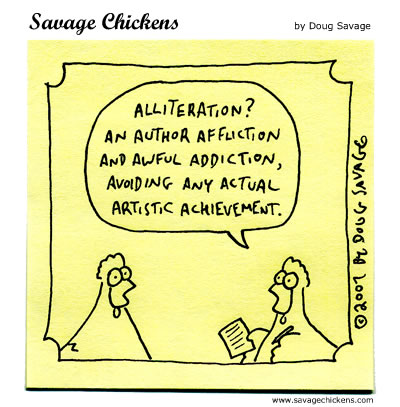
Prompt: Alliteration, Masturbation and Other Literary Terms


We all were taught literary terms in school, especially during some poetry unit. Simile, metaphor, personification and many others were supposed to be the common vocabulary and grammar we used to dissect the poems.

This month's model poem for our prompt is one that is titled with a literary term - alliteration. The poem itself is no ars poetica though.

Alliteration
by Paul Hostovsky

I whacked off in these woods once.
But that was a long time ago when
everything rhymed a little with
the trees all facing upward and the sky
was full of itself and no one
was around. And everything smelled good.
I smelled good myself. A sweaty,
muddy, musky, burning smell of
autumn or late summer or very early
spring was in the air, and I was so
excited to be so young and existential
and solipsistic, that I peeled off my shirt
and pants and underpants, and stood there
erect and steeply rocking under a sycamore,
my peeled bark in a little pile at my feet,
my head tossing in the wind, my mouth
opening, wider, wider, as if trying
to pronounce all the vowels at the same time
and failing deliciously, and sinking down
to the ground, totally spent and spluttering
a few choice consonants like kisses meant
for the pursed lips of the wind.


We know that alliteration is the repetition of the initial sounds (usually consonants) of stressed syllables in neighboring words. Usually it occurs at word beginnings, as in this line from Shelley's "The Cloud":  I bear light shade for the leaves when laid.

The poem has alliteration, but do you see a connection from the term to the poem's subject?  Repetition? The "few choice consonants" of spluttered sound? How intentional was it in this somewhat naughty-boy poem that has several puns that another name for alliteration is head rhyme?

For our August prompt, select a literary term as your title and starting point. Besides the common terms, there are plenty of lesser known ones (like half rhyme). And a term like "meter" has many sub-topics to offer. Pentameter and caesura suggest things outside of poetry to me. What would a poem titled "Free Verse" or "Masculine Verse" or "Feminine Verse" address?

To avoid preconceived notions, perhaps you should just browse a list of literary terms for poetry and find one that gets your interest.


Paul Hostovsky is the author of four books of poetry, Hurt Into Beauty (2012), A Little in Love a Lot (2011), Dear Truth (2009), and Bending the Notes (2008). His poems have won a Pushcart Prize, two Best of the Net awards, numerous chapbook contests, and have been featured on Poetry Daily, Verse Daily, and The Writer's Almanac. He works in Boston as a sign language interpreter at the Massachusetts Commission for the Deaf
"Alliteration" is from his forthcoming book Naming Names which can be pre-ordered now online.

Paul is online at www.paulhostovsky.com


July 9, 2013

Prompt: First (Poetic) Love


Who is the first poet you fell in love with? In this video from The Poetry Foundation, Edward Hirsch, Evie Shockley, Jean Valentine, Juan Felipe Herrera, Katy Lederer, Marilyn Hacker, Pierre Joris and Rachel Levitsky talk about first poetry loves.

Several of the poets ask the interviewer if the question is meant literally or figuratively, or if the answer can be a poem rather than the poet. This inspired me use that first love of poetry as our prompt and inspiration.

Who is the poet that was your first love? This might be the love of a poem, but it might be a crush on the poet, either by way of a poem or just a photo on a book jacket or an encounter at a reading.

Emily, as she appears on "her" Twitter page
I had a little adolescent crush on plain old Emily Dickinson because I felt sorry for her and imagined that if I had been there in Amherst that I might have been friends with her. I would have gotten her outside into nature and maybe we would have even dated.I also had a crush on glamorous Marilyn Monroe at that time because I also wanted to save her from the world.

In “Taking Off Emily Dickinson’s Clothes,” Billy Collins takes that idea to a playful extreme. His poem is an extended metaphor for reading a Dickinson poem. The undressing is also the uncovering of the poems. FOr example, taking off her "tippet made of tulle” is like opening her book.

First, her tippet made of tulle,
easily lifted off her shoulders and laid
on the back of a wooden chair.

And her bonnet,
the bow undone with a light forward pull.

Then the long white dress, a more
complicated matter with mother-of-pearl
buttons down the back,
so tiny and numerous that it takes forever
before my hands can part the fabric,
like a swimmer’s dividing water,
and slip inside.

Emily's simple poems are "a more complicated matter" when you actually read them. They are not so easy.

Later, I wrote in a notebook
it was like riding a swan into the night,
but, of course, I cannot tell you everything -
the way she closed her eyes to the orchard,
how her hair tumbled free of its pins,
how there were sudden dashes
whenever we spoke.

Emily's habit was to wear a white dress, although she rarely left her family home in Amherst. She was a recluse for the latter part of her life, hiding behind the door when there were visitors. It is assumed that she died a virgin. You can hear Billy Collins read this poem and some of Emily's poetry online and Collins says that "There are many speculations about her...Was she lesbian? Was she celibate? Did she have an affair?" All of that speculation inspired him to write the poem in which he wanted, in a playful way, to put the guessing to rest by undressing her and having sex.

Naomi Shihab Nye
The first time I heard a poem by Naomi Shihab Nye it was her reading "Making a Fist" at a Dodge Poetry Festival. I loved the poem and I had a bit of a crush on the poet too. I bought two of her books because I wanted to read them, but also because I wanted to go up to her and ask her to sign them and say something to her.

In another video, Naomi Shihab Nye talks about how poetry inspires us. She says, "I've carried, for perhaps 30 years, a very tattered piece of notebook paper that says: Philip Levine has described the muse as 'being the portion of the self that largely lives asleep. Being inspired is really being totally alive.' He says that such a state feels a 'little odd' and also 'delicious.' " She also carries with her William Stafford's poem, "The Sky."

Despite my Emily and Naomi crushes, the poem I carry in my wallet is "When You Are Old" by William Butler Yeats. That was one I fell in love with in high school and that I memorized and that reads even better to me as I grow old and gray and full of sleep myself.

For this month's writing prompt, we write about First (Poetic) Love. This can mean the first poem you recall loving or the first poet you loved (in any sense of the word).

Submission Deadline: Wednesday, July 31st