Showing posts with label Walt Whitman. Show all posts

May 31, 2020

Walt Whitman: Leaves of Grass and Self-Promotion

whitman 1854
Whitman at age 35, image used as the frontispiece to Leaves of Grass - a steel engraving by Samuel Hollyer
 from a lost daguerreotype by Gabriel Harrison


The daily Writer's Almanac reminded me that today is the birthday of the poet Walt Whitman. He was born in West Hills, Long Island, New York (1819) and he lived in many places but he lived out the last part of his life in Camden, New Jersey until his death in 1892.

My first memory of Whitman was reading his short poem "When I Heard the Learn’d Astronomer" which was in the high school sophomore anthology we used in English class. 

When I heard the learn’d astronomer, 
When the proofs, the figures, were ranged in columns before me, 
When I was shown the charts and diagrams, to add, divide, and measure them, 
When I sitting heard the astronomer where he lectured with much applause in the lecture-room, 
How soon unaccountable I became tired and sick, 
Till rising and gliding out I wander’d off by myself, 
In the mystical moist night-air, and from time to time,
Look’d up in perfect silence at the stars. 

That poem resonated with me. That person in the astronomer's lecture who gets bored and going outside and seeing the stars of that lecture and is much more pleased and in awe, reminded me of me. At first, I identified as a high school student and later as a college student in a classroom bored with theories and wanting practices. I also began to understand that people interpreting poems, literature, songs, art, films, and the natural wonders of Earth and the universe were far less interesting than the things they were interpreting. 

I will admit that I didn't love Whitman's much more famous Leaves of Grass which is often mistakenly thought of as a single poem but is a collection of poems that are loosely connected. It is considered an American classic. 

Walt was really into self-promotion with Leaves of Grass. In 1842, Charles Dickens came to America for a tour and is sometimes credited for started the book tour. He could reasonably have been billed as the most famous writer in the world after Oliver Twist and The Pickwick Papers. Perhaps, Walt had that in mind when he published the first edition of Leaves of Grass in 1855. 

Though self-publishing your writing once had a bad name (still does, sometimes) Whitman did so with the collection. He even did most of the typesetting for the book himself. He wanted the book to be small enough to fit in a pocket. He paid for the publication of 795 copies. He was 37. 

It might surprise a 2020 reader that some of those poems were criticized for being openly erotic. Reviewers at the time said it was “a mass of stupid filth” that promoted “that horrible sin [homosexuality] not to be mentioned among Christians" and that it was “full of indecent passages” and that Whitman himself was a “very bad man” and a “free lover.” 

Henry Thoreau, not a fan, wrote, “It is as if the beasts spoke” but his friend and mentor Ralph Waldo Emerson said the collection was “the most extraordinary piece of wit and wisdom America has yet contributed.” 

Whitman was always revising. He added 146 poems to his third edition. He spent those New Jersey years revising and expanding the collection until the 1891 eighth and final edition. 

Walt had no social media for self-promotion but he had a journalism background. In 1855, he got at least three anonymous positive self-reviews of the first edition of Leaves of Grass in the United States Review, the American Phrenological Journal, and the Brooklyn Daily Eagle. The one gain with an overly confident statement that we have  "An American bard at last!"

What Walt did is no secret. He was discovered early on. In 1856 Leaves, a reviewer in the New York Times identified Walt as the author of the three anonymous reviews. Whitman reprinted the "exposé" with the original self-reviews in a publicity pack along with the 1860 edition.

modernized Walt
A slightly updated image of Walt by Courtney Nicholas
 
Whitman was open about those reviews and his self-promotion and viewed it as he did the initial self-publication - a necessary way to get his work out to the public.

I think if Walt had been writing in the 21st century, he would be on Twitter, Instagram and Facebook, posting videos on YouTube and offering his book's first edition as an Amazon Original. Walt would have loved the self-promotion of social media. And today he might be an openly gay author but when he was asked about his sexuality even at the end of his life, he declined to answer. At the end of his life he said that sex was “the thing in my work which has been most misunderstood — that has excited the roundest opposition, the sharpest venom, the unintermitted slander, of the people who regard themselves as the custodians of the morals of the world.”

He was unorthodox in his life, his writing and his way of creating the image of the "The Gray Poet" not unlike a modern-day Bob Dylan or any celebrity artist who has created a persona that mixes reality and fiction. 

In the film Dead Poets Society, Mr. Keating (Robin Williams) alludes to Whitman's poem "O Captain! My Captain!" and other passages from Leaves of Grass. When Keating is fired from the school because his unorthodox teaching, his students use the poem to salute him.


I rediscovered some of the Whitman poems individually through other sources. "I Sing the Body Electric" came back to me through Ray Bradbury using it as the title of a short story and the title of his story collection. Earlier it had been the title of a Bradbury episode written for The Twilight Zone in 1962. Of course, I went back to the poem and though it had not changed, I had and so did my appreciation of the poem. 

That poem is a good example of the versions of the poems in the collection. Originally, like the other poems in Leaves of Grass, it did not have a title and it didn't have the line "I sing the body electric" until the 1867 edition because "electric" was not a commonly used term in 1855. 

Last summer was the 200th birthday of Whitman. I went to an exhibit at The Morgan Library and Museum in New York, "Walt Whitman: Bard of Democracy," much of which was about Leaves of Grass.


About 20 years ago, I visited Whitman's New Jersey home in Camden which is now maintained by the state. Touring the modest home wasn't inspiring. Unlike some other author's homes I have visited, I didn't feel Walt's energy there. 

I'm reading poet Mark Doty's new book, What Is the Grass: Walt Whitman in My Life, which begins with Mark's visit to the home. It's about the connections he has made personally with the poet and Leaves of Grass. His visit also seemed to be less inspiring than expected, but he works his way through the poems and Walt's life and looks for how it has influenced his own life and work. It's an interesting journey.

This essay originally appeared at Weekends in Paradelle


Visit our website at poetsonline.org

April 25, 2020

Walt Whitman Webinar

Whitman, age 36

You might want to "attend" a special event with the Library of Congress on Friday, May 1. 

Last year, the National Council of Teachers of English (NCTE) and By the People teamed up to host a webinar on the day the Library of Congress launched the “Walt Whitman at 200” Campaign which invited us who are online to transcribe, review and analyze primary sources. 

On May 1, they are doing a follow-up webinar and a challenge for educators and students who are interested in analyzing Whitman’s original works. 

All of the 4,000 Whitman papers released last year have been transcribed, but 1,400 still need to be reviewed. Review is a crucial part of the process–it’s an opportunity for someone to check that a transcription matches the original document, and either edit or approve it. In this new webinar, there will be tips and suggestions about how to incorporate book history approaches to textual analysis into your teaching. 

Everyone can take part (NCTE membership is not required to be part of this event).


cover

I have just started reading the brand new book, Mark Doty's What Is the Grass, his personal look at how Whitman entered and changed his life, which I plan to review for the Paterson Literary Review, so I'm interested in what will be said in the webinar.

Mark Doty is an extraordinary poet and has felt "haunted by Walt Whitman’s bold, perennially new American voice, and by his equally radical claims about body and soul and what it means to be a self."

In What Is the Grass, Doty addresses many questions, including Whitman's own question of "What is it then between us?" Doty also asks "How does a voice survive death?" And the book's title asks the big question from a reader of Whitman's Leaves of Grass - What is the grass?


Visit our website at poetsonline.org

February 5, 2020

Prompt: Time Passes

A Copernican calendar based on the Sun's movement through the seasons

Humans have many time-keeping traditions. Our calendars track the movement of the Sun or the Moon. You could have a celestial calendar that tracked the movement of the stars.

I suspect that some people might track the year based on the changing seasons. You might personally mark the new year on your birthday. After 40 years of teaching, it is difficult for me to not feel that September starts a new year. The way we mark time throughout a day or year is often personal despite the larger time-keeping that is supposed to organize time for us.

When I mentioned to another poet that I was thinking about using a writing prompt about keeping time, she said: "You mean like in music?" That was a natural way to view my prompt for her because she is a musician.

In Walt Whitman's "To Think of Time," his thoughts turn to questions all of us have had at some point.

To think of time—of all that retrospection!
To think of to-day, and the ages continued henceforward!

Have you guess'd you yourself would not continue?
Have you dreaded these earth-beetles?
Have you fear'd the future would be nothing to you?

Is to-day nothing? Is the beginningless past nothing?

In our model poem for this prompt titled "Time Passes," Joy Ladin personifies Time which seems to have as much trouble dealing with itself as we have dealing with it. I love that while the other three dimensions are sleeping, Time is sweating it out in the middle of the night and feeling lost.

Time too is afraid of passing, is riddled with holes
through which time feels itself leaking...
Time has lost every picture of itself as a child.
Now time is old, leathery and slow.
Can’t sneak up on anyone anymore...

All of our attempts to control time ultimately fail. Even the best calendars and clocks are off at some point. Laura Kasischke has a poem titled "The Time Machine" which suggests that long-wished-for-ability to go back or forward in time to somehow change the present.

My mother begged me: Please, please, study
stenography...
Without it
I would have no future, and this
is the future that was lost in time to me...

When I first read T.S. Eliot's "The Love Song of J. Alfred Prufrock," the image that stayed with me was of measuring a life with coffee spoons.

For I have known them all already, known them all:
Have known the evenings, mornings, afternoons,
I have measured out my life with coffee spoons;
I know the voices dying with a dying fall
Beneath the music from a farther room.
So how should I presume?


This month, we ask you to write a poem that measures the passing of time using some personal metric that may only be useful or relevant to you.


Deadline for submissions: February (Leap Year!) 29, 2020


Visit our website at poetsonline.org

July 26, 2018

Restoring the Walt Whitman Neighborhood in New Jersey

Whitman's home is second from the left on the busy street now-named Martin Luther King Blvd.

I was glad to see a recent article about Walt Whitman's home (a National Historic Landmark) in Camden, New Jersey. It is still there, but the home and the surrounding neighborhood have needed some work.  A $895,730 contract for design work was awarded this month by the NJ Department of Environmental Protection, which owns the structures, to upgrade this historical, literary, and architectural gem.

The Walt Whitman Association is an all-volunteer association that goes back to friends and fans who knew and supported Whitman and his work during his lifetime. The organization has encouraged Whitman studies and promoting the house for the past hundred years. The association diligently lobbied for the “Whitman’s neighborhood” project.

The new plans call for the exteriors of the three houses, including the former home of noted architect Stephen Decatur Button at #332, to be restored to their original appearance. The three interiors are to be re-purposed as exhibit areas and other facilities for visitor and educational programs, as well as association and state park offices.

Whitman bought the house in 1884 and lived there until his death in 1892.

Whitman's surprisingly grand tomb is also in Camden.

The Mickle Street home and its neighbors - other adjoining homes have since been demolished. Image Library of Congress, 1890


May 31, 2015

Walt Whitman's Birthday - "I Celebrate Myself"


It's the birthday of Walt Whitman (books by this author), born in West Hills, Long Island, New York (1819). Whitman worked as a printing press typesetter, teacher, journalist, and newspaper editor. He was working as a carpenter, his father's trade, and living with his mother in Brooklyn, when he read Ralph Waldo Emerson's essay "The Poet," which claimed the new United States needed a poet to properly capture its spirit. Whitman decided he was that poet. "I was simmering, simmering, simmering," Whitman later said. "Emerson brought me to a boil."

Whitman began work on his collection Leaves of Grass, crafting an American epic that celebrated the common man. He did most of the typesetting for the book himself, and he made sure the edition was small enough to fit in a pocket, later explaining, "I am nearly always successful with the reader in the open air." He was 37 years old when he paid for the publication of 795 copies out of his own pocket.

Whitman spent the last 20 years of his life revising and expanding Leaves of Grass, issuing the eighth and final edition in 1891, saying it was "at last complete — after 33 y'rs of hackling at it, all times & moods of my life, fair weather & foul, all parts of the land, and peace and war, young and old."

Today, most scholars agree that Whitman was likely gay. When he was asked directly, toward the end of his life, Whitman declined to answer. But he did say, shortly before he died, that sex was "the thing in my work which has been most misunderstood — that has excited the roundest opposition, the sharpest venom, the unintermitted slander, of the people who regard themselves as the custodians of the morals of the world."

via http://writersalmanac.org

I celebrate myself;   
And what I assume you shall assume;   
For every atom belonging to me, as good belongs to you.   
 
I loafe and invite my Soul;   
I lean and loafe at my ease, observing a spear of summer grass.             5
 
Houses and rooms are full of perfumes—the shelves are crowded with perfumes;   
I breathe the fragrance myself, and know it and like it;   
The distillation would intoxicate me also, but I shall not let it.   
 
The atmosphere is not a perfume—it has no taste of the distillation—it is odorless;   
It is for my mouth forever—I am in love with it;      10
I will go to the bank by the wood, and become undisguised and naked;   
I am mad for it to be in contact with me.


There are many editions of Whitman's poems, including the free to read online Leaves of Grass at www.bartleby.com

January 29, 2014

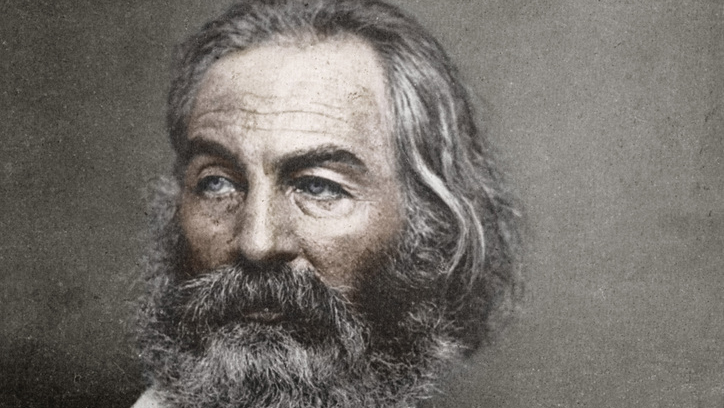
Walt Whitman 2014


Walt is all around us lately.

Did you take note of the Apple television ad for the iPad Air? It quotes Whitman's “O Me! O Life!” to promote the idea of creating, and it uses Robin Williams from his English teacher role in Dead Poets Society.


“That the powerful play goes on,
and you may contribute a verse.”


Walt is also on the new poster designed by the Academy of American Poets for this year's  National Poetry Month.  You can request a copy online.

The poster uses the closing lines of “Song of Myself,”

“Failing to fetch me at first, keep encouraged;
Missing me one place, search another;
I stop somewhere, waiting for you.”

If you want to go deeply into Walt Whitman's "Song of Myself," you can enroll in a free course offered online by the University of Iowa. This course - known as a MOOC (Massive Open Online Course) - will be open to thousands of people at no cost (and for no credit).

”Every Atom: Walt Whitman’s Song of Myself" will take a collective approach to a close reading of America’s democratic verse epic, first published without a title in the 1855 edition of Leaves of Grass and later titled "Song of Myself" in the 1881 edition.


    August 18, 2013

    Breaking Bad and Walt Whitman


    There have been several Walt Whitman references during the four and a half seasons of AMC’s Breaking Bad. This month the final episodes of the series are being shown.

    The two WW's - Whitman and Breaking Bad protagonist, Walter White - have a strange connection.

    The two don't seem similar. White is a high school science teacher who finds out he has cancer and becomes a crystal meth maker and distributor to build up a cash reserve for his family. Over the seasons, he breaks very bad, going “from Mr. Chips to Scarface” as the show's creator, Vince Gilligan, has said.

    Whitman is nothing like that. Whitman and his book, Leaves of Grass, were not part of some original plot plan by the creator, But he keeps popping up.

    In season three, White’s lab assistant, Gale, recites Whitman's poem “When I Heard the Learn’d Astronomer", a poem about disillusionment with theory and a need to engage with the world.
    When I was shown the charts and diagrams, to add, divide, and measure them,
    When I sitting heard the astronomer where he lectured with much applause in the lecture-room,
    How soon unaccountable I became tired and sick,
    Till rising and gliding out I wander’d off by myself,
    In the mystical moist night-air,…

    Gale gives Walt a copy of Leaves of Grass as a gift. In a later scene, Walt read the book which Gale inscribed with “To my other favorite W.W. It is an honor working with you.”

    The name of this year's fifth season’s midpoint cliffhanger episode was “Gliding Over All,” which is an allusion to a poem in the book, "Song of Myself."

    Gliding o’er all, through all,
    Through Nature, Time, and Space,
    As a ship on the waters advancing,
    The voyage of the soul—not life alone,
    Death, many deaths I’ll sing.

    This poem connects with the Walt that White has become.

    And then Walt’s brother-in-law Hank, a D.E.A. agent who has been pursuing the meth cook that is Walt, found the copy of Leaves of Grass in Walt's bathroom, and reading the inscription written by the now dead Gale, knows that Walt is the meth cook and drug lord also known as "Heisenberg."

    Walter "Walt" Whitman the poet was a humanist and part of the transition between transcendentalism and realism. He is among the most influential poets in the American canon, often called the father of free verse.

    His work was very controversial in its time, particularly Leaves of Grass, which was described as obscene for its overt sexuality.

    Will "The Good Gray Poet" figure in the final episodes of the series?

    As at thy portals also death,
    Entering thy sovereign, dim, illimitable grounds...
    I grave a monumental line, before I go, amid these songs,
    And set a tombstone here.


    More About WW and WW
    http://breakingbad.wikia.com/wiki/Walt_Whitman
    http://www.poetryfoundation.org/article/246218

    June 17, 2009

    The American Voice in Poetry: the Legacy of Whitman, Williams, and Ginsberg

    The Poetry Center at my college, Passaic County Community College, has put out a call for submissions of poems for a contest to celebrate the 30th anniversary of its founding.

    The American Voice in Poetry: the Legacy of Whitman, Williams, and Ginsberg is looking for poems rooted in the literary tradition that honors place, voice, and specificity. The contest will produce an anthology of the selected poems.

    The winners will be invited to read their poems at a book launch for the anthology of winning poems to be held on Saturday, April 10, 2010 at the Poetry Center in Paterson, NJ.

    Contest Rules:
    • Two poems per person will be accepted for consideration.
    • Two copies of each poem should be submitted with name, address, phone number, and email on one copy of each poem.
    • Poems should be no more than two manuscript pages.
    • Do not submit poems that imitate poems by Whitman, Ginsberg and Williams!
    • Only unpublished poems may be submitted to this contest.
    • Deadline: November 15, 2009
    • Please include SASE for list of winners.
    • Winners will be contacted by email or by phone, if email is not available.
    • Please do not call our office in reference to the contest.

    Send poems to:

    Maria Mazziotti Gillan
    Executive Director
    Poetry Center
    Passaic County Community College
    One College Boulevard
    Paterson, New Jersey 07506