Showing posts with label Robert Hass. Show all posts

November 9, 2016

Translation

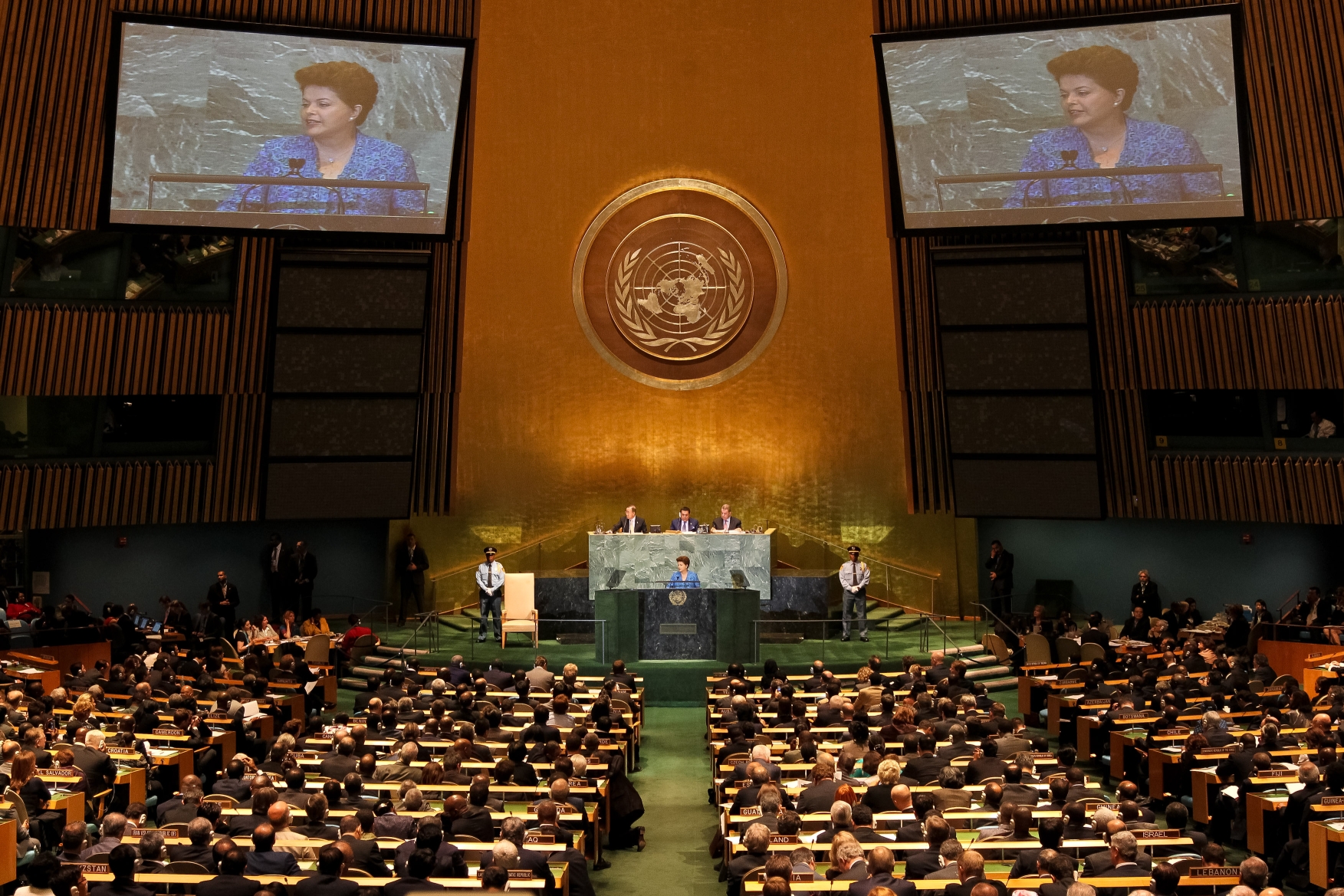
When the U.N. General Assembly listens to a speaker, how much is lost in the translations?
"As you know, translation is really a problem-solving task. Every once in a while you see the original and something comes into your head that is also a formal solution to the problem of getting it into lively English, and you feel like you've written a poem. But that's pretty rare. I wouldn't exactly say it's more like doing crossword puzzles than it is like writing poetry, but it's a mix of the two. "                    

- Robert Hass, "Interview: A Common Language"


Ask Google Translate to do its work on "poets online" and you will get in Italian "poeti in linea" and in French "poètes en ligne" and though I can't read Japanese, I'm sure that  詩人オンライン is also a "poet on a line" of some type. Something is certainly "lost in translation."

Translation is difficult. Edward Hirsch says that "Strictly speaking, total translation is impossible, since languages differ and each language carries its own complex of linguistic resources, historical and social values. This is especially true in poetry, the maximal of language."

The translation of poetry needs something more than simply translating words and getting the same general meaning. In defining "translation" for his Poets Glossary, Edward Hirsch notes:
That’s why its untranslatability has been one of the defining features of poetry. Samuel Taylor Coleridge coined the word untranslatableness. Robert Frost famously said, “Poetry is what gets lost in translation.” An Italian pun captures the idea: traduttore/traditore, translator/traitor.
You can find advice about translating poetry, but I am interested here more in using poetry to talk about translation.

We sometimes say, "Let me translate that for you" meaning that we will rephrase something complex into a more understandable form.  We use the expression "in simple English"  in this way.

Richard Blanco's poem"Translation for Mamá" begins:

What I’ve written for you, I have always written
in English, my language of silent vowel endings
never translated into your language of silent h’s.
               Lo que he escrito para ti, siempre lo he escrito
               en inglés, en mi lengua llena de vocales mudas
               nunca traducidas a tu idioma de haches mudas
.
He writes his poems and also translates it into his mother's Spanish.

But "How do I say it?” is what Joy Harjo is really concerned with in her poem “Deer Dancer..”  Though she can be referring to the language of her own Mvskoke/Creek Nation, she is also talking about the inadequacies of all languages. 

How do I say it?  In this language there are no words for how the real world
collapses.  I could say it in my own and the sacred mounds would come into
focus, but I couldn’t take it in this dingy envelope.  So I look at the stars in
this strange city, frozen to the back of the sky, the only promises that ever
make sense.
Harjo is trying to tell a story about an incident in a bar, but language can't quite convey all that happened there that night.

Nearly everyone had left that bar in the middle of winter except the
hardcore.  It was the coldest night of the year, every place shut down, but
not us.  Of course we noticed when she came in.  We were Indian ruins.  She
was the end of beauty.  No one knew her, the stranger whose tribe we
recognized, her family related to deer, if that’s who she was, a people
accustomed to hearing songs in pine trees, and making them hearts.

The word "translation" derives from the Latin translatio, which in turn comes from trans- and fero, meaning “to carry across” or “to bring across.” It usually mean the transfer of meaning from one language to another, but it also is what we do in interpreting the world around us every day.
One of my poems is about this everyday translating we do - from other languages, in interpreting the world and certainly in writing and reading poetry.

Translation

My grandparents would speak Slovak
with my father, the aunts and the uncles
at the Sunday dinners at their home in Newark
when they didn’t want us to know.
In those days, the priests spoke Latin.
That was the mystery of the faith.
The boys on the #42 bus spoke Spanish
as I rode to my afterschool job
and when they laughed, looking in my direction.
Too fast for my B+  Spanish III  understanding
but enough that it hurt.
The waiter at the Chinese restaurant
changes my order into words
that I want to understand,
but will  never know.
Translation.
This is the poet’s job,
and the job of the reader too.
We have been in training
all our lives.

- Kenneth Ronkowitz

Our writing prompt for November is a poem about translation in any of those three ways: from other languages, in interpreting the world, or in writing and reading poetry.

January 24, 2013

June 24, 2008

Poetry at the Library of Congress

Most people probably think of the Library of Congress as, well, a library. Fans of poetry may also think of the Library of Congress as the home of our Poet Laureate.

Connected to that is a good number of other poetry-related events and resources that you can browse at Poetry at the Library of Congress.

One of those resources is the "Poet and the Poem" webcasts. This is an ongoing series of live poetry interviews (they run just under an hour in length) at the Library of Congress with distinguished artists that are available as webcasts online. The poets talk with host Grace Cavalieri about their craft and sources of inspiration.

Some of the poets featured include:
Another program is "Poet Vision" that features poets reading and talking about their work in video that was originally filmed and broadcast in Philadelphia from 1988-90. The 12 episodes capture for posterity insights from and about Lucille Clifton, Rita Dove, Allen Ginsberg, Louise Glück, Sam Hamill, Michael Harper, Stanley Kunitz, Denise Levertov, and Robert Penn Warren. The original tapes were donated to the Library of Congress in 2000 by producers Rohm and Haas and are kept in the Library’s Motion Picture, Broadcasting and Recorded Sound Division. View all webcasts in the Poet Vision series

April 27, 2008

2008 Pulitzer Prize Winners in Poetry

There are two winners this year - Robert Hass for Time and Materials, and Philip Schultz for Failure.

See winners and short biographical information from previous years for poetry, fiction and other categories at:

http://www.iowalum.com/pulitzerPrize/winnerTimeline.htm


December 27, 2007

The Conversation of Couples: Robert Hass and Brenda Hillman


I first realized that there was a new poetry collection from Robert Hass when I read online that it had received the National Book Award for 2007.

Time and Materials: Poems 1997-2005 is his first collection to appear in a decade. The book's title has a date range such as we might find on a "selected poems" and the idea of "materials" suggests the things we build our poems from that we have collected over time. I have heard Hass read some of these poems over the last 10 years, and the book seems to me to be a kind of selected poems.

His materials are familiar to those who have read him before - California settings, art and literature, nature, desire, history and historic figures, domestic life and parts of conversations. The forms of his poems continue to range from prose to broken stanzas. You might also know him for his translations (see bio at bottom).

Maybe I'm reading into the poems, but more poems in this collection seem to be about memory and the failure of memory, or perhaps it's the failure of language to describe the passage of time.

You can listen to an interview with Robert Hass and hear him read at UC Berkeley and judge for yourself.

I know that Hass has done readings together with his wife, Brenda Hillman. I don't believe I have actually heard them read together, though I have heard both of them at Dodge Poetry Festivals.

Here's a link to Brenda's comments on Robert's poem “A Supple Wreath of Myrtle.” I caught on the lines where she says:

"The poem suggests that the daily and the heroic are always intertwined... The poem is one to live with; it captures something very powerful about human life, about the brevity of conviction, and about the individual’s relationship to his own story, to history in general, to reputation.


For this prompt, I have paired poems by them. One is Hass' poem "Futures in Lilacs" from his new book, and the other is Hillman's poem "Male Nipples" from an older book of hers called Loose Sugar.

I am imagining that the "she" of Hass' poem is Brenda, and that the man in her poem is Robert - though it doesn't change our reading of the poem or the prompt if I am wrong.

What I like about these two poems is that both contain some of the erotic conversation of couples. Those conversations, in words or not, exist within a poem of the present world around them and also connect with the past.

He writes:

"Tender little Buddha," she said
Of my least Buddha-like member.
She was probably quoting Allen Ginsberg...
She was taking off a blouse,
Almost transparent, the color of a silky tangerine.

And she describes male nipples, maybe the motorcycle boy's

convinced him to take only
his shirt off. They were, well, one
was brown and one was like the inside of a story--


and then describes someone perhaps nearby-

--So I told the little hairs
around his nipple: lie flat! and they did,
like a campfire, without the stories--


I see this prompt as a window frame. In the glass I see reflected this couple, but I also see the world outside. The window is framed with the past.

Tell us what this couple is saying and doing. Tell us about what is outside that window and how the past has framed it.

~~~~~~~

Robert Hass was born in San Francisco in 1941. He attended St. Mary’s College in California, and received both an MA and Ph.D. in English from Stanford University.

His books of poetry include Sun Under Wood: New Poems (Ecco Press, 1996); Human Wishes (1989), Praise (1979), and Field Guide (1973). Hass also co-translated several volumes of poetry with Czeslaw Milosz, most recently Facing the River (1995), and is author or editor of several other collections of essays and translation, including The Essential Haiku: Versions of Basho, Buson, and Issa (1994), and Twentieth Century Pleasures: Prose on Poetry (1984).

Robert Hass served as poet laureate of the United States from 1995 to 1997. He teaches at the University of California, Berkeley.


Brenda Hillman was born in Tucson, Arizona, in 1951 and attended Pomona College and the University of Iowa.

Some of her books include Cascadia (2001); Loose Sugar (1997 - a finalist for National Book Critic's Circle); Bright Existence (1993 - finalist for Pulitzer Prize); and Death Tractates (1992). She was also the editor of a collection of Emily Dickinson's poems published by Shambhala Press in 1995.

Hillman has taught at the Napa Valley Writer’s Conference and the University of California, Berkeley. She currently holds the Olivia Filippi Chair in Poetry at St. Mary's College in California. She lives in the Bay Area with her husband, Robert Hass.


October 15, 2007

Haiku For Blog Action Day


Today is Blog Action Day.

The theme this year is the environment and anyone with a a blog can join in by posting something today related to the environment.

Maybe it's a local environmental issue, or the beach cleanup nearby, or a poem or story with an environmental theme. Podblogs, videoblogs, and photoblogs count too!

The purpose is to have a massive hit on public awareness by sharing as many ideas in as many ways as possible.

Check out the Blog Action Day blog and read more about how bloggers can change the world. You can register your blog and join the 15,000+ other blogs (with 12 million readers) that are already signed up.

I clicked over to the excellent Poetry Foundation web site for inspiration, and using their search tool found some haiku.

I enjoy haiku for many reasons, but I do particularly like the close-up focus they often take on something in nature.

A few haiku from "After the Gentle Poet Kobayashi Issa" by Robert Hass

New Year’s morning—
everything is in blossom!
I feel about average.

A huge frog and I
staring at each other,
neither of us moves.


And two by Gary Snyder-

Hammering a dent out of a bucket
a woodpecker
answers from the woods

At the last turn in the path
“goodbye—”
—bending, bowing,
(moss and a bit of
wild
bird-)
down.


Both of those poets are ones that I particularly enjoy reading and having met them both and heard them read, I know that their sense of nature and its influence on their poetry is quite - organic. Is that the word I want? It is within them, not something they take on in the writing. It is part of their practice of poetry.

Still, my favorite haiku still come from the masters.

In this one by Bashō,

In Kyoto,
hearing the cuckoo,
I long for Kyoto.

you might say, "Where is nature?" I would have trouble answering you, and yet I am fairly certain that within that longing for place that is prompted by the bird's call is some longing for something lost from nature. Am I imagining that?

In this poem by Issa,

On a branch
floating downriver
a cricket, singing.

the branch, river and cricket represent three areas of the natural world. I hear that cricket's sound as joyful (singing) and yet I also feel it may be doomed in its river journey. Is it singing like those on the Titanic going down? I might even convince some (especially without the author or time period being identified) that this small poem is a plea for our natural world (cricket) which is being carried away while we sing a song of ignorance is bliss or the song of the sirens or a sad dirge.