Showing posts with label spring. Show all posts

March 21, 2021

Spring and All


Spring slipped into place yesterday morning. Did you feel it? Perhaps not, since there is a good chance that where you are now doesn't look or feel like spring. In my neighborhood, it still looks like winter but for a few buds on trees or shoots poking out of the muddy ground. Of course, you might be south of me and it looks like summer, or far north where winter still reigns. Still, the universe tells us that in the Northern Hemisphere will begin on March 20 and ends on June 20 and by that last day of spring, it will probably look and feel like summer here. 

In William Carlos Williams' poem, "Spring and All," the opening is rather ominous. 

By the road to the contagious hospital
under the surge of the blue
mottled clouds driven from the
northeast—a cold wind.

Williams wrote the poem not long after T. S. Eliot's "The Waste Land," was published. Eliot's poem also opens with a not-so-favorable view of early spring.

April is the cruellest month, breeding
Lilacs out of the dead land, mixing
Memory and desire, stirring
Dull roots with spring rain.

Eliot goes on to use an image of winter that is not typical: 

Winter kept us warm, covering
Earth in forgetful snow, feeding
A little life with dried tubers.

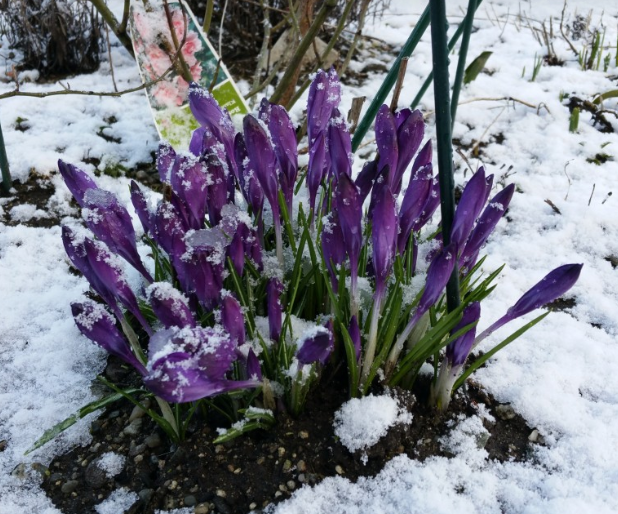
When we brought my first son home from the hospital, it was the first day of spring and the daffodils, crocuses, and wood hyacinths were covered with snow.  Spring is a fickled season.

In literature and mythology, spring usually concerns themes of rebirth and renewal with symbols from the season. Spring also refers to love, hope, youth and growth. The seasonal symbolism for this period may also allude to religious celebrations such as Passover or Easter.

The Vernal Equinox: "vernal" translates to “new” or “fresh” and equinox comes from the Latin aequus (equal) and nox (night). The time of daylight between sunrise and sunset has been growing slightly longer each day since the Winter Solstice in December. Of course, we messed with the celestial plan last weekend with Daylight Saving Time.

I still try to mark the vernal equinox as it has been seen for centuries as a turning point. It is not the only turning point, but daylight does defeat darkness, and that is a reason to celebrate.

Soon, I hope the only things like snowfall here will be the storm of blossoms from cherry and other spring-blooming trees.


A version of this post first appeared at Weekends in Paradelle.  


Visit our website at poetsonline.org

February 22, 2020

February Words


I was looking through some February poems and it was rather depressing. Most of them were filled with rather grim winter images.

"Afternoon In February" by Henry Wadsworth Longfellow starts out like this:

The day is ending,
The night is descending;
The marsh is frozen,
The river dead.

and I didn't want to go further.

Things are not much better in "February: The Boy Breughel" by Norman Dubie with its deadly nature imagery.

The birches stand in their beggar's row:
Each poor tree
Has had its wrists nearly
Torn from the clear sleeves of bone,
These icy trees
Are hanging by their thumbs...

And a fox crosses through snow
Down a hill; then, he runs,
He has overcome something white
Beside a white bush, he shakes
It twice, and as he turns
For the woods, the blood in the snow

There's only a brief line of hope because those poor tortured birch trees are "Under a sun / That will begin to heal them soon."


The only hopeful February poems I cam across concerned themselves with thinking beyond February.

Jane Kenyon was looking ahead in her "February: Thinking of Flowers"

Now wind torments the field,
Turning the white surface back
On itself, back and back on itself,
Like an animal licking a wound.

Nothing but white the air, the light;
Only one brown milkweed pod
Bobbing in the gully, smallest
Brown boat on the immense tide.

A single green sprouting thing
Would restore me...

Then think of the tall delphinium,
Swaying, or the bee when it comes
To the tongue of the burgundy lily.

I saw my first green sprouting things - crocuses and the tops of daffodils - this past week. It is a hopeful thing.

And Ted Kooser in his poem "Late February" must also have been thinking on one of those early warm days when:

...by mid-afternoon
the snow is no more
than a washing
strewn over the yards,
the bedding rolled in knots
and leaking water,
the white shirts lying
under the evergreens.

But it's a brief respite from winter, a false spring and:

by five o'clock
the chill of sundown,
darkness, the blue TVs
flashing like storms
in the picture windows,
the yards gone gray,
the wet dogs barking
at nothing.

And in his final lines, those hopeful green things of early spring take an unexpected and horrible turn.

Far off
across the cornfields
staked for streets and sewers,
the body of a farmer
missing since fall
will show up
in his garden tomorrow,
as unexpected
as a tulip

Oh February, "month of despair" as Margaret Atwood describes it "with a skewered heart in the centre," you need some optimism.

I think dire thoughts, and lust for French fries
with a splash of vinegar.
Cat, enough of your greedy whining
and your small pink bumhole.
Off my face! You're the life principle,
more or less, so get going
on a little optimism around here.
Get rid of death. Celebrate increase. Make it be spring.

 Yes!


Visit our website at poetsonline.org

April 5, 2019

Prompt: Reverdie


The reverdie is an old French poetic genre. It originated with troubadour ballads of the early Middle Ages and so many of them were song lyrics. They are usually about the arrival of spring. The word "reverdie" translates as "re-greening." There are some traditions in those old poems and lyrics, such as addressing spring as a beautiful woman. Reverdies were often dancing songs and were popular during the time of Chaucer.

The Middle English reverdie that begins "Svmer is icumen in/ Lhude sing cuccu" can be translated as "Summer has arrived / Sing loudly, cuckoo! /The seed is growing / And the meadow is blooming /And the wood is coming into leaf now / Sing, cuckoo!" This "Cuckoo Song" is one I always find odd because it says that summer is coming and yet all the images seem to be of spring.

There are many, perhaps too many, poems about spring. In lists of them, you will find Eliot's "The Waste Land." I like Eliot's poetry, but his images of spring are pretty grim. The poem's first section is subtitled "The Burial of the Dead" and its opening is often quoted:

April is the cruellest month, breeding
Lilacs out of the dead land, mixing
Memory and desire, stirring
Dull roots with spring rain.
Winter kept us warm, covering
Earth in forgetful snow, feeding
A little life with dried tubers.

Spring and All is a volume of poems by William Carlos Williams and the section we consider for this prompt is "By the road to the contagious hospital" - which also sounds pretty grim.

By the road to the contagious hospital
under the surge of the blue
mottled clouds driven from the
northeast-a cold wind. Beyond, the
waste of broad, muddy fields
brown with dried weeds, standing and fallen

patches of standing water
the scattering of tall trees

The landscape is "Lifeless in appearance" but Williams knows that "sluggish dazed spring approaches" and the poem is more optimistic in this very early spring.

They enter the new world naked,
cold, uncertain of all
save that they enter. All about them the cold, familiar wind- Now the grass, tomorrow
the stiff curl of wild carrot leaf
One by one objects are defined-
It quickens: clarity, outline of leaf...
Still, the profound change
has come upon them: rooted, they
grip down and begin to awaken

E. E. Cummings describes Spring as being "like a perhaps hand
(which comes carefully
out of Nowhere)arranging
a window,into which people look(while
people stare
arranging and changing placing
carefully there a strange
thing and a known thing here)and
changing everything carefully

What we asked poets to do this month was to write a reverdie about the arrival of spring but - is this is not easy - say something that has not been said by poets before.

In "Spring Snow" by Arthur Sze, I see a picture of the spring around me currently - a mix of winter and summer that has not been well blended.

A spring snow coincides with plum blossoms.
In a month, you will forget, then remember

what I like about the poem is the unexpected images that follow in his reverdie. Snow and plum blossoms seem like a wrong coincidence, but it occurs in haiku fairly often, But he follows with several images of that odd mix.

when nine ravens perched in the elm sway in wind.

I will remember when I brake to a stop,
and a hubcap rolls through the intersection

In "National Poetry Month" the poem speaks by itself, according to Elaine Equi. The poem mentions April, but can you find the spring within it?

Sometimes the poem weaves
like a basket around
two loaves of yellow bread.

“Break off a piece
of this April with its
raisin nipples," it says.

“And chew them slowly
under your pillow.
You belong in bed with me.”

March 14, 2013

March by William Carlos Williams


March (Parts I and II)
by William Carlos Williams
from Sour Grapes, 1921. This book is available free online at Project Gutenberg


I
Winter is long in this climate
and spring—a matter of a few days
only,—a flower or two picked
from mud or from among wet leaves
or at best against treacherous
bitterness of wind, and sky shining
teasingly, then closing in black
and sudden, with fierce jaws.

II
March,
you remind me of
the pyramids, our pyramids—
stript of the polished stone
that used to guard them!
March,
you are like Fra Angelico
at Fiesole, painting on plaster!

March,
you are like a band of
young poets that have not learned
the blessedness of warmth
(or have forgotten it).

At any rate—
I am moved to write poetry
for the warmth there is in it
and for the loneliness—
a poem that shall have you
in it March.

continue reading