Showing posts with label seasons. Show all posts

February 5, 2020

Prompt: Time Passes

A Copernican calendar based on the Sun's movement through the seasons

Humans have many time-keeping traditions. Our calendars track the movement of the Sun or the Moon. You could have a celestial calendar that tracked the movement of the stars.

I suspect that some people might track the year based on the changing seasons. You might personally mark the new year on your birthday. After 40 years of teaching, it is difficult for me to not feel that September starts a new year. The way we mark time throughout a day or year is often personal despite the larger time-keeping that is supposed to organize time for us.

When I mentioned to another poet that I was thinking about using a writing prompt about keeping time, she said: "You mean like in music?" That was a natural way to view my prompt for her because she is a musician.

In Walt Whitman's "To Think of Time," his thoughts turn to questions all of us have had at some point.

To think of time—of all that retrospection!
To think of to-day, and the ages continued henceforward!

Have you guess'd you yourself would not continue?
Have you dreaded these earth-beetles?
Have you fear'd the future would be nothing to you?

Is to-day nothing? Is the beginningless past nothing?

In our model poem for this prompt titled "Time Passes," Joy Ladin personifies Time which seems to have as much trouble dealing with itself as we have dealing with it. I love that while the other three dimensions are sleeping, Time is sweating it out in the middle of the night and feeling lost.

Time too is afraid of passing, is riddled with holes
through which time feels itself leaking...
Time has lost every picture of itself as a child.
Now time is old, leathery and slow.
Can’t sneak up on anyone anymore...

All of our attempts to control time ultimately fail. Even the best calendars and clocks are off at some point. Laura Kasischke has a poem titled "The Time Machine" which suggests that long-wished-for-ability to go back or forward in time to somehow change the present.

My mother begged me: Please, please, study
stenography...
Without it
I would have no future, and this
is the future that was lost in time to me...

When I first read T.S. Eliot's "The Love Song of J. Alfred Prufrock," the image that stayed with me was of measuring a life with coffee spoons.

For I have known them all already, known them all:
Have known the evenings, mornings, afternoons,
I have measured out my life with coffee spoons;
I know the voices dying with a dying fall
Beneath the music from a farther room.
So how should I presume?


This month, we ask you to write a poem that measures the passing of time using some personal metric that may only be useful or relevant to you.


Deadline for submissions: February (Leap Year!) 29, 2020


Visit our website at poetsonline.org

October 2, 2019

Prompt: Seasonal Change


The autumnal equinox has passed, days are shorter, colors are vivid in nature although they are also fading and perhaps dying, or at least going into a kind of seasonal hibernation.

I saw Elizabeth Alexander's poem "Equinox" on the Academy of American Poets "Teach This Poem" project page. (read and listen to the poet read her poem)

I have written elsewhere about the signs in nature and weather lore are believed by many to signal the change of seasons and act as signs of the weather to come. The changing of the seasons has long interested poets.

In late summer and fall, worker bees work long hours collecting enough nectar to feed and maintain the colony throughout the winter. Most bees stay in the hives all winter, but new queens hibernate alone underground. The former queen, the male bees and the female worker bees fall in autumn, dying out. In her poem, Alexander writes the bees in late September and their late burst of energy.

Now is the time of year when bees are wildand eccentric. They fly fast and in crampedloop-de-loops, dive-bomb clusters of conversants

She writes that the bees are "dervishes because they are dying" but the poem moves on to how Alexander connects this sign from nature to her own world and her grandmother.

Our October prompt is to write about the changing of seasons, but you need to connect it with something outside of nature - perhaps, your life, or something in the news or from history.

Autumn is a lot more than bees. And there are four seasons (and those odd days between seasons) to choose from for your writing.

Submission Deadline: October 31, 2019


Visit our website at poetsonline.org

October 23, 2017

By the pricking of my thumbs, something wicked this way comes

Halloween is my least favorite calendar event. I know it is the favorite of many of you. I never liked dressing up as something else, and trick or treating always felt too much like begging.
Maybe you celebrate Halloween, or perhaps you celebrate Hallowtide or Samhain. The latter is a Gaelic festival marking the end of the harvest season and the beginning of winter or the “darker half” of the year. Samhain is celebrated from sunset on October 31st until sunset on November first and was chosen because it was the midpoint between the autumn equinox and the winter solstice.
I do enjoy tales of Halloween, Martians and Radio Terrorists and, growing up in New Jersey, I enjoyed hearing about when the Martians landed in my home state. 
halloweengrinchSo, I am pretty much a Halloween Grinch. 
I would rather think of this time following my birthday as spooky in the way that a book and movie about the season scared me as a kid. That story is Something Wicked This Way Comes by Ray Bradbury which takes its title from Mr. Shakespeare's tale of wickedness with witches, Macbeth. 
"By the pricking of my thumbsSomething wicked this way comes."

And then there is the night before Halloween, known as "Mischief Night" and the "Devil's Night" which is less about the occult and lightweight vandalism.
But if you need some poetry for those nights, Poets.org suggests these:


“The Vampire” by Conrad Aiken
“The Apparition” by John Donne
“The Owner of the Night” by Mark Doty
“From a Train” by Lynn Emanuel
“Omens” by Cecilia Llompart
“The Haunted Palace” by Edgar Allan Poe
“All Hallows Night” by Lizette Woodworth Reese
“Bats” by Paisley Rekdal
“Black Cat” by Rainer Maria Rilke
“To Live in the Zombie Apocalypse” by Burlee Vang


By the pricking of my thumbs,
Something wicked this way comes.
Open, locks,
Whoever knocks.

July 8, 2017

Prompt: Seasons and Days


Before you read the rest of this post, listen to Robert Hayden read his poem "Those Winter Sundays."

Looking back on the poem on the page, "Those Winter Sundays" is a kind of sonnet of a Sunday morning ritual of making a fire to warm the house. It has been done so many times that the son probably never thought about it then. He is not alone in his inattention or in being with his father, but "no one ever thanked him."

Sundays too my father got up early
and put his clothes on in the blueblack cold,
then with cracked hands that ached
from labor in the weekday weather made
banked fires blaze. No one ever thanked him. 

As the haiku poets know so well, the names of the seasons suggest many different things. Winter has been used symbolically to represent death, old age, hardship and endings. But writers have also used it in opposite ways - the pure, white snow s a blanket, a time of rest before renewal. 

Hayden's winter is hard. His father works hard all week, but still has to get up early to warm the house before he wakes his son. It's a kind gesture, but the house also contains chronic angers that the warming fire can't dispel.

I’d wake and hear the cold splintering, breaking.
When the rooms were warm, he’d call,
and slowly I would rise and dress,
fearing the chronic angers of that house, 

The days of the week have also taken on characteristics. Some are cliches by now - the drudgery of back to school and work Monday mornings, the freedom of Friday evenings, or the rest of a Saturday. To some a Sunday morning might suggest church, and to someone else it is a big breakfast or brunch. We made Wednesday into a Hump Day, a mid-week peak that we needed to get over.

Speaking indifferently to him,
who had driven out the cold
and polished my good shoes as well.
What did I know, what did I know
of love’s austere and lonely offices?

Those last two lines are my favorites. They are an unrhymed couplet to close the sonnet. They are the clincher, the lesson learned only years later.

This is a poem that is often anthologized and frequently taught. There is a guide to the poem online if you want a short lesson.

In these lazy days of summer, our July prompt is very simple. Begin with a title that must contain minimally a season and a day of the week.  Your title might be as plain as "Spring Saturday" or as detailed as "Waking at 3 a.m. on the Last Sunday of Summer."  Where your poem goes from there is yet to be known.

Submission Deadline: August 6, 2017

April 9, 2013

Cherry Blossom Haiku and the Seasons


HAIKU BY ISSA

Under the cherry-blossoms
none are
utter strangers.

Cherry blossoms in evening.
Ah well, today also
belongs to the past.


Kigo is another aspect of traditional Japanese haiku, although it is not always present in modern and non-Japanese haiku. Kigo words are those associated with a particular season. It is a tradition that goes back to the mid-8th century in Japanese poetry and culture.

Rather than say the name of a season, it would usually be alluded to by kigo words, such as cherry blossoms to indicate spring.

In haiku, winter is traditionally the time of grief, distance and serenity, and might be indicated by "snow," "ice" or "bare tree."

Summer haiku often invoke warmth and heat, love and also rage or lust. Kigo words like rice planting, peonies, moths, fireflies, ants and mosquitos or fireworks or swimming could all indicate summer.

crossing the river -
how pleasing with sandals
in my hand!

even after falling
its image still stands -
the peony flower

clinging to the bell
he dozes so peacefully
this new butterfly
                ~ Buson


Autumn in haiku often depicts decay, the paranormal (ghosts and such), suspicion, regret, loss, and endings. The Moon, shadows and seasonal plants like persimmons and apples or insects like crickets could all indicate autumn.

In an old pond
a frog ages
while leaves fall

goodbye, will go
alone down Kiso road
old as autumn
              ~ Buson


In the Japanese calendar, seasons traditionally followed the lunisolar calendar with the solstices and equinoxes at the middle of a season. So, the kigo words traditionall used may not match your own calendar of seasonal events in nature. The traditional Japanese seasons are Spring: 4 February–5 May; Summer: 6 May–7 August; Autumn: 8 August–6 November; Winter: 7 November–3 February.

Spring haiku is often written with words that connote youth, innocence and infatuation.Animals used in spring haiku include frogs, skylarks, swallows, and songbird songs. Plants for spring haiku could be azalea, wisteria, and especially cherry blossoms. In fact, cherry blossom viewing (hanami) is so common that just mentioning blossoms (hana) would probably mean cherry blossoms.


HAIKU BY BASHO

The oak tree stands
noble on the hill even in
cherry blossom time

Temple bells die out.
The fragrant blossoms remain.
A perfect evening!

Unknown spring --
Plum blossom
Behind the mirror.

With plum blossom scent,
this sudden sun emerges
along a mountain trail

Very brief -
Gleam of blossoms in the treetops
On a moonlit night.

From among the peach trees
blooming everywhere,
the first cherry blossoms.

A lovely spring night
suddenly vanished while we
viewed cherry blossoms

From every direction
cherry blossom petals blow
into Lake Biwa

Kannon's tiled temple
roof floats far away in clouds
of cherry blossoms
            (Kannon is the Bodhisattva of Compassion)

From all these trees –
in salads, soups, everywhere –
cherry blossoms fall


But not all blossoms come in spring, so when Basho writes -
Along the roadside
blossoming wild roses
in my horse’s mouth

he would mean it is late spring, possibly early summer.

Referencing a lily, lotus flower, orange blossoms, or sunflowers would mean summer.

Colored leaves would mean autumn, and fallen or dry leaves would indicate winter.

SPRING HAIKU BY BUSON

When Yosa Buson writes about plum blossoms, we know it is spring, and the cold that remains tells us it is early spring.

In nooks and corners
cold remains -
flowers of the plum

no bridge
and the sun going down -
spring currents

A woman
Reading a letter by moonlight -
Pear blossoms

Drinking up the clouds
it spews out cherry blossoms -
Yoshino Mountain.

In the moonlight,
the color and scent of wisteria
seems far away.

Pure white plum blossoms
slowly begin to turn
the color of dawn


October 3, 2012

Prompt: The Four Seasons


Autumn on Reservoir Road by Ken Ronkowitz on Flickr

It is hard to read poetry without occasionally coming  across a poem about one of the seasons. If you read haiku, you know that the seasons enter almost all haiku written in a traditional way. If you have been writing poetry for a few years, you probably have a few poems about seasons. So, it would be easy enough for poets to dig into their poetry collection and come up with a poem about one of the seasons.

Right now, in the Northern Hemisphere, we are in early autumn and so you may be inspired to write about what you see in the season.

You could create quite a thick anthology just collecting poems on autumn. And the collection would include traditional takes on this season "When yellow leaves, or none, or few, do hang / Upon those boughs which shake against the cold" as Shakespeare writes in Sonnet LXXIII.

There are certain literary associations to the seasons, as in this short poem,"November Night," by Adelaide Crapsey.
Listen...
With faint dry sound,
Like steps of passing ghosts,
The leaves, frost-crisp'd, break from the trees
And fall.
Some of these associations have become clichés - such as, the Old Man Winter of old age, dying and death and the rebirth of spring.

I prefer poems that use the season as setting but go somewhere that I have not been in that season. In
"My Autumn Leaves" by Bruce Weigl
the poet starts with a familiar place and familiar seasonal props like deer and apples.
I watch the woods for deer as if I’m armed.
I watch the woods for deer who never come.
I know the hes and shes in autumn
rendezvous in orchards stained with fallen
apples’ scent...
and then goes back to find a younger self who has not left him.
                                    ...They know the boy
who lives inside me still won’t go away.
The deer are ghosts who slip between the light   
through trees, so you may only hear the snap   
of branches in the thicket beyond hope.   
I watch the woods for deer, as if I’m armed.

That departure was what appealed to me in reading "Another Autumn" by Adele Kenny from her collection, What Matters. It is the model poem for our current writing prompt for October.
Like Weigel, she uses some of the familiars of the season - leaf-rot, chrysanthemums, chilling air and gaunt roses - but they are contrasted with a hidden passion of "sweat, and the smell of it" that leads us to a place where "trees on fire" are not just fall foliage.

On Adele's own blog, she offers a range of writing prompts from playing with form (such as in writing an "adeleanelle") and her own approach to what autumn brings.

And our own prompt this month? We will not limit ourselves to autumn. In "To Autumn," John Keats' writes about this "season of mists and mellow fruitfulness" but asks "Where are the songs of Spring?"

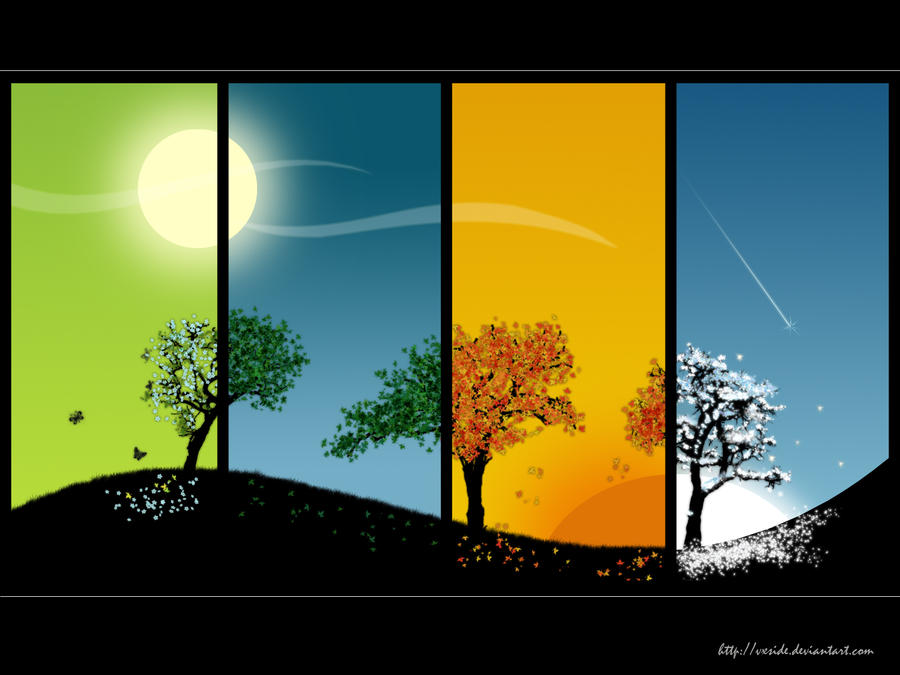
Your assignment this month is to write a poem that includes all four seasons. For example, you might take a place, a person or a situation through the seasons as a way of contrasting changes. (Perhaps, you can listen to Vivaldi's Four Seasons as you write.) You could take alternative views on those seasonal clichés. (Think of T.S. Eliot's view of spring/April as "the cruelest month" rather than a time of rebirth.) 

Four Seasons image/print available from vxside.deviantart.com

You may be interested in reading an earlier version of Adele Kenny's poem "Another Autumn" to contrast it with the version published in What Matters which we used as the model this month.


July 17, 2009

Poems For Summer

The Academy of American Poets has selected a group of poems for summer. I was reading through them yesterday and selected a few to link to here.