December 27, 2013

Prompt: When You and I

white on white, on Flickr by Ken Ronkowitz

I was paging through an anthology of poems looking for inspiration this past weekend. Sometimes, anthologies will index poems by author, title and first lines. I noticed little groupings in the titles and first lines - ones that a number of authors have used.

A poem that I memorized for a class many years ago was in such a group of "when" poems. "When You are Old" by William Butler Yeats is a poem I have loved for a long time. I imagine it as a great dedication for a book of poems - a book to be picked up by the woman who inspired the poems many years later.

When you are old and grey and full of sleep,
And nodding by the fire, take down this book,
And slowly read, and dream of the soft look
Your eyes had once, and of their shadows deep;

How many loved your moments of glad grace,
And loved your beauty with love false or true,
But one man loved the pilgrim soul in you,
And loved the sorrows of your changing face;

And bending down beside the glowing bars,
Murmur, a little sadly, how Love fled
And paced upon the mountains overhead
And hid his face amid a crowd of stars.

Another poem in the group is also an old favorite:

"When I Have Fears that I May Cease to Be" by John Keats

When I have fears that I may cease to be
Before my pen has glean’d my teeming brain,
Before high piled books, in charact’ry,
Hold like rich garners the full-ripen’d grain;
When I behold, upon the night’s starr’d face,
Huge cloudy symbols of a high romance,
And think that I may never live to trace
Their shadows, with the magic hand of chance;
And when I feel, fair creature of an hour!
That I shall never look upon thee more,
Never have relish in the faery power
Of unreflecting love!—then on the shore
Of the wide world I stand alone, and think
Till Love and Fame to nothingness do sink.


And that led me to another poem from the period - a poem sometimes titled "Song" or just known for its first line "When I am dead, my dearest" by Christina Rossetti

When I am dead, my dearest,
Sing no sad songs for me;
Plant thou no roses at my head,
Nor shady cypress tree:
Be the green grass above me
With showers and dewdrops wet;
And if thou wilt, remember,
And if thou wilt, forget.

I shall not see the shadows,
I shall not feel the rain;
I shall not hear the nightingale
Sing on, as if in pain:
And dreaming through the twilight
That doth not rise nor set,
Haply I may remember,
And haply may forget.

Sometimes, the simplest prompt can set you to writing. I attended a poetry retreat this month and the two poets leading us, Maria Gillan and Laura Boss, hit you with a shotgun blast of prompts. They might give a half dozen suggestions or opening lines and people write for twenty minutes and return with some unbelievably good first drafts that use one or a combination of those prompts, or start with one and turn unexpectedly in another direction.

And that's all we should expect from a prompt - a little push to set our boat into the water.

For this month's prompt, as an opening line, begin with "When you" or "When I" and start paddling. You might choose to use use both openings for different lines or stanzas or blend the two into "When you and I."

There are plenty of modern poems that use that opening too. Listen to "When You're Lost in Juarez in the Rain and It's Easter Time Too" by Charles Wright which starts with that title which is tangled up in some lines by Bob Dylan.

In "When I Am in the Kitchen" by Jeanne Marie Beaumont, she uses the line as her title and moves on like this:
I think about the past. I empty the ice-cube trays
crack crack cracking like bones, and I think
of decades of ice cubes and of John Cheever,
of Anne Sexton making cocktails, of decades
of cocktail parties, and it feels suddenly far
too lonely at my counter...
Submission deadline: Sunday, January 19, 2013


December 24, 2013

Christmas Light


via the writersalmanac.publicradio.org

Christmas Light


When everyone had gone
I sat in the library
With the small silent tree,
She and I alone.
How softly she shone!

And for the first time then
For the first time this year,
I felt reborn again,
I knew love's presence near.

Love distant, love detached
And strangely without weight,
Was with me in the night
When everyone had gone
And the garland of pure light
Stayed on, stayed on.

by May Sarton, from May Sarton, Collected Poems, 1930-1993


December 20, 2013

Stopping by Woods on a Solstice Evening


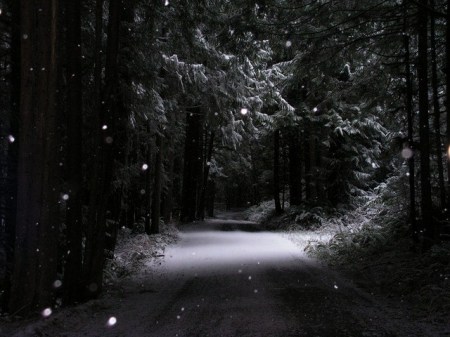
woods


Robert Frost called "Stopping by Woods on a Snowy Evening" the poem that was his "best bid for remembrance" and it is one that almost every American student encounters.

I'm thinking about that poem on this solstice evening before Christmas which was part of its inspiration.

Robert Frost was a character and he built his own kind of image as a poet for the public. He had said that the poem came to him in one quick rush, but biographers have found drafts of the poem that show revisions. No matter. I am sure it was a poem that came to him in a rush. It has happened to me that way and no matter how much I play with the words and lines later, it will always feel like it came in one piece.

In Roads Not Taken: Rereading Robert Frost, a story is retold about a conversation Frost had with an audience member about the poem after a reading at Bowdoin College.

The poem had been around for 24 years and was a part of his reading repertoire. During the Q&A,  a young man named N. Arthur Bleau asked that standard and unanswerable question - Which poem is your favorite? Frost replied that he liked them all equally. But after the reading, Frost invited Bleau up to the stage and told him that really his favorite was "Stopping by Woods on a Snowy Evening." And, according to Bleau, he told him the poem's back story.

It was on a winter solstice when Frost and his wife knew they were poor enough that they probably wouldn't be able to buy Christmas presents for their children. Frost was a farmer, but not a very successful one. He took whatever produce he had and took it into town with horse and wagon to see if he could sell enough to buy some gifts.

He didn't sell anything. He didn't buy any presents. He headed home as evening came and it began to snow. Imagine that journey. He had failed as a farmer, but right then he had failed in some way as a father and as a provider.
My little horse must think it queer
To stop without a farmhouse near
Between the woods and frozen lake
The darkest evening of the year.
Perhaps, he was in his own head and not paying attention to the road. Maybe his horse sensed his mood or inattention because it stopped in the middle of a wood that wasn't near home. Frost told Bleau that he "bawled like a baby."

They were still. The snow continued to fill the woods. They were in woods owned by someone who lived in town and might have been a wealthy landowner. The horse shook and jingled its bells. A reminder of Christmas and a reminder to go on and get home to his family.
The woods are lovely, dark, and deep.
But I have promises to keep,
And miles to go before I sleep,
And miles to go before I sleep.
In the book, Roads Not Taken (page 127), Frost's daughter, Lesley, confirmed the story told at the reading. She said her father told her that "A man has as much right as a woman to a good cry now and again. The snow gave me shelter; the horse understood and gave me the time."

I encountered the poem a few times in school. I recall being told it was about responsibility, about taking time to see the beauty around us, about depression and suicide. There's some of all those in it. It's also about going home.

I took my big volume of his poems, The Collected Poems, Complete and Unabridged, off the shelf this morning. I may go for a walk in the little woods near my home today. I do that a lot anyway. And tonight, when the night is dark and deep, I think I will read some Frost poems about winter, snow and going home.


There is also a very nice picture-book edition of "Stopping By Woods on a Snowy Evening" illustrated by Susan Jeffers

Cross-posted from Weekends in Paradelle

November 20, 2013

Fragments of Marilyn


Plenty has been written about Marilyn Monroe, and yet, she still remains something of a mystery. She had a spectacular and sad life. She was treated like a dumb blonde and she played into that image at times. She also wanted to be considered a serious actress. She wrote poetry and journals that never appeared during her lifetime and that, perhaps, she never wanted to appear. She married a high profile baseball legend, Joe Dimaggio, that only turned the wattage on the spotlight even brighter. Then she married an intellectual playwright, Arthur Miller, who must have been attractive for very different reasons.

 A few years ago, I bought a collection of her own writing—diaries, poems, and letters—  titled Fragments.

It is fragments. Never meant to be a book. It shows many of the scars of her sexual abuse, psychotherapy, betrayals, her fears of madness in her genes, and someone who wanted to really master her art.

Marilyn also wrote (or had ghostwritten by Ben Hecht) an autobiography called My Story when her career was peaking, but it was not published until over a decade after her death. In the book she describes herself as "the kind of girl they found dead in the hall bedroom with an empty bottle of sleeping pills in her hand."

There are a number of photos online of Marilyn reading. A few seem candid. Some seem staged, as if trying to promote that other Marilyn.

A famous one is by Eve Arnold showing her reading James Joyce’s Ulysses. Alfred Eisenstaedt photographed her reading and looking casual curled on her sofa in front of her real personal library. Another photograph shows her reading the poetry of Heinrich Heine.

The book of her fragments shows that she was serious about writing and that poetry was a way she tried to understand herself and her very strange place in the world.

Her marriage to MIller, like all her marriages and relationships with men, went bad and he was a real betrayal for her. But when her love for him was new, she wrote a poem imagining him as a young boy.


my love sleeps besides me—
in the faint light—I see his manly jaw
give way—and the mouth of his
boyhood returns
with a softness softer
its sensitiveness trembling
in stillness
his eyes must have look out
wonderously from the cave of the little
boy—when the things he did not understand—
he forgot

but will he look like this when he is dead
oh unbearable fact inevitable
yet sooner would I rather his love die
than/or him?

I don't put the poem forward to say she was an important poet. She wrote, as many of us do, because we feel we must write, even if the audience for our poems is small or non-existent. The poem would not seem out of place at a workshop or open reading or coming from one of my students.

My own boyhood crush on Marilyn the movie star turned in a very different direction when she died the summer of 1962 at age 36. I heard terrible stories about her - the difficult and spoiled diva, drugs and affairs with the Kennedys.  When I was a teenager, I read her autobiography and read about her life and each new sad revelation made me feel sorry for her.

I know that she probably didn't want pity, but I definitely went through a phase when I fantasized being the man that might have really understood her - and saved her.

"Goodbye Norma Jean, you lived your life like a candle in the wind," sings Elton John and I'm sure that my fantasy and his were not so far apart. "I would have liked to have known you, but I was just a kid.  Your candle burned out long before your legend ever did."

Elton John's lyric sums up pretty well the short arc of her career that didn't really end very far from where it started in the eyes of the press and public.

Hollywood created a superstar
And pain was the price you paid
Even when you died
Oh, the press still hounded you
All the papers had to say
Was that Marilyn was found in the nude

Reading her personal writing again this past weekend reminds me of why we write and what writing can do, and not do, to help us deal with our lives and those lives that are tied to us.