I have written here in the past few months about recent best-selling poets Amanda Gorman, Rupi Paur, and Courtney Peppernell. But some of the real best-selling poets are from pretty far in the past. Rumi, Lao Tzu, and the classic haiku poets like Basho and Issa have been selling well for hundreds of years. Amazon has an always-updating list of poetry best-sellers on the site that are a very eclectic group of "poets."
 |
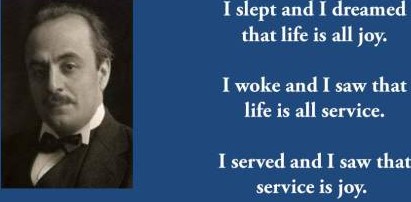
| Gibran |
I saw a while back that it was the birthday of poet Khalil Gibran who was born in Lebanon in 1883. However, he lived in Boston where he met Alfred A. Knopf who published his book The Prophet in 1923. It wasn't an instant best-seller but it gained popularity. In the swinging 1960s, it became a favorite of the counterculture.
It has been translated into more than 100 languages. It has never been out of print. Today, Gibran is now the third-best-selling poet in history, after two other exceptionally good poets, William Shakespeare and Lao-Tzu.
The book is not what some will consider typical "poetry." It is 26 prose poetry "fables."
The "prophet" is not Gibran. It is Al Mustafa who after living away for 12 years, he is about to board a ship home. He is stopped by a group of people and talks with them about life and the human condition. Each chapter deals with a topic like love, marriage, children, giving, eating and drinking, work, joy and sorrow, houses, clothes, buying and selling, crime and punishment, laws, freedom, reason and passion, pain, self-knowledge, teaching, friendship, talking, time, good and evil, prayer, pleasure, beauty, religion, and death. That's a lot of ground to cover.
The book's appeal is not totally unlike some contemporary best-selling poets. Short pieces on big topics. Quotable lines. Easy to read. No dense language.
The Prophet often shows up being quoted at weddings.
Love one another, but make not a bond of love:
Let it rather be a moving sea between the shores of your souls
I've heard it at births, baptisms, and baby events.
Your children are not your children.
They are the sons and daughters of Life's longing for itself.
They come through you but not from you,
And though they are with you they belong not to you.
And his lines show up at the other end of life.
When you are sorrowful look again in
your heart, and you shall see that in truth
you are weeping for that which has been
your delight.
Visit our website at poetsonline.org


 (1923). It didn’t sell well at first, but gradually gained a readership, becoming especially popular in the 1960s and was eventually translated into more than 30 languages.

 (also Laozi or Lao-Tze) was a philosopher and poet of ancient China. He is known as the reputed author of the Tao Te Ching and the founder of philosophical Taoism, and as a deity in religious Taoism and traditional Chinese religions. Although he is a legendary figure, he is usually dated to around the 6th century BCE and reckoned a contemporary of Confucius.